

7 Flight Mystery and Aerodynamic Principles
499
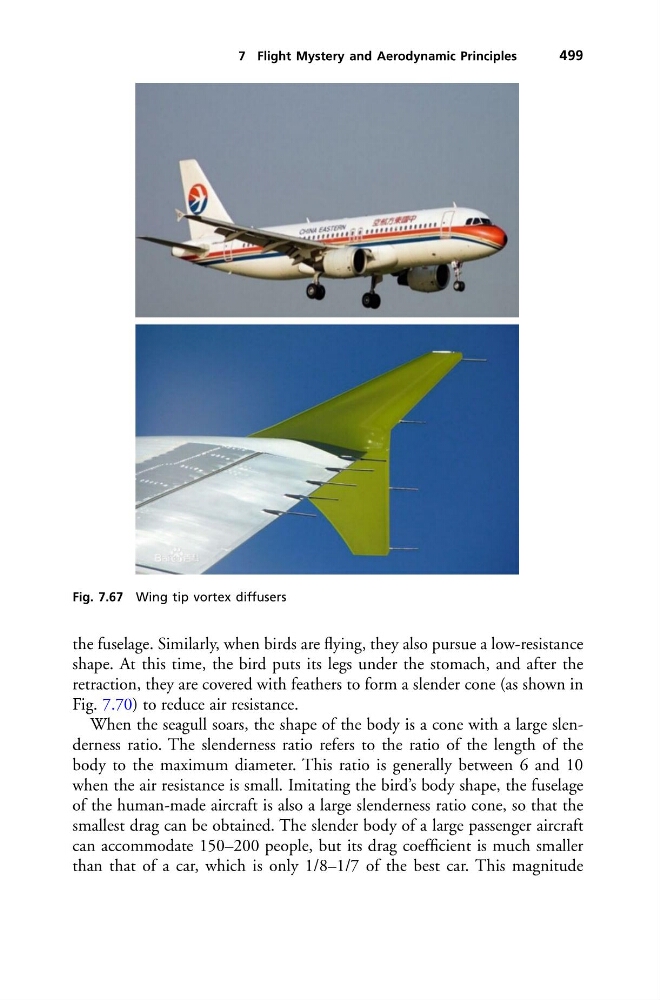
Fig. 7.67 Wing tip vortex diffusers
the fuselage. Similarly, when birds are flying, they also pursue a low-resistance
shape. At this time, the bird puts its legs under the stomach, and after the
retraction, they are covered with feathers to form a slender cone (as shown in
Fig. 7.70) to reduce air resistance.
When the seagull soars, the shape of the body is a cone with a large slenderness ratio. The slenderness ratio refers to the ratio of the length of the
body to the maximum diameter. This ratio is generally between 6 and 10
when the air resistance is small. Imitating the bird’s body shape, the fuselage
of the human-made aircraft is also a large slenderness ratio cone, so that the
smallest drag can be obtained. The slender body of a large passenger aircraft
can accommodate 150–200 people, but its drag coefficient is much smaller
than that of a car, which is only 1/8–1/7 of the best car. This magnitude
499
Fig. 7.67 Wing tip vortex diffusers
the fuselage. Similarly, when birds are flying, they also pursue a low-resistance
shape. At this time, the bird puts its legs under the stomach, and after the
retraction, they are covered with feathers to form a slender cone (as shown in
Fig. 7.70) to reduce air resistance.
When the seagull soars, the shape of the body is a cone with a large slenderness ratio. The slenderness ratio refers to the ratio of the length of the
body to the maximum diameter. This ratio is generally between 6 and 10
when the air resistance is small. Imitating the bird’s body shape, the fuselage
of the human-made aircraft is also a large slenderness ratio cone, so that the
smallest drag can be obtained. The slender body of a large passenger aircraft
can accommodate 150–200 people, but its drag coefficient is much smaller
than that of a car, which is only 1/8–1/7 of the best car. This magnitude