

484
P. Liu
The lift line theory is an approximate potential flow theory for solving large
aspect ratio straight wing flow. After the known wing plane shape and airfoil
aerodynamic data, the circulation distribution, the lift coefficient distribution
of the profile, the lift coefficient, slope of the lift line, and induced drag coefficient of the entire wing can be obtained. The outstanding advantage is that
the influence of the wing plane shape parameters on the aerodynamic characteristics of the wing can be clearly given. The application conditions of this
theory are as follows:
1. The angle of attack cannot be too large (α < 10°). The lift line theory does
not consider the viscosity of the air, and there is a significant separation of
the flow at high angle of attack.
2. The aspect ratio cannot be too small (λ ≥ 5).
3. The sweep angle cannot be too large (β ≤ 20°).
7.6 Supercritical Wing
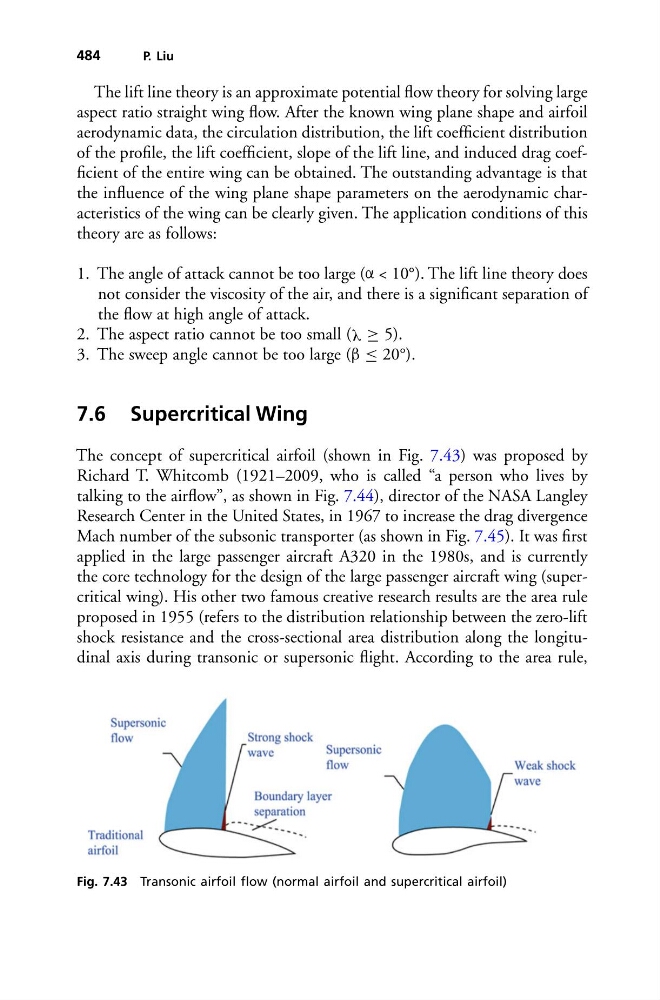
The concept of supercritical airfoil (shown in Fig. 7.43) was proposed by
Richard T. Whitcomb (1921–2009, who is called “a person who lives by
talking to the airflow”, as shown in Fig. 7.44), director of the NASA Langley
Research Center in the United States, in 1967 to increase the drag divergence
Mach number of the subsonic transporter (as shown in Fig. 7.45). It was first
applied in the large passenger aircraft A320 in the 1980s, and is currently
the core technology for the design of the large passenger aircraft wing (supercritical wing). His other two famous creative research results are the area rule
proposed in 1955 (refers to the distribution relationship between the zero-lift
shock resistance and the cross-sectional area distribution along the longitudinal axis during transonic or supersonic flight. According to the area rule,
Fig. 7.43 Transonic airfoil flow (normal airfoil and supercritical airfoil)
P. Liu
The lift line theory is an approximate potential flow theory for solving large
aspect ratio straight wing flow. After the known wing plane shape and airfoil
aerodynamic data, the circulation distribution, the lift coefficient distribution
of the profile, the lift coefficient, slope of the lift line, and induced drag coefficient of the entire wing can be obtained. The outstanding advantage is that
the influence of the wing plane shape parameters on the aerodynamic characteristics of the wing can be clearly given. The application conditions of this
theory are as follows:
1. The angle of attack cannot be too large (α < 10°). The lift line theory does
not consider the viscosity of the air, and there is a significant separation of
the flow at high angle of attack.
2. The aspect ratio cannot be too small (λ ≥ 5).
3. The sweep angle cannot be too large (β ≤ 20°).
7.6 Supercritical Wing
The concept of supercritical airfoil (shown in Fig. 7.43) was proposed by
Richard T. Whitcomb (1921–2009, who is called “a person who lives by
talking to the airflow”, as shown in Fig. 7.44), director of the NASA Langley
Research Center in the United States, in 1967 to increase the drag divergence
Mach number of the subsonic transporter (as shown in Fig. 7.45). It was first
applied in the large passenger aircraft A320 in the 1980s, and is currently
the core technology for the design of the large passenger aircraft wing (supercritical wing). His other two famous creative research results are the area rule
proposed in 1955 (refers to the distribution relationship between the zero-lift
shock resistance and the cross-sectional area distribution along the longitudinal axis during transonic or supersonic flight. According to the area rule,
Fig. 7.43 Transonic airfoil flow (normal airfoil and supercritical airfoil)