

7 Flight Mystery and Aerodynamic Principles
483
passing through, and the circulation is zero, which simulates the spanwise distribution of the circulation and lift (the elliptical distribution is
the best). It can be seen that the strength of the attached vortex varies
along the span, and is the same as the profile lift distribution which is
zero at the wing tip and largest at the wing root.
(3) The -shaped horseshoe vortices are parallel to the inflow and drag
infinity downstream, simulating the free vortex sheet. Since the free
vortex intensity drawn between the spanwise adjacent two sections is
equal to the circulation difference of the attached vortices on the two
sections, the relationship between the spanwise free vortex line intensity
and the circulation of attached vortex on the wing is established.
(4) For the large aspect ratio straight wing, since the chord length is much
smaller than the span length, the attached vortices on the wing can be
approximately combined into a vortex line with variable strength along
spanwise. When the lift of each section acts on the line, it is called the lift
line hypothesis. Because the lift increasement of the low-speed airfoil acts
on the focus, about the quarter chord point, the attached vortex line can
be placed on the line connecting the quarter chord point of each section,
which is the lift line.
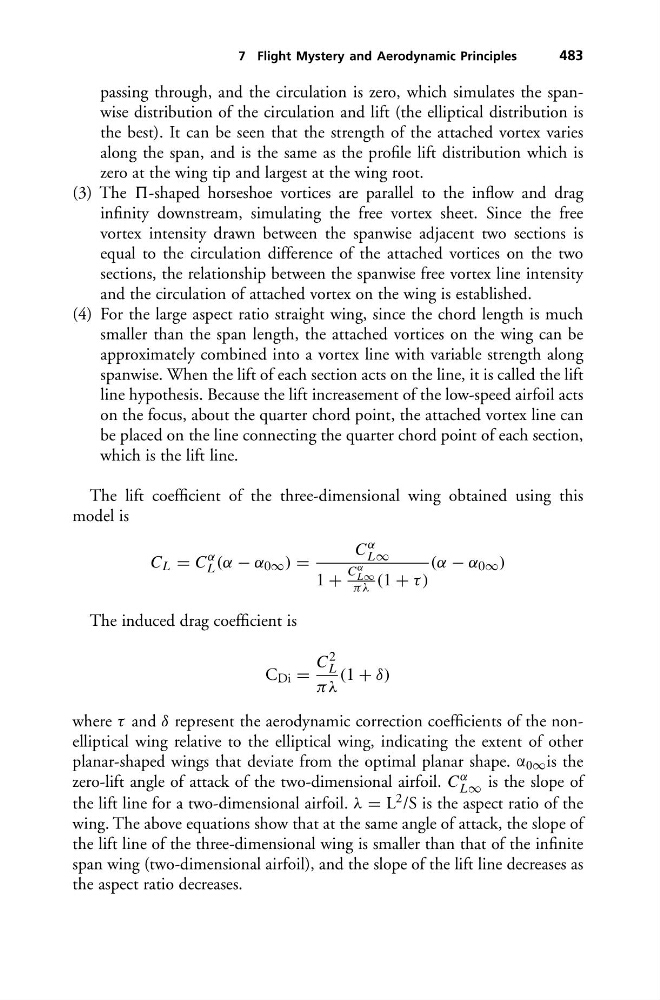
The lift coefficient of the three-dimensional wing obtained using this
model is
C L = C
α
L (α − α 0∞ ) =
C α
L∞
1 +
C α
L∞
πλ (1 + τ )
(α − α 0∞ )
The induced drag coefficient is
C Di =
C 2
L
πλ
(1 + δ)
where τ and δ represent the aerodynamic correction coefficients of the nonelliptical wing relative to the elliptical wing, indicating the extent of other
planar-shaped wings that deviate from the optimal planar shape. α 0∞ is the
zero-lift angle of attack of the two-dimensional airfoil. C α
L∞ is the slope of
the lift line for a two-dimensional airfoil. λ = L 2 /S is the aspect ratio of the
wing. The above equations show that at the same angle of attack, the slope of
the lift line of the three-dimensional wing is smaller than that of the infinite
span wing (two-dimensional airfoil), and the slope of the lift line decreases as
the aspect ratio decreases.
483
passing through, and the circulation is zero, which simulates the spanwise distribution of the circulation and lift (the elliptical distribution is
the best). It can be seen that the strength of the attached vortex varies
along the span, and is the same as the profile lift distribution which is
zero at the wing tip and largest at the wing root.
(3) The -shaped horseshoe vortices are parallel to the inflow and drag
infinity downstream, simulating the free vortex sheet. Since the free
vortex intensity drawn between the spanwise adjacent two sections is
equal to the circulation difference of the attached vortices on the two
sections, the relationship between the spanwise free vortex line intensity
and the circulation of attached vortex on the wing is established.
(4) For the large aspect ratio straight wing, since the chord length is much
smaller than the span length, the attached vortices on the wing can be
approximately combined into a vortex line with variable strength along
spanwise. When the lift of each section acts on the line, it is called the lift
line hypothesis. Because the lift increasement of the low-speed airfoil acts
on the focus, about the quarter chord point, the attached vortex line can
be placed on the line connecting the quarter chord point of each section,
which is the lift line.
The lift coefficient of the three-dimensional wing obtained using this
model is
C L = C
α
L (α − α 0∞ ) =
C α
L∞
1 +
C α
L∞
πλ (1 + τ )
(α − α 0∞ )
The induced drag coefficient is
C Di =
C 2
L
πλ
(1 + δ)
where τ and δ represent the aerodynamic correction coefficients of the nonelliptical wing relative to the elliptical wing, indicating the extent of other
planar-shaped wings that deviate from the optimal planar shape. α 0∞ is the
zero-lift angle of attack of the two-dimensional airfoil. C α
L∞ is the slope of
the lift line for a two-dimensional airfoil. λ = L 2 /S is the aspect ratio of the
wing. The above equations show that at the same angle of attack, the slope of
the lift line of the three-dimensional wing is smaller than that of the infinite
span wing (two-dimensional airfoil), and the slope of the lift line decreases as
the aspect ratio decreases.