

7 Flight Mystery and Aerodynamic Principles
475
wing (or the gross area). For general fluid mechanics textbooks, the area S
used to calculate the drag coefficient is generally the windward area (refers to
the projected area of the object perpendicular to the flow direction).
A large number of wind tunnel tests have shown that for a given wing
profile, the wing lift is primarily a function of the following variables without
side slip.
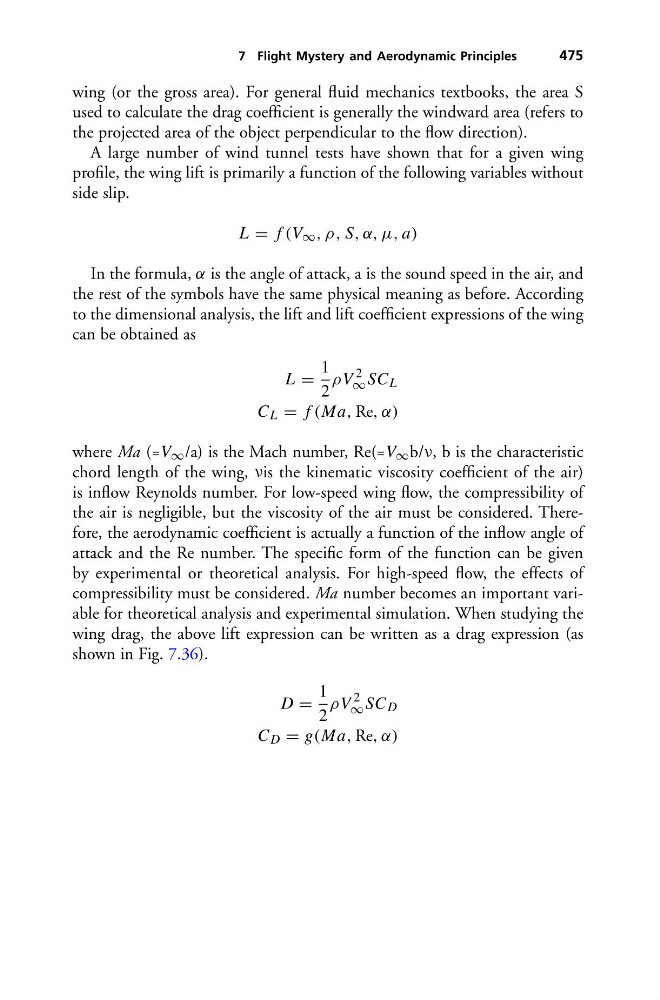
L = f (V ∞ , ρ, S, α, μ, a)
In the formula, α is the angle of attack, a is the sound speed in the air, and
the rest of the symbols have the same physical meaning as before. According
to the dimensional analysis, the lift and lift coefficient expressions of the wing
can be obtained as
L =
1
2
ρV
2
∞ SC L
C L = f (Ma, Re, α)
where Ma (=V ∞ /a) is the Mach number, Re(=V ∞ b/ν, b is the characteristic
chord length of the wing, νis the kinematic viscosity coefficient of the air)
is inflow Reynolds number. For low-speed wing flow, the compressibility of
the air is negligible, but the viscosity of the air must be considered. Therefore, the aerodynamic coefficient is actually a function of the inflow angle of
attack and the Re number. The specific form of the function can be given
by experimental or theoretical analysis. For high-speed flow, the effects of
compressibility must be considered. Ma number becomes an important variable for theoretical analysis and experimental simulation. When studying the
wing drag, the above lift expression can be written as a drag expression (as
shown in Fig. 7.36).
D =
1
2
ρV
2
∞ SC D
C D = g(Ma, Re, α)
475
wing (or the gross area). For general fluid mechanics textbooks, the area S
used to calculate the drag coefficient is generally the windward area (refers to
the projected area of the object perpendicular to the flow direction).
A large number of wind tunnel tests have shown that for a given wing
profile, the wing lift is primarily a function of the following variables without
side slip.
L = f (V ∞ , ρ, S, α, μ, a)
In the formula, α is the angle of attack, a is the sound speed in the air, and
the rest of the symbols have the same physical meaning as before. According
to the dimensional analysis, the lift and lift coefficient expressions of the wing
can be obtained as
L =
1
2
ρV
2
∞ SC L
C L = f (Ma, Re, α)
where Ma (=V ∞ /a) is the Mach number, Re(=V ∞ b/ν, b is the characteristic
chord length of the wing, νis the kinematic viscosity coefficient of the air)
is inflow Reynolds number. For low-speed wing flow, the compressibility of
the air is negligible, but the viscosity of the air must be considered. Therefore, the aerodynamic coefficient is actually a function of the inflow angle of
attack and the Re number. The specific form of the function can be given
by experimental or theoretical analysis. For high-speed flow, the effects of
compressibility must be considered. Ma number becomes an important variable for theoretical analysis and experimental simulation. When studying the
wing drag, the above lift expression can be written as a drag expression (as
shown in Fig. 7.36).
D =
1
2
ρV
2
∞ SC D
C D = g(Ma, Re, α)