

7 Flight Mystery and Aerodynamic Principles
463
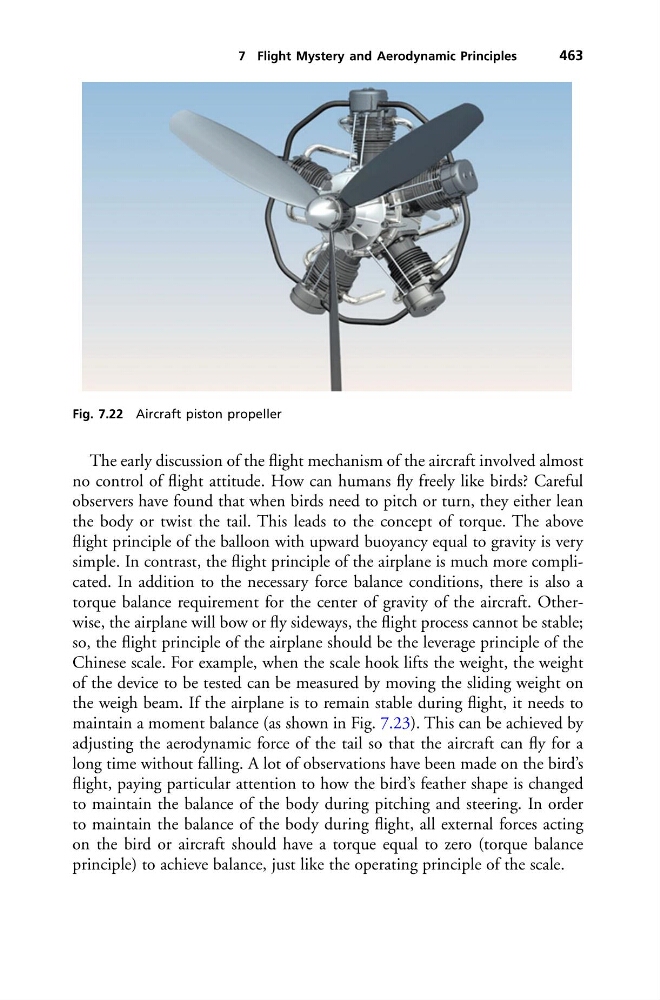
Fig. 7.22 Aircraft piston propeller
The early discussion of the flight mechanism of the aircraft involved almost
no control of flight attitude. How can humans fly freely like birds? Careful
observers have found that when birds need to pitch or turn, they either lean
the body or twist the tail. This leads to the concept of torque. The above
flight principle of the balloon with upward buoyancy equal to gravity is very
simple. In contrast, the flight principle of the airplane is much more complicated. In addition to the necessary force balance conditions, there is also a
torque balance requirement for the center of gravity of the aircraft. Otherwise, the airplane will bow or fly sideways, the flight process cannot be stable;
so, the flight principle of the airplane should be the leverage principle of the
Chinese scale. For example, when the scale hook lifts the weight, the weight
of the device to be tested can be measured by moving the sliding weight on
the weigh beam. If the airplane is to remain stable during flight, it needs to
maintain a moment balance (as shown in Fig. 7.23). This can be achieved by
adjusting the aerodynamic force of the tail so that the aircraft can fly for a
long time without falling. A lot of observations have been made on the bird’s
flight, paying particular attention to how the bird’s feather shape is changed
to maintain the balance of the body during pitching and steering. In order
to maintain the balance of the body during flight, all external forces acting
on the bird or aircraft should have a torque equal to zero (torque balance
principle) to achieve balance, just like the operating principle of the scale.
463
Fig. 7.22 Aircraft piston propeller
The early discussion of the flight mechanism of the aircraft involved almost
no control of flight attitude. How can humans fly freely like birds? Careful
observers have found that when birds need to pitch or turn, they either lean
the body or twist the tail. This leads to the concept of torque. The above
flight principle of the balloon with upward buoyancy equal to gravity is very
simple. In contrast, the flight principle of the airplane is much more complicated. In addition to the necessary force balance conditions, there is also a
torque balance requirement for the center of gravity of the aircraft. Otherwise, the airplane will bow or fly sideways, the flight process cannot be stable;
so, the flight principle of the airplane should be the leverage principle of the
Chinese scale. For example, when the scale hook lifts the weight, the weight
of the device to be tested can be measured by moving the sliding weight on
the weigh beam. If the airplane is to remain stable during flight, it needs to
maintain a moment balance (as shown in Fig. 7.23). This can be achieved by
adjusting the aerodynamic force of the tail so that the aircraft can fly for a
long time without falling. A lot of observations have been made on the bird’s
flight, paying particular attention to how the bird’s feather shape is changed
to maintain the balance of the body during pitching and steering. In order
to maintain the balance of the body during flight, all external forces acting
on the bird or aircraft should have a torque equal to zero (torque balance
principle) to achieve balance, just like the operating principle of the scale.