

438
P. Liu
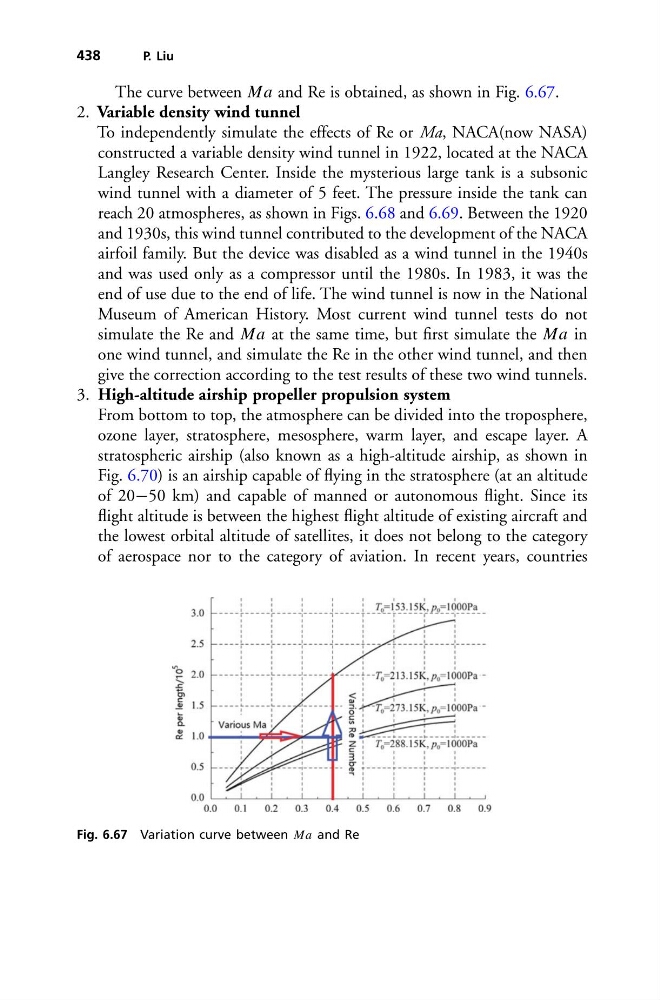
The curve between Ma and Re is obtained, as shown in Fig. 6.67.
2. Variable density wind tunnel
To independently simulate the effects of Re or Ma, NACA(now NASA)
constructed a variable density wind tunnel in 1922, located at the NACA
Langley Research Center. Inside the mysterious large tank is a subsonic
wind tunnel with a diameter of 5 feet. The pressure inside the tank can
reach 20 atmospheres, as shown in Figs. 6.68 and 6.69. Between the 1920
and 1930s, this wind tunnel contributed to the development of the NACA
airfoil family. But the device was disabled as a wind tunnel in the 1940s
and was used only as a compressor until the 1980s. In 1983, it was the
end of use due to the end of life. The wind tunnel is now in the National
Museum of American History. Most current wind tunnel tests do not
simulate the Re and Ma at the same time, but first simulate the Ma in
one wind tunnel, and simulate the Re in the other wind tunnel, and then
give the correction according to the test results of these two wind tunnels.
3. High-altitude airship propeller propulsion system
From bottom to top, the atmosphere can be divided into the troposphere,
ozone layer, stratosphere, mesosphere, warm layer, and escape layer. A
stratospheric airship (also known as a high-altitude airship, as shown in
Fig. 6.70) is an airship capable of flying in the stratosphere (at an altitude
of 20−50 km) and capable of manned or autonomous flight. Since its
flight altitude is between the highest flight altitude of existing aircraft and
the lowest orbital altitude of satellites, it does not belong to the category
of aerospace nor to the category of aviation. In recent years, countries
Fig. 6.67 Variation curve between Ma and Re
P. Liu
The curve between Ma and Re is obtained, as shown in Fig. 6.67.
2. Variable density wind tunnel
To independently simulate the effects of Re or Ma, NACA(now NASA)
constructed a variable density wind tunnel in 1922, located at the NACA
Langley Research Center. Inside the mysterious large tank is a subsonic
wind tunnel with a diameter of 5 feet. The pressure inside the tank can
reach 20 atmospheres, as shown in Figs. 6.68 and 6.69. Between the 1920
and 1930s, this wind tunnel contributed to the development of the NACA
airfoil family. But the device was disabled as a wind tunnel in the 1940s
and was used only as a compressor until the 1980s. In 1983, it was the
end of use due to the end of life. The wind tunnel is now in the National
Museum of American History. Most current wind tunnel tests do not
simulate the Re and Ma at the same time, but first simulate the Ma in
one wind tunnel, and simulate the Re in the other wind tunnel, and then
give the correction according to the test results of these two wind tunnels.
3. High-altitude airship propeller propulsion system
From bottom to top, the atmosphere can be divided into the troposphere,
ozone layer, stratosphere, mesosphere, warm layer, and escape layer. A
stratospheric airship (also known as a high-altitude airship, as shown in
Fig. 6.70) is an airship capable of flying in the stratosphere (at an altitude
of 20−50 km) and capable of manned or autonomous flight. Since its
flight altitude is between the highest flight altitude of existing aircraft and
the lowest orbital altitude of satellites, it does not belong to the category
of aerospace nor to the category of aviation. In recent years, countries
Fig. 6.67 Variation curve between Ma and Re