

6 Wind and Water Tunnel Equipment
437
independently in conventional wind tunnels. However, if a wind tunnel
can be developed to independently control the total temperature, total
pressure, fan speed, and other parameters in the test section, then the
influence of changes in Ma (compressibility) and Re (viscosity) can
be studied independently. For example, different combinations of total
temperature, total pressure, and fan speed can be used to study the influence law of different Re at a given Ma. It is also possible to study the
influence law of different Ma under a given Re. Such wind tunnels are
often called variable density wind tunnels. According to the definition,
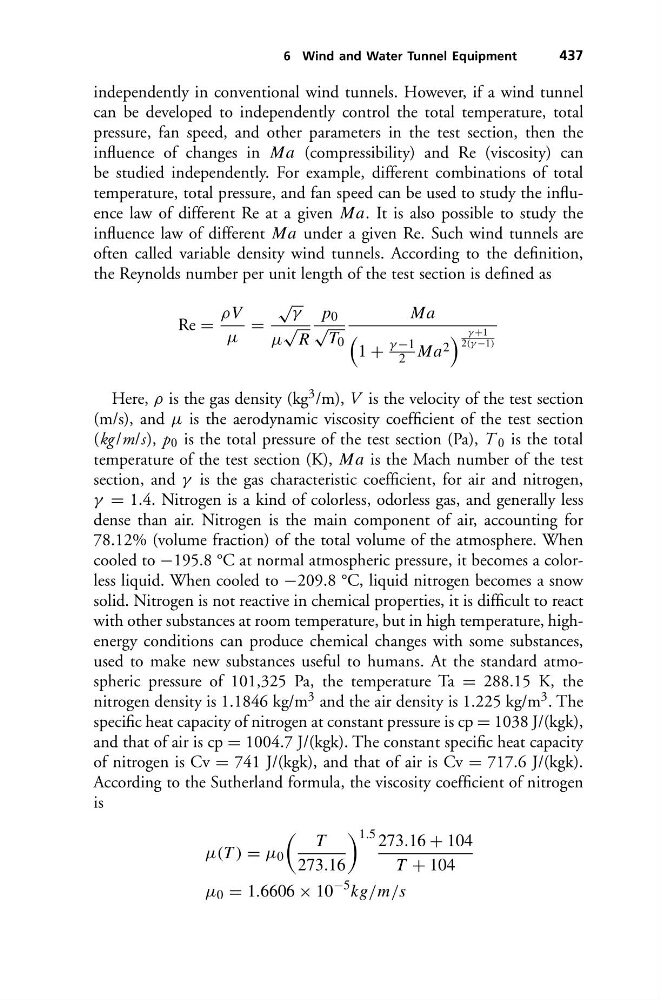
the Reynolds number per unit length of the test section is defined as
Re =
ρV
μ
=
√ γ
μ
√
R
p 0
√
T 0
Ma
1 +
γ −1
2 Ma 2
γ +1
2(γ −1)
Here, ρ is the gas density (kg 3 /m), V is the velocity of the test section
(m/s), and μ is the aerodynamic viscosity coefficient of the test section
(kg /m/s), p 0 is the total pressure of the test section (Pa), T 0 is the total
temperature of the test section (K), Ma is the Mach number of the test
section, and γ is the gas characteristic coefficient, for air and nitrogen,
γ = 1.4. Nitrogen is a kind of colorless, odorless gas, and generally less
dense than air. Nitrogen is the main component of air, accounting for
78.12% (volume fraction) of the total volume of the atmosphere. When
cooled to −195.8 °C at normal atmospheric pressure, it becomes a colorless liquid. When cooled to −209.8 °C, liquid nitrogen becomes a snow
solid. Nitrogen is not reactive in chemical properties, it is difficult to react
with other substances at room temperature, but in high temperature, highenergy conditions can produce chemical changes with some substances,
used to make new substances useful to humans. At the standard atmospheric pressure of 101,325 Pa, the temperature Ta = 288.15 K, the
nitrogen density is 1.1846 kg/m 3 and the air density is 1.225 kg/m 3 . The
specific heat capacity of nitrogen at constant pressure is cp = 1038 J/(kgk),
and that of air is cp = 1004.7 J/(kgk). The constant specific heat capacity
of nitrogen is Cv = 741 J/(kgk), and that of air is Cv = 717.6 J/(kgk).
According to the Sutherland formula, the viscosity coefficient of nitrogen
is
μ(T ) = μ 0
T
273.16
1.5 273.16 + 104
T + 104
μ 0 = 1.6606 × 10
−5 kg/m/s
437
independently in conventional wind tunnels. However, if a wind tunnel
can be developed to independently control the total temperature, total
pressure, fan speed, and other parameters in the test section, then the
influence of changes in Ma (compressibility) and Re (viscosity) can
be studied independently. For example, different combinations of total
temperature, total pressure, and fan speed can be used to study the influence law of different Re at a given Ma. It is also possible to study the
influence law of different Ma under a given Re. Such wind tunnels are
often called variable density wind tunnels. According to the definition,
the Reynolds number per unit length of the test section is defined as
Re =
ρV
μ
=
√ γ
μ
√
R
p 0
√
T 0
Ma
1 +
γ −1
2 Ma 2
γ +1
2(γ −1)
Here, ρ is the gas density (kg 3 /m), V is the velocity of the test section
(m/s), and μ is the aerodynamic viscosity coefficient of the test section
(kg /m/s), p 0 is the total pressure of the test section (Pa), T 0 is the total
temperature of the test section (K), Ma is the Mach number of the test
section, and γ is the gas characteristic coefficient, for air and nitrogen,
γ = 1.4. Nitrogen is a kind of colorless, odorless gas, and generally less
dense than air. Nitrogen is the main component of air, accounting for
78.12% (volume fraction) of the total volume of the atmosphere. When
cooled to −195.8 °C at normal atmospheric pressure, it becomes a colorless liquid. When cooled to −209.8 °C, liquid nitrogen becomes a snow
solid. Nitrogen is not reactive in chemical properties, it is difficult to react
with other substances at room temperature, but in high temperature, highenergy conditions can produce chemical changes with some substances,
used to make new substances useful to humans. At the standard atmospheric pressure of 101,325 Pa, the temperature Ta = 288.15 K, the
nitrogen density is 1.1846 kg/m 3 and the air density is 1.225 kg/m 3 . The
specific heat capacity of nitrogen at constant pressure is cp = 1038 J/(kgk),
and that of air is cp = 1004.7 J/(kgk). The constant specific heat capacity
of nitrogen is Cv = 741 J/(kgk), and that of air is Cv = 717.6 J/(kgk).
According to the Sutherland formula, the viscosity coefficient of nitrogen
is
μ(T ) = μ 0
T
273.16
1.5 273.16 + 104
T + 104
μ 0 = 1.6606 × 10
−5 kg/m/s