

30
P. Liu
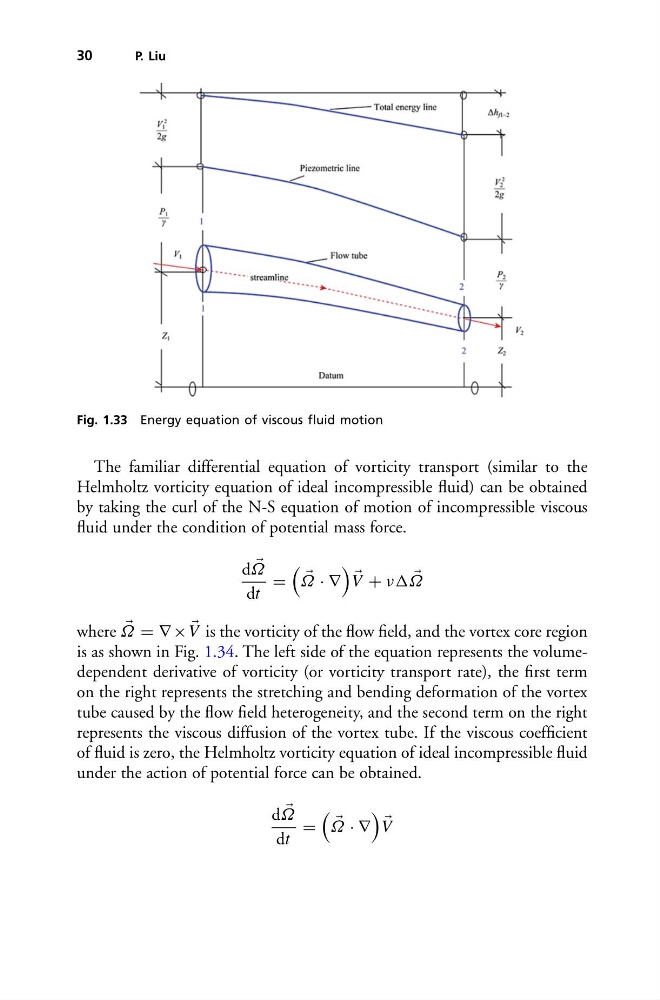
Fig. 1.33 Energy equation of viscous fluid motion
The familiar differential equation of vorticity transport (similar to the
Helmholtz vorticity equation of ideal incompressible fluid) can be obtained
by taking the curl of the N-S equation of motion of incompressible viscous
fluid under the condition of potential mass force.
d
Ω
dt
=
Ω · ∇
V + νν
Ω
where
Ω = ∇ ×
V is the vorticity of the flow field, and the vortex core region
is as shown in Fig. 1.34. The left side of the equation represents the volumedependent derivative of vorticity (or vorticity transport rate), the first term
on the right represents the stretching and bending deformation of the vortex
tube caused by the flow field heterogeneity, and the second term on the right
represents the viscous diffusion of the vortex tube. If the viscous coefficient
of fluid is zero, the Helmholtz vorticity equation of ideal incompressible fluid
under the action of potential force can be obtained.
d
Ω
dt
=
Ω · ∇
V
P. Liu
Fig. 1.33 Energy equation of viscous fluid motion
The familiar differential equation of vorticity transport (similar to the
Helmholtz vorticity equation of ideal incompressible fluid) can be obtained
by taking the curl of the N-S equation of motion of incompressible viscous
fluid under the condition of potential mass force.
d
Ω
dt
=
Ω · ∇
V + νν
Ω
where
Ω = ∇ ×
V is the vorticity of the flow field, and the vortex core region
is as shown in Fig. 1.34. The left side of the equation represents the volumedependent derivative of vorticity (or vorticity transport rate), the first term
on the right represents the stretching and bending deformation of the vortex
tube caused by the flow field heterogeneity, and the second term on the right
represents the viscous diffusion of the vortex tube. If the viscous coefficient
of fluid is zero, the Helmholtz vorticity equation of ideal incompressible fluid
under the action of potential force can be obtained.
d
Ω
dt
=
Ω · ∇
V