

1 Foundation of Fluid Mechanics
29
This system of equations shows that the mass force, pressure difference
force (surface normal force), and viscous force (surface tangential force) acting
on the fluid microelement cause the acceleration of the fluid microelement,
which is reflected in the viscous diffusion behavior of momentum in the
motion equation. Note that there is no viscous dissipation here, and viscous
dissipation can only occur in the energy equation. Comparing the Boltzmann
equation with N-S equation, it is found that there is a certain relationship
between them. In fact, N-S equation system is the hydrodynamic limit of the
Boltzmann equation. So far, from 1755 to 1845, the Euler equations of ideal
fluid motion were derived and the N-S equations of viscous fluid motion were
derived. Through 90 years, mathematicians had made outstanding contributions to the establishment and derivation of the main equations of fluid
mechanics. Thereafter, fluid mechanics began to enter the stage of solving
and applying many flow problems.
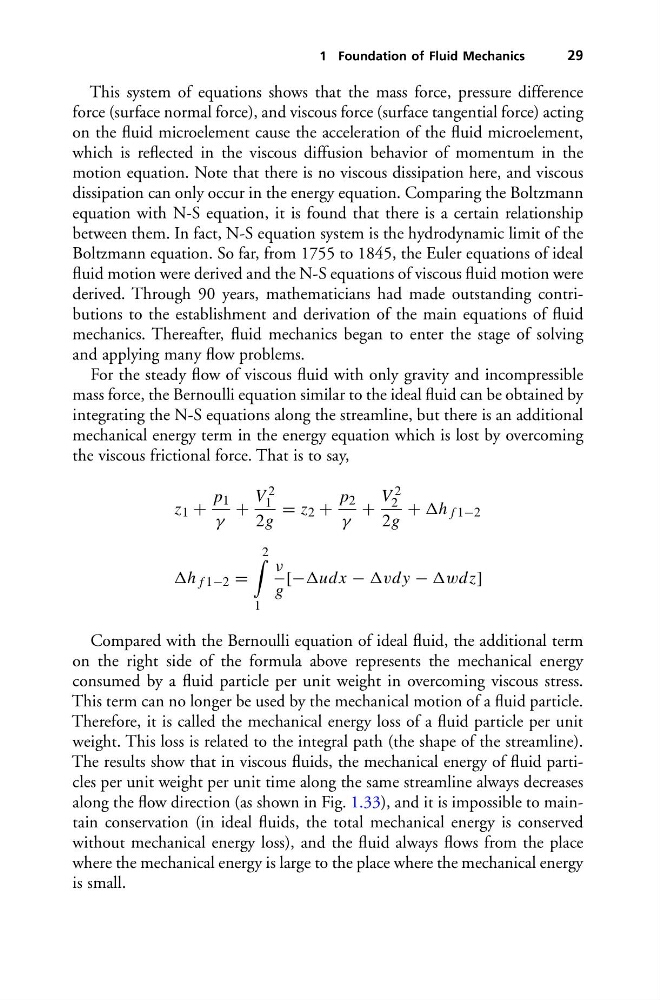
For the steady flow of viscous fluid with only gravity and incompressible
mass force, the Bernoulli equation similar to the ideal fluid can be obtained by
integrating the N-S equations along the streamline, but there is an additional
mechanical energy term in the energy equation which is lost by overcoming
the viscous frictional force. That is to say,
z 1 +
p 1
γ
+
V 2
1
2g
= z 2 +
p 2
γ
+
V 2
2
2g
+ h f 1−2
h f 1−2 =
2
1
ν
g
[−udx − vdy − wdz]
Compared with the Bernoulli equation of ideal fluid, the additional term
on the right side of the formula above represents the mechanical energy
consumed by a fluid particle per unit weight in overcoming viscous stress.
This term can no longer be used by the mechanical motion of a fluid particle.
Therefore, it is called the mechanical energy loss of a fluid particle per unit
weight. This loss is related to the integral path (the shape of the streamline).
The results show that in viscous fluids, the mechanical energy of fluid particles per unit weight per unit time along the same streamline always decreases
along the flow direction (as shown in Fig. 1.33), and it is impossible to maintain conservation (in ideal fluids, the total mechanical energy is conserved
without mechanical energy loss), and the fluid always flows from the place
where the mechanical energy is large to the place where the mechanical energy
is small.
29
This system of equations shows that the mass force, pressure difference
force (surface normal force), and viscous force (surface tangential force) acting
on the fluid microelement cause the acceleration of the fluid microelement,
which is reflected in the viscous diffusion behavior of momentum in the
motion equation. Note that there is no viscous dissipation here, and viscous
dissipation can only occur in the energy equation. Comparing the Boltzmann
equation with N-S equation, it is found that there is a certain relationship
between them. In fact, N-S equation system is the hydrodynamic limit of the
Boltzmann equation. So far, from 1755 to 1845, the Euler equations of ideal
fluid motion were derived and the N-S equations of viscous fluid motion were
derived. Through 90 years, mathematicians had made outstanding contributions to the establishment and derivation of the main equations of fluid
mechanics. Thereafter, fluid mechanics began to enter the stage of solving
and applying many flow problems.
For the steady flow of viscous fluid with only gravity and incompressible
mass force, the Bernoulli equation similar to the ideal fluid can be obtained by
integrating the N-S equations along the streamline, but there is an additional
mechanical energy term in the energy equation which is lost by overcoming
the viscous frictional force. That is to say,
z 1 +
p 1
γ
+
V 2
1
2g
= z 2 +
p 2
γ
+
V 2
2
2g
+ h f 1−2
h f 1−2 =
2
1
ν
g
[−udx − vdy − wdz]
Compared with the Bernoulli equation of ideal fluid, the additional term
on the right side of the formula above represents the mechanical energy
consumed by a fluid particle per unit weight in overcoming viscous stress.
This term can no longer be used by the mechanical motion of a fluid particle.
Therefore, it is called the mechanical energy loss of a fluid particle per unit
weight. This loss is related to the integral path (the shape of the streamline).
The results show that in viscous fluids, the mechanical energy of fluid particles per unit weight per unit time along the same streamline always decreases
along the flow direction (as shown in Fig. 1.33), and it is impossible to maintain conservation (in ideal fluids, the total mechanical energy is conserved
without mechanical energy loss), and the fluid always flows from the place
where the mechanical energy is large to the place where the mechanical energy
is small.