

378
P. Liu
The number of positive or negative errors with equal absolute values is equivalent, that is, the probability of error is the same, which is the symmetry
of the error; (3) the probability of occurrence of a large positive or negative error is very small, that is, a large error generally does not appear, this is
the boundedness of the error; (4) As the number of measurements increases,
the arithmetic mean of the random error approaches zero. This is called the
low compensation of the error. According to the above error characteristics,
the probability distribution of random errors appears to satisfy the Gaussian
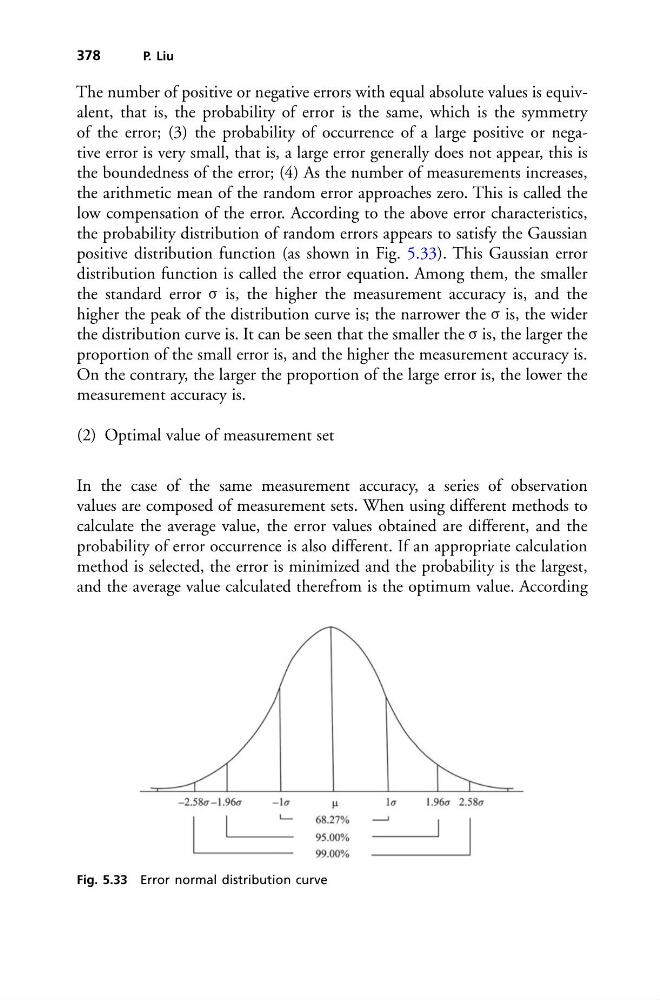
positive distribution function (as shown in Fig. 5.33). This Gaussian error
distribution function is called the error equation. Among them, the smaller
the standard error σ is, the higher the measurement accuracy is, and the
higher the peak of the distribution curve is; the narrower the σ is, the wider
the distribution curve is. It can be seen that the smaller the σ is, the larger the
proportion of the small error is, and the higher the measurement accuracy is.
On the contrary, the larger the proportion of the large error is, the lower the
measurement accuracy is.
(2) Optimal value of measurement set
In the case of the same measurement accuracy, a series of observation
values are composed of measurement sets. When using different methods to
calculate the average value, the error values obtained are different, and the
probability of error occurrence is also different. If an appropriate calculation
method is selected, the error is minimized and the probability is the largest,
and the average value calculated therefrom is the optimum value. According
Fig. 5.33 Error normal distribution curve
P. Liu
The number of positive or negative errors with equal absolute values is equivalent, that is, the probability of error is the same, which is the symmetry
of the error; (3) the probability of occurrence of a large positive or negative error is very small, that is, a large error generally does not appear, this is
the boundedness of the error; (4) As the number of measurements increases,
the arithmetic mean of the random error approaches zero. This is called the
low compensation of the error. According to the above error characteristics,
the probability distribution of random errors appears to satisfy the Gaussian
positive distribution function (as shown in Fig. 5.33). This Gaussian error
distribution function is called the error equation. Among them, the smaller
the standard error σ is, the higher the measurement accuracy is, and the
higher the peak of the distribution curve is; the narrower the σ is, the wider
the distribution curve is. It can be seen that the smaller the σ is, the larger the
proportion of the small error is, and the higher the measurement accuracy is.
On the contrary, the larger the proportion of the large error is, the lower the
measurement accuracy is.
(2) Optimal value of measurement set
In the case of the same measurement accuracy, a series of observation
values are composed of measurement sets. When using different methods to
calculate the average value, the error values obtained are different, and the
probability of error occurrence is also different. If an appropriate calculation
method is selected, the error is minimized and the probability is the largest,
and the average value calculated therefrom is the optimum value. According
Fig. 5.33 Error normal distribution curve