

5 Experimental Fluid Mechanics
353
followability, so the display effect is better when it is used for a steady flow
and the display error is larger when it is used for an unsteady flow.
(4) Optical method
The conventional optical flow visualization method mainly refers to a
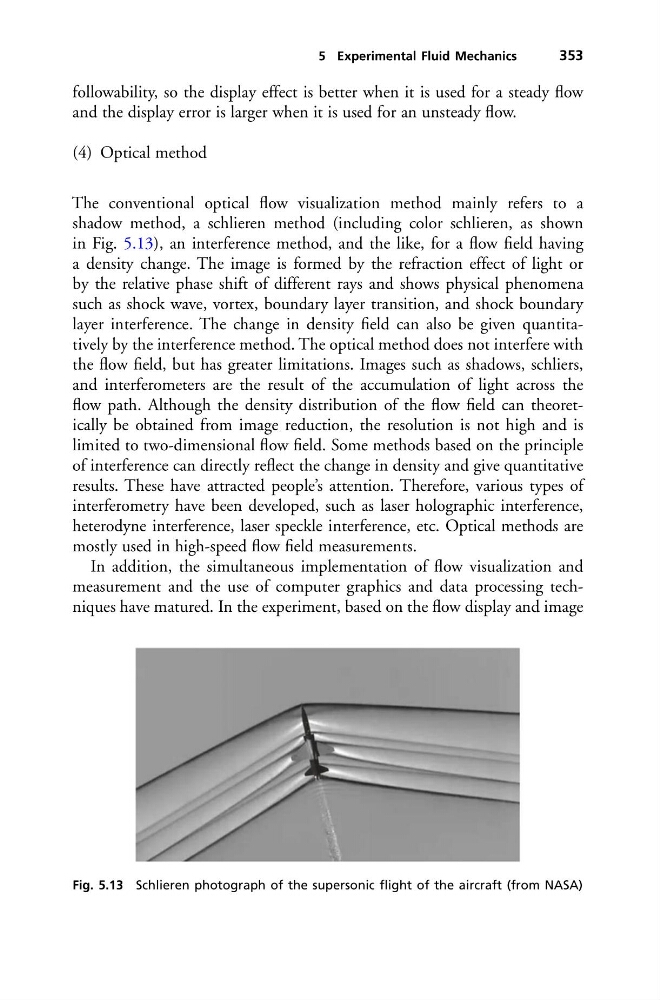
shadow method, a schlieren method (including color schlieren, as shown
in Fig. 5.13), an interference method, and the like, for a flow field having
a density change. The image is formed by the refraction effect of light or
by the relative phase shift of different rays and shows physical phenomena
such as shock wave, vortex, boundary layer transition, and shock boundary
layer interference. The change in density field can also be given quantitatively by the interference method. The optical method does not interfere with
the flow field, but has greater limitations. Images such as shadows, schliers,
and interferometers are the result of the accumulation of light across the
flow path. Although the density distribution of the flow field can theoretically be obtained from image reduction, the resolution is not high and is
limited to two-dimensional flow field. Some methods based on the principle
of interference can directly reflect the change in density and give quantitative
results. These have attracted people’s attention. Therefore, various types of
interferometry have been developed, such as laser holographic interference,
heterodyne interference, laser speckle interference, etc. Optical methods are
mostly used in high-speed flow field measurements.
In addition, the simultaneous implementation of flow visualization and
measurement and the use of computer graphics and data processing techniques have matured. In the experiment, based on the flow display and image
Fig. 5.13 Schlieren photograph of the supersonic flight of the aircraft (from NASA)
353
followability, so the display effect is better when it is used for a steady flow
and the display error is larger when it is used for an unsteady flow.
(4) Optical method
The conventional optical flow visualization method mainly refers to a
shadow method, a schlieren method (including color schlieren, as shown
in Fig. 5.13), an interference method, and the like, for a flow field having
a density change. The image is formed by the refraction effect of light or
by the relative phase shift of different rays and shows physical phenomena
such as shock wave, vortex, boundary layer transition, and shock boundary
layer interference. The change in density field can also be given quantitatively by the interference method. The optical method does not interfere with
the flow field, but has greater limitations. Images such as shadows, schliers,
and interferometers are the result of the accumulation of light across the
flow path. Although the density distribution of the flow field can theoretically be obtained from image reduction, the resolution is not high and is
limited to two-dimensional flow field. Some methods based on the principle
of interference can directly reflect the change in density and give quantitative
results. These have attracted people’s attention. Therefore, various types of
interferometry have been developed, such as laser holographic interference,
heterodyne interference, laser speckle interference, etc. Optical methods are
mostly used in high-speed flow field measurements.
In addition, the simultaneous implementation of flow visualization and
measurement and the use of computer graphics and data processing techniques have matured. In the experiment, based on the flow display and image
Fig. 5.13 Schlieren photograph of the supersonic flight of the aircraft (from NASA)