

5 Experimental Fluid Mechanics
351
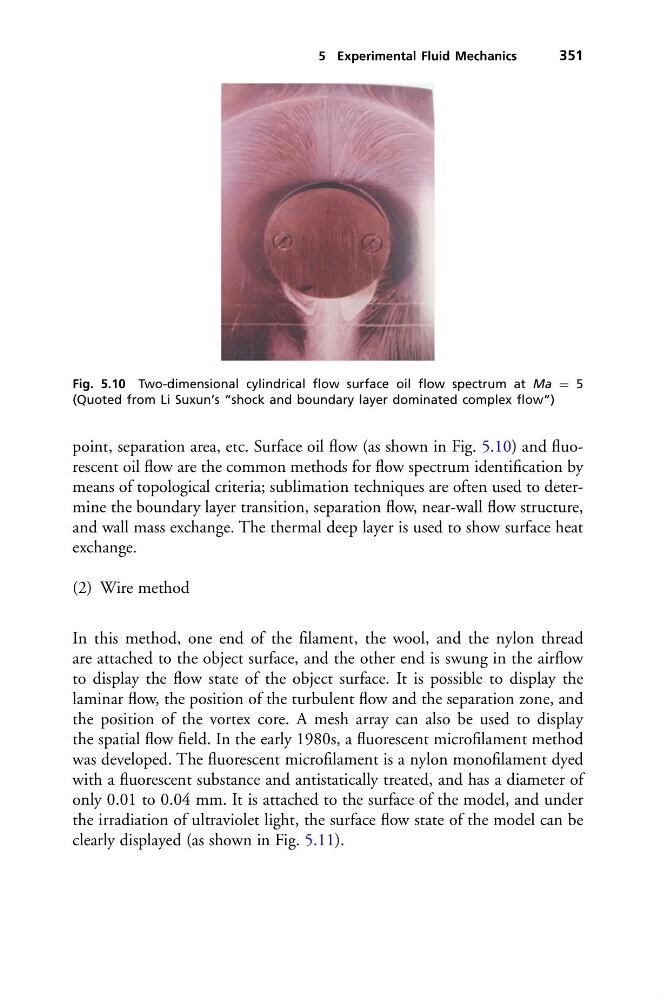
Fig. 5.10 Two-dimensional cylindrical flow surface oil flow spectrum at Ma = 5
(Quoted from Li Suxun’s “shock and boundary layer dominated complex flow”)
point, separation area, etc. Surface oil flow (as shown in Fig. 5.10) and fluorescent oil flow are the common methods for flow spectrum identification by
means of topological criteria; sublimation techniques are often used to determine the boundary layer transition, separation flow, near-wall flow structure,
and wall mass exchange. The thermal deep layer is used to show surface heat
exchange.
(2) Wire method
In this method, one end of the filament, the wool, and the nylon thread
are attached to the object surface, and the other end is swung in the airflow
to display the flow state of the object surface. It is possible to display the
laminar flow, the position of the turbulent flow and the separation zone, and
the position of the vortex core. A mesh array can also be used to display
the spatial flow field. In the early 1980s, a fluorescent microfilament method
was developed. The fluorescent microfilament is a nylon monofilament dyed
with a fluorescent substance and antistatically treated, and has a diameter of
only 0.01 to 0.04 mm. It is attached to the surface of the model, and under
the irradiation of ultraviolet light, the surface flow state of the model can be
clearly displayed (as shown in Fig. 5.11).
351
Fig. 5.10 Two-dimensional cylindrical flow surface oil flow spectrum at Ma = 5
(Quoted from Li Suxun’s “shock and boundary layer dominated complex flow”)
point, separation area, etc. Surface oil flow (as shown in Fig. 5.10) and fluorescent oil flow are the common methods for flow spectrum identification by
means of topological criteria; sublimation techniques are often used to determine the boundary layer transition, separation flow, near-wall flow structure,
and wall mass exchange. The thermal deep layer is used to show surface heat
exchange.
(2) Wire method
In this method, one end of the filament, the wool, and the nylon thread
are attached to the object surface, and the other end is swung in the airflow
to display the flow state of the object surface. It is possible to display the
laminar flow, the position of the turbulent flow and the separation zone, and
the position of the vortex core. A mesh array can also be used to display
the spatial flow field. In the early 1980s, a fluorescent microfilament method
was developed. The fluorescent microfilament is a nylon monofilament dyed
with a fluorescent substance and antistatically treated, and has a diameter of
only 0.01 to 0.04 mm. It is attached to the surface of the model, and under
the irradiation of ultraviolet light, the surface flow state of the model can be
clearly displayed (as shown in Fig. 5.11).