

5 Experimental Fluid Mechanics
341
results that the high-speed airflow can produce lifts that are several times
the weight of the wing when passing over the wing. This finding confirmed
people’s belief in making airplanes. The use of wind tunnel tests to study
the shape of the aircraft marks the transition from adventure to science in
the creative activities of humanity’s long-awaited flight. Later, in September
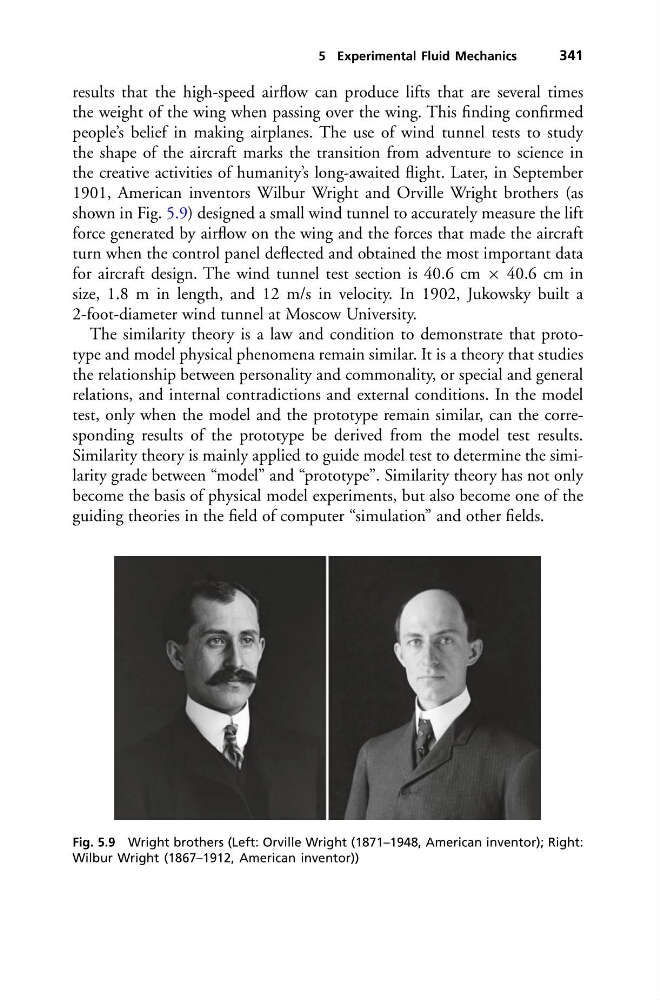
1901, American inventors Wilbur Wright and Orville Wright brothers (as
shown in Fig. 5.9) designed a small wind tunnel to accurately measure the lift
force generated by airflow on the wing and the forces that made the aircraft
turn when the control panel deflected and obtained the most important data
for aircraft design. The wind tunnel test section is 40.6 cm × 40.6 cm in
size, 1.8 m in length, and 12 m/s in velocity. In 1902, Jukowsky built a
2-foot-diameter wind tunnel at Moscow University.
The similarity theory is a law and condition to demonstrate that prototype and model physical phenomena remain similar. It is a theory that studies
the relationship between personality and commonality, or special and general
relations, and internal contradictions and external conditions. In the model
test, only when the model and the prototype remain similar, can the corresponding results of the prototype be derived from the model test results.
Similarity theory is mainly applied to guide model test to determine the similarity grade between “model” and “prototype”. Similarity theory has not only
become the basis of physical model experiments, but also become one of the
guiding theories in the field of computer “simulation” and other fields.
Fig. 5.9 Wright brothers (Left: Orville Wright (1871–1948, American inventor); Right:
Wilbur Wright (1867–1912, American inventor))
341
results that the high-speed airflow can produce lifts that are several times
the weight of the wing when passing over the wing. This finding confirmed
people’s belief in making airplanes. The use of wind tunnel tests to study
the shape of the aircraft marks the transition from adventure to science in
the creative activities of humanity’s long-awaited flight. Later, in September
1901, American inventors Wilbur Wright and Orville Wright brothers (as
shown in Fig. 5.9) designed a small wind tunnel to accurately measure the lift
force generated by airflow on the wing and the forces that made the aircraft
turn when the control panel deflected and obtained the most important data
for aircraft design. The wind tunnel test section is 40.6 cm × 40.6 cm in
size, 1.8 m in length, and 12 m/s in velocity. In 1902, Jukowsky built a
2-foot-diameter wind tunnel at Moscow University.
The similarity theory is a law and condition to demonstrate that prototype and model physical phenomena remain similar. It is a theory that studies
the relationship between personality and commonality, or special and general
relations, and internal contradictions and external conditions. In the model
test, only when the model and the prototype remain similar, can the corresponding results of the prototype be derived from the model test results.
Similarity theory is mainly applied to guide model test to determine the similarity grade between “model” and “prototype”. Similarity theory has not only
become the basis of physical model experiments, but also become one of the
guiding theories in the field of computer “simulation” and other fields.
Fig. 5.9 Wright brothers (Left: Orville Wright (1871–1948, American inventor); Right:
Wilbur Wright (1867–1912, American inventor))