

340
P. Liu
In order to establish the similarity relationship between the scaled model
test and the real test, as early as 1851, Stokes, a British mechanic and mathematician, proposed the dynamic similarity theory based on the differential
equations under the conditions of geometric similarity and motion similarity
theory. Later in 1873, Helmholtz, a German scientist, further demonstrated
this theory. In 1892 and 1904, Rayleigh, a British physicist, used the dimensional analysis method to propose two similar dynamic similarity parameters.
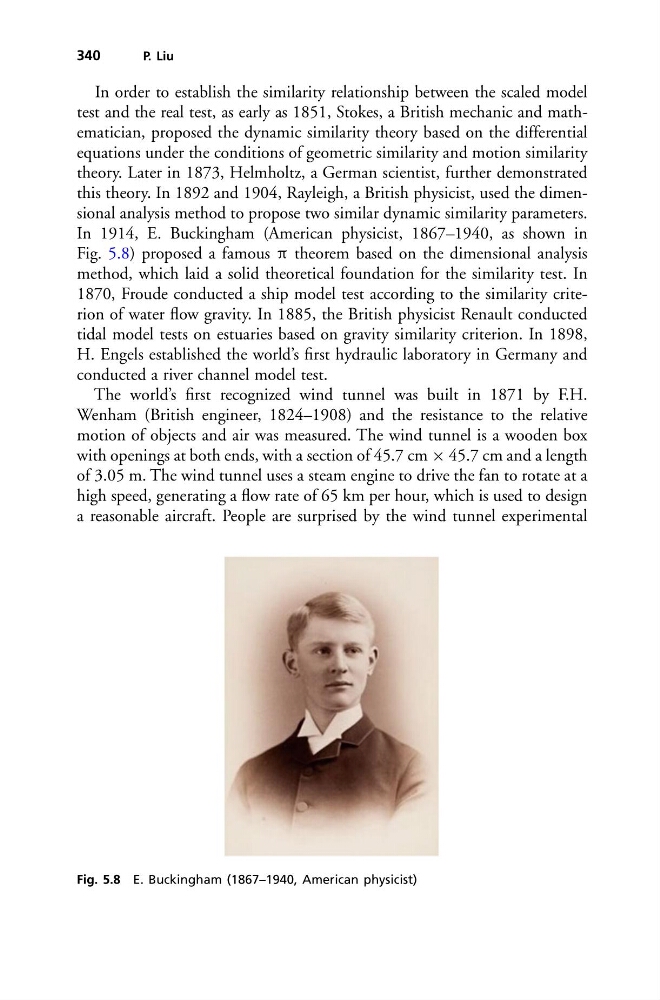
In 1914, E. Buckingham (American physicist, 1867–1940, as shown in
Fig. 5.8) proposed a famous π theorem based on the dimensional analysis
method, which laid a solid theoretical foundation for the similarity test. In
1870, Froude conducted a ship model test according to the similarity criterion of water flow gravity. In 1885, the British physicist Renault conducted
tidal model tests on estuaries based on gravity similarity criterion. In 1898,
H. Engels established the world’s first hydraulic laboratory in Germany and
conducted a river channel model test.
The world’s first recognized wind tunnel was built in 1871 by F.H.
Wenham (British engineer, 1824–1908) and the resistance to the relative
motion of objects and air was measured. The wind tunnel is a wooden box
with openings at both ends, with a section of 45.7 cm × 45.7 cm and a length
of 3.05 m. The wind tunnel uses a steam engine to drive the fan to rotate at a
high speed, generating a flow rate of 65 km per hour, which is used to design
a reasonable aircraft. People are surprised by the wind tunnel experimental
Fig. 5.8 E. Buckingham (1867–1940, American physicist)
P. Liu
In order to establish the similarity relationship between the scaled model
test and the real test, as early as 1851, Stokes, a British mechanic and mathematician, proposed the dynamic similarity theory based on the differential
equations under the conditions of geometric similarity and motion similarity
theory. Later in 1873, Helmholtz, a German scientist, further demonstrated
this theory. In 1892 and 1904, Rayleigh, a British physicist, used the dimensional analysis method to propose two similar dynamic similarity parameters.
In 1914, E. Buckingham (American physicist, 1867–1940, as shown in
Fig. 5.8) proposed a famous π theorem based on the dimensional analysis
method, which laid a solid theoretical foundation for the similarity test. In
1870, Froude conducted a ship model test according to the similarity criterion of water flow gravity. In 1885, the British physicist Renault conducted
tidal model tests on estuaries based on gravity similarity criterion. In 1898,
H. Engels established the world’s first hydraulic laboratory in Germany and
conducted a river channel model test.
The world’s first recognized wind tunnel was built in 1871 by F.H.
Wenham (British engineer, 1824–1908) and the resistance to the relative
motion of objects and air was measured. The wind tunnel is a wooden box
with openings at both ends, with a section of 45.7 cm × 45.7 cm and a length
of 3.05 m. The wind tunnel uses a steam engine to drive the fan to rotate at a
high speed, generating a flow rate of 65 km per hour, which is used to design
a reasonable aircraft. People are surprised by the wind tunnel experimental
Fig. 5.8 E. Buckingham (1867–1940, American physicist)