

338
P. Liu
I was born, everyone knew that there was such a vortex. The first thing I
saw was a picture in Bologna Church, Italy. The picture depicts St. Christopher holding her young Jesus across the river. The painter painted a staggered
vortex behind Christopher’s bare feet.
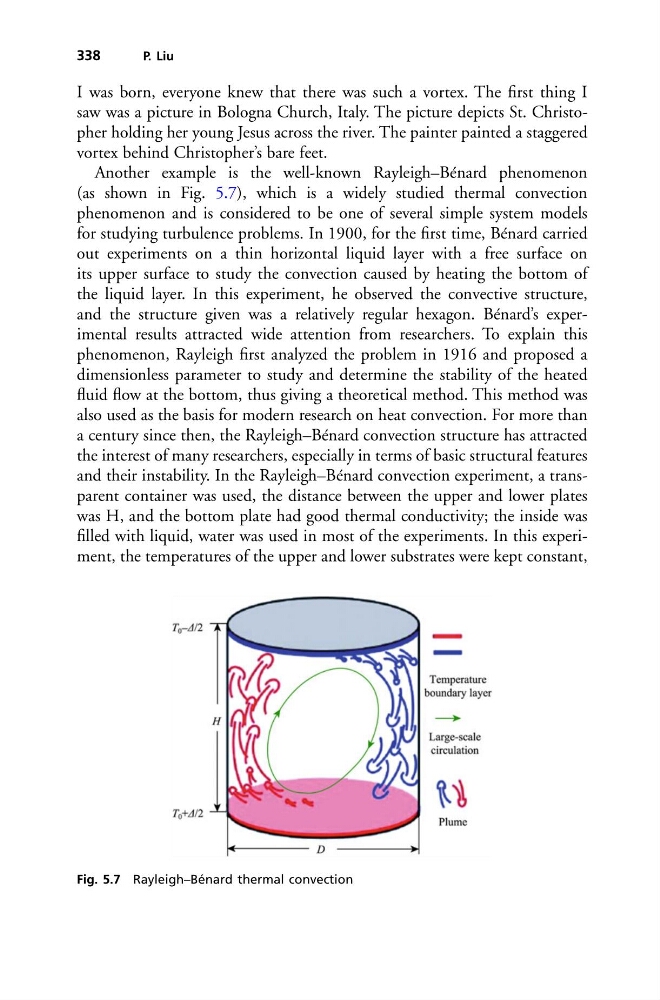
Another example is the well-known Rayleigh–Bénard phenomenon
(as shown in Fig. 5.7), which is a widely studied thermal convection
phenomenon and is considered to be one of several simple system models
for studying turbulence problems. In 1900, for the first time, Bénard carried
out experiments on a thin horizontal liquid layer with a free surface on
its upper surface to study the convection caused by heating the bottom of
the liquid layer. In this experiment, he observed the convective structure,
and the structure given was a relatively regular hexagon. Bénard’s experimental results attracted wide attention from researchers. To explain this
phenomenon, Rayleigh first analyzed the problem in 1916 and proposed a
dimensionless parameter to study and determine the stability of the heated
fluid flow at the bottom, thus giving a theoretical method. This method was
also used as the basis for modern research on heat convection. For more than
a century since then, the Rayleigh–Bénard convection structure has attracted
the interest of many researchers, especially in terms of basic structural features
and their instability. In the Rayleigh–Bénard convection experiment, a transparent container was used, the distance between the upper and lower plates
was H, and the bottom plate had good thermal conductivity; the inside was
filled with liquid, water was used in most of the experiments. In this experiment, the temperatures of the upper and lower substrates were kept constant,
Fig. 5.7 Rayleigh–Bénard thermal convection
P. Liu
I was born, everyone knew that there was such a vortex. The first thing I
saw was a picture in Bologna Church, Italy. The picture depicts St. Christopher holding her young Jesus across the river. The painter painted a staggered
vortex behind Christopher’s bare feet.
Another example is the well-known Rayleigh–Bénard phenomenon
(as shown in Fig. 5.7), which is a widely studied thermal convection
phenomenon and is considered to be one of several simple system models
for studying turbulence problems. In 1900, for the first time, Bénard carried
out experiments on a thin horizontal liquid layer with a free surface on
its upper surface to study the convection caused by heating the bottom of
the liquid layer. In this experiment, he observed the convective structure,
and the structure given was a relatively regular hexagon. Bénard’s experimental results attracted wide attention from researchers. To explain this
phenomenon, Rayleigh first analyzed the problem in 1916 and proposed a
dimensionless parameter to study and determine the stability of the heated
fluid flow at the bottom, thus giving a theoretical method. This method was
also used as the basis for modern research on heat convection. For more than
a century since then, the Rayleigh–Bénard convection structure has attracted
the interest of many researchers, especially in terms of basic structural features
and their instability. In the Rayleigh–Bénard convection experiment, a transparent container was used, the distance between the upper and lower plates
was H, and the bottom plate had good thermal conductivity; the inside was
filled with liquid, water was used in most of the experiments. In this experiment, the temperatures of the upper and lower substrates were kept constant,
Fig. 5.7 Rayleigh–Bénard thermal convection