

336
P. Liu
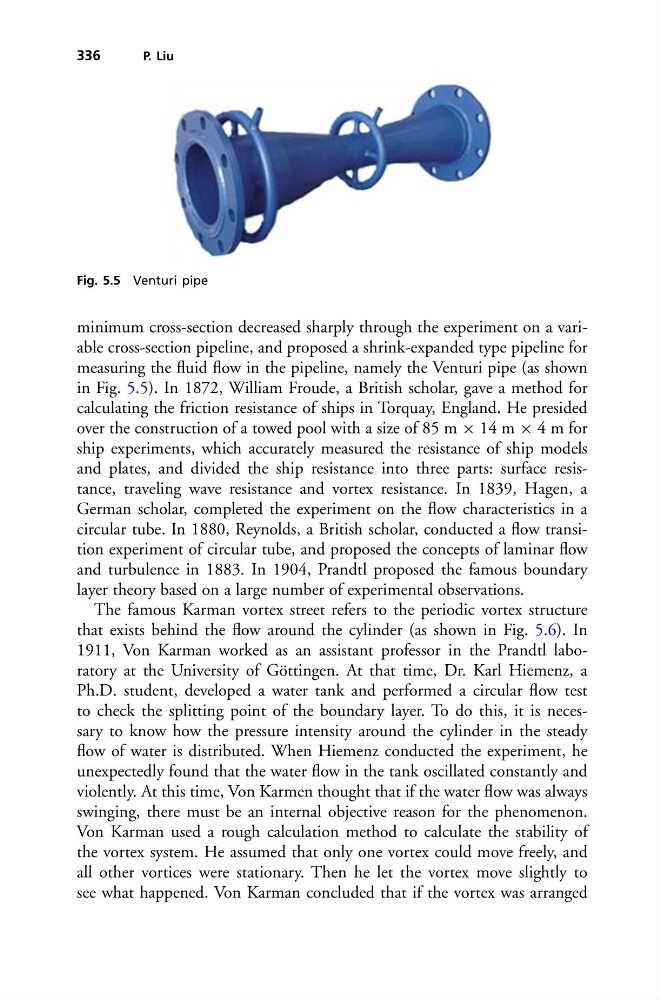
Fig. 5.5 Venturi pipe
minimum cross-section decreased sharply through the experiment on a variable cross-section pipeline, and proposed a shrink-expanded type pipeline for
measuring the fluid flow in the pipeline, namely the Venturi pipe (as shown
in Fig. 5.5). In 1872, William Froude, a British scholar, gave a method for
calculating the friction resistance of ships in Torquay, England. He presided
over the construction of a towed pool with a size of 85 m × 14 m × 4 m for
ship experiments, which accurately measured the resistance of ship models
and plates, and divided the ship resistance into three parts: surface resistance, traveling wave resistance and vortex resistance. In 1839, Hagen, a
German scholar, completed the experiment on the flow characteristics in a
circular tube. In 1880, Reynolds, a British scholar, conducted a flow transition experiment of circular tube, and proposed the concepts of laminar flow
and turbulence in 1883. In 1904, Prandtl proposed the famous boundary
layer theory based on a large number of experimental observations.
The famous Karman vortex street refers to the periodic vortex structure
that exists behind the flow around the cylinder (as shown in Fig. 5.6). In
1911, Von Karman worked as an assistant professor in the Prandtl laboratory at the University of Göttingen. At that time, Dr. Karl Hiemenz, a
Ph.D. student, developed a water tank and performed a circular flow test
to check the splitting point of the boundary layer. To do this, it is necessary to know how the pressure intensity around the cylinder in the steady
flow of water is distributed. When Hiemenz conducted the experiment, he
unexpectedly found that the water flow in the tank oscillated constantly and
violently. At this time, Von Karmen thought that if the water flow was always
swinging, there must be an internal objective reason for the phenomenon.
Von Karman used a rough calculation method to calculate the stability of
the vortex system. He assumed that only one vortex could move freely, and
all other vortices were stationary. Then he let the vortex move slightly to
see what happened. Von Karman concluded that if the vortex was arranged
P. Liu
Fig. 5.5 Venturi pipe
minimum cross-section decreased sharply through the experiment on a variable cross-section pipeline, and proposed a shrink-expanded type pipeline for
measuring the fluid flow in the pipeline, namely the Venturi pipe (as shown
in Fig. 5.5). In 1872, William Froude, a British scholar, gave a method for
calculating the friction resistance of ships in Torquay, England. He presided
over the construction of a towed pool with a size of 85 m × 14 m × 4 m for
ship experiments, which accurately measured the resistance of ship models
and plates, and divided the ship resistance into three parts: surface resistance, traveling wave resistance and vortex resistance. In 1839, Hagen, a
German scholar, completed the experiment on the flow characteristics in a
circular tube. In 1880, Reynolds, a British scholar, conducted a flow transition experiment of circular tube, and proposed the concepts of laminar flow
and turbulence in 1883. In 1904, Prandtl proposed the famous boundary
layer theory based on a large number of experimental observations.
The famous Karman vortex street refers to the periodic vortex structure
that exists behind the flow around the cylinder (as shown in Fig. 5.6). In
1911, Von Karman worked as an assistant professor in the Prandtl laboratory at the University of Göttingen. At that time, Dr. Karl Hiemenz, a
Ph.D. student, developed a water tank and performed a circular flow test
to check the splitting point of the boundary layer. To do this, it is necessary to know how the pressure intensity around the cylinder in the steady
flow of water is distributed. When Hiemenz conducted the experiment, he
unexpectedly found that the water flow in the tank oscillated constantly and
violently. At this time, Von Karmen thought that if the water flow was always
swinging, there must be an internal objective reason for the phenomenon.
Von Karman used a rough calculation method to calculate the stability of
the vortex system. He assumed that only one vortex could move freely, and
all other vortices were stationary. Then he let the vortex move slightly to
see what happened. Von Karman concluded that if the vortex was arranged