

4 Computational Fluid Dynamics
323
finite volume method very convenient for mesh generation. The finite volume
can be divided into structural grid or unstructured grid. Structural grid is
easy to construct high-precision discrete equations; unstructured grid is easy
to generate, has strong applicability. The combination of these two types of
grid can be also used in the simulation. Because the simulation condition is
low-speed flow, the numerical simulation employs the incompressible flow to
calculate. The whole wind tunnel computational domain is closed, the whole
flow is static at the outset, and the boundary condition is that the fan blades
rotate at the design speed.
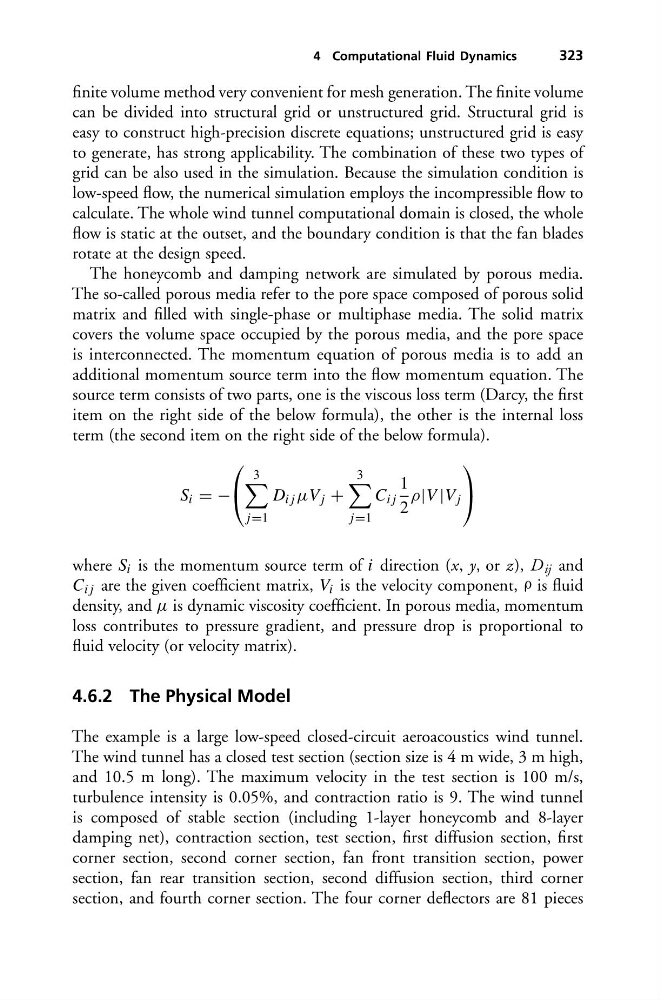
The honeycomb and damping network are simulated by porous media.
The so-called porous media refer to the pore space composed of porous solid
matrix and filled with single-phase or multiphase media. The solid matrix
covers the volume space occupied by the porous media, and the pore space
is interconnected. The momentum equation of porous media is to add an
additional momentum source term into the flow momentum equation. The
source term consists of two parts, one is the viscous loss term (Darcy, the first
item on the right side of the below formula), the other is the internal loss
term (the second item on the right side of the below formula).
S i = −
⎛
⎝
3
j=1
D i j μV j +
3
j=1
C i j
1
2
ρ|V |V j
⎞
⎠
where S i is the momentum source term of i direction (x, y, or z ), D ij and
C i j are the given coefficient matrix, V i is the velocity component, ρ is fluid
density, and μ is dynamic viscosity coefficient. In porous media, momentum
loss contributes to pressure gradient, and pressure drop is proportional to
fluid velocity (or velocity matrix).
4.6.2 The Physical Model
The example is a large low-speed closed-circuit aeroacoustics wind tunnel.
The wind tunnel has a closed test section (section size is 4 m wide, 3 m high,
and 10.5 m long). The maximum velocity in the test section is 100 m/s,
turbulence intensity is 0.05%, and contraction ratio is 9. The wind tunnel
is composed of stable section (including 1-layer honeycomb and 8-layer
damping net), contraction section, test section, first diffusion section, first
corner section, second corner section, fan front transition section, power
section, fan rear transition section, second diffusion section, third corner
section, and fourth corner section. The four corner deflectors are 81 pieces
323
finite volume method very convenient for mesh generation. The finite volume
can be divided into structural grid or unstructured grid. Structural grid is
easy to construct high-precision discrete equations; unstructured grid is easy
to generate, has strong applicability. The combination of these two types of
grid can be also used in the simulation. Because the simulation condition is
low-speed flow, the numerical simulation employs the incompressible flow to
calculate. The whole wind tunnel computational domain is closed, the whole
flow is static at the outset, and the boundary condition is that the fan blades
rotate at the design speed.
The honeycomb and damping network are simulated by porous media.
The so-called porous media refer to the pore space composed of porous solid
matrix and filled with single-phase or multiphase media. The solid matrix
covers the volume space occupied by the porous media, and the pore space
is interconnected. The momentum equation of porous media is to add an
additional momentum source term into the flow momentum equation. The
source term consists of two parts, one is the viscous loss term (Darcy, the first
item on the right side of the below formula), the other is the internal loss
term (the second item on the right side of the below formula).
S i = −
⎛
⎝
3
j=1
D i j μV j +
3
j=1
C i j
1
2
ρ|V |V j
⎞
⎠
where S i is the momentum source term of i direction (x, y, or z ), D ij and
C i j are the given coefficient matrix, V i is the velocity component, ρ is fluid
density, and μ is dynamic viscosity coefficient. In porous media, momentum
loss contributes to pressure gradient, and pressure drop is proportional to
fluid velocity (or velocity matrix).
4.6.2 The Physical Model
The example is a large low-speed closed-circuit aeroacoustics wind tunnel.
The wind tunnel has a closed test section (section size is 4 m wide, 3 m high,
and 10.5 m long). The maximum velocity in the test section is 100 m/s,
turbulence intensity is 0.05%, and contraction ratio is 9. The wind tunnel
is composed of stable section (including 1-layer honeycomb and 8-layer
damping net), contraction section, test section, first diffusion section, first
corner section, second corner section, fan front transition section, power
section, fan rear transition section, second diffusion section, third corner
section, and fourth corner section. The four corner deflectors are 81 pieces