

278
P. Liu
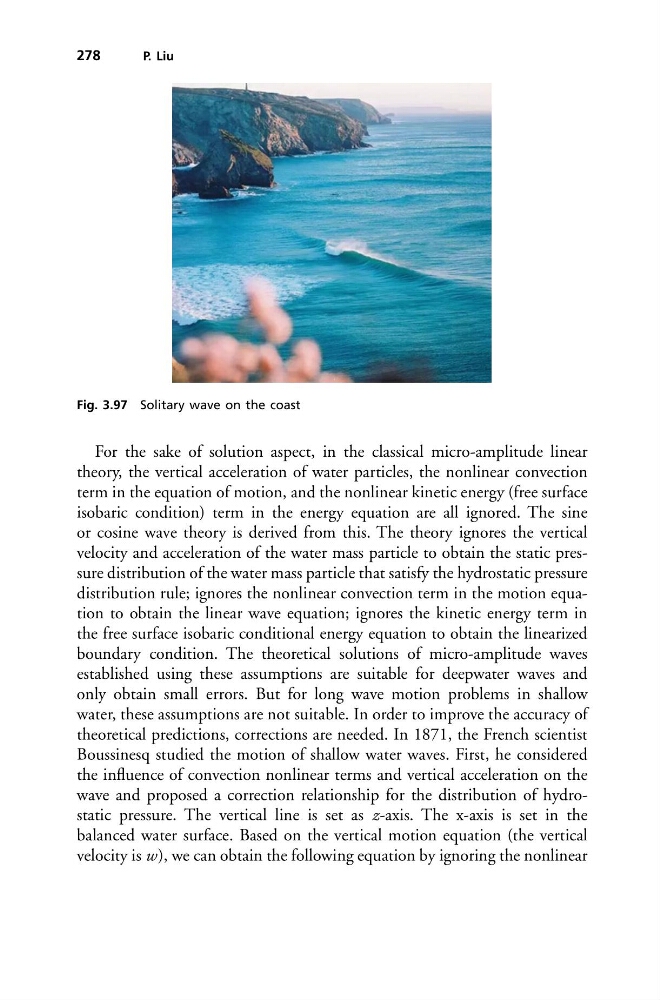
Fig. 3.97 Solitary wave on the coast
For the sake of solution aspect, in the classical micro-amplitude linear
theory, the vertical acceleration of water particles, the nonlinear convection
term in the equation of motion, and the nonlinear kinetic energy (free surface
isobaric condition) term in the energy equation are all ignored. The sine
or cosine wave theory is derived from this. The theory ignores the vertical
velocity and acceleration of the water mass particle to obtain the static pressure distribution of the water mass particle that satisfy the hydrostatic pressure
distribution rule; ignores the nonlinear convection term in the motion equation to obtain the linear wave equation; ignores the kinetic energy term in
the free surface isobaric conditional energy equation to obtain the linearized
boundary condition. The theoretical solutions of micro-amplitude waves
established using these assumptions are suitable for deepwater waves and
only obtain small errors. But for long wave motion problems in shallow
water, these assumptions are not suitable. In order to improve the accuracy of
theoretical predictions, corrections are needed. In 1871, the French scientist
Boussinesq studied the motion of shallow water waves. First, he considered
the influence of convection nonlinear terms and vertical acceleration on the
wave and proposed a correction relationship for the distribution of hydrostatic pressure. The vertical line is set as z-axis. The x-axis is set in the
balanced water surface. Based on the vertical motion equation (the vertical
velocity is w), we can obtain the following equation by ignoring the nonlinear
P. Liu
Fig. 3.97 Solitary wave on the coast
For the sake of solution aspect, in the classical micro-amplitude linear
theory, the vertical acceleration of water particles, the nonlinear convection
term in the equation of motion, and the nonlinear kinetic energy (free surface
isobaric condition) term in the energy equation are all ignored. The sine
or cosine wave theory is derived from this. The theory ignores the vertical
velocity and acceleration of the water mass particle to obtain the static pressure distribution of the water mass particle that satisfy the hydrostatic pressure
distribution rule; ignores the nonlinear convection term in the motion equation to obtain the linear wave equation; ignores the kinetic energy term in
the free surface isobaric conditional energy equation to obtain the linearized
boundary condition. The theoretical solutions of micro-amplitude waves
established using these assumptions are suitable for deepwater waves and
only obtain small errors. But for long wave motion problems in shallow
water, these assumptions are not suitable. In order to improve the accuracy of
theoretical predictions, corrections are needed. In 1871, the French scientist
Boussinesq studied the motion of shallow water waves. First, he considered
the influence of convection nonlinear terms and vertical acceleration on the
wave and proposed a correction relationship for the distribution of hydrostatic pressure. The vertical line is set as z-axis. The x-axis is set in the
balanced water surface. Based on the vertical motion equation (the vertical
velocity is w), we can obtain the following equation by ignoring the nonlinear