

3 Hydrodynamics
277
Fig. 3.95 Solitary wave in the river
body of water pushed by the ship did not stop, but formed a smooth and a
well-defined large water bag with a height of about 0.3 to 0.5 m, a length of
about 1 m, and spread forward along the river at a speed of about 13 km per
hour. When Russell tracked the water bag along the canal, he found that its
size, shape, and speed changed slowly. It did not disappear on the river until
3 to 4 km. Later, Russell conducted a large number of tank tests and called
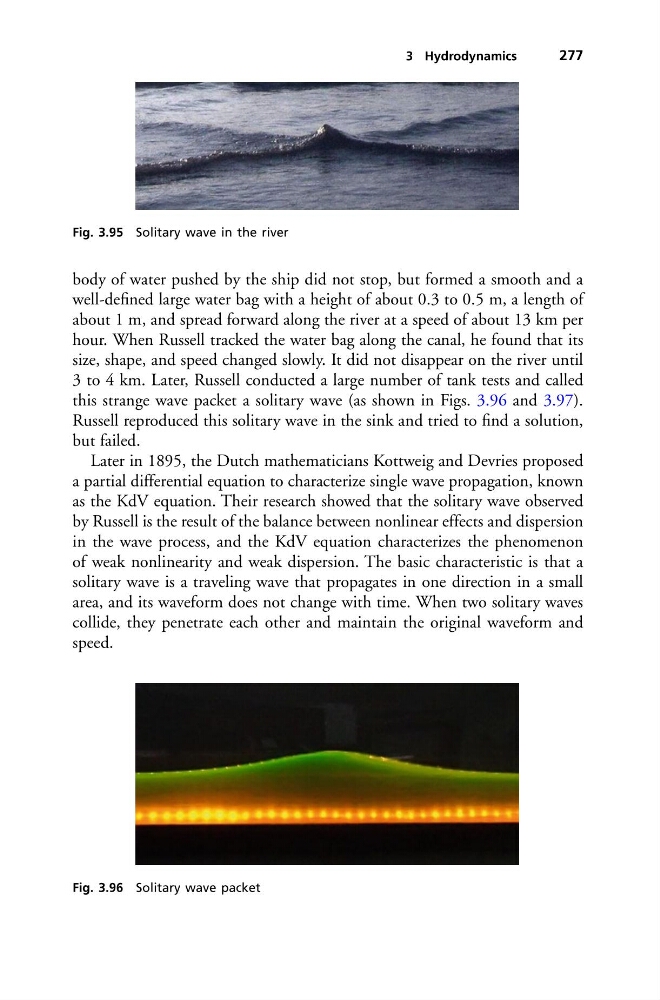
this strange wave packet a solitary wave (as shown in Figs. 3.96 and 3.97).
Russell reproduced this solitary wave in the sink and tried to find a solution,
but failed.
Later in 1895, the Dutch mathematicians Kottweig and Devries proposed
a partial differential equation to characterize single wave propagation, known
as the KdV equation. Their research showed that the solitary wave observed
by Russell is the result of the balance between nonlinear effects and dispersion
in the wave process, and the KdV equation characterizes the phenomenon
of weak nonlinearity and weak dispersion. The basic characteristic is that a
solitary wave is a traveling wave that propagates in one direction in a small
area, and its waveform does not change with time. When two solitary waves
collide, they penetrate each other and maintain the original waveform and
speed.
Fig. 3.96 Solitary wave packet
277
Fig. 3.95 Solitary wave in the river
body of water pushed by the ship did not stop, but formed a smooth and a
well-defined large water bag with a height of about 0.3 to 0.5 m, a length of
about 1 m, and spread forward along the river at a speed of about 13 km per
hour. When Russell tracked the water bag along the canal, he found that its
size, shape, and speed changed slowly. It did not disappear on the river until
3 to 4 km. Later, Russell conducted a large number of tank tests and called
this strange wave packet a solitary wave (as shown in Figs. 3.96 and 3.97).
Russell reproduced this solitary wave in the sink and tried to find a solution,
but failed.
Later in 1895, the Dutch mathematicians Kottweig and Devries proposed
a partial differential equation to characterize single wave propagation, known
as the KdV equation. Their research showed that the solitary wave observed
by Russell is the result of the balance between nonlinear effects and dispersion
in the wave process, and the KdV equation characterizes the phenomenon
of weak nonlinearity and weak dispersion. The basic characteristic is that a
solitary wave is a traveling wave that propagates in one direction in a small
area, and its waveform does not change with time. When two solitary waves
collide, they penetrate each other and maintain the original waveform and
speed.
Fig. 3.96 Solitary wave packet