

3 Hydrodynamics
273
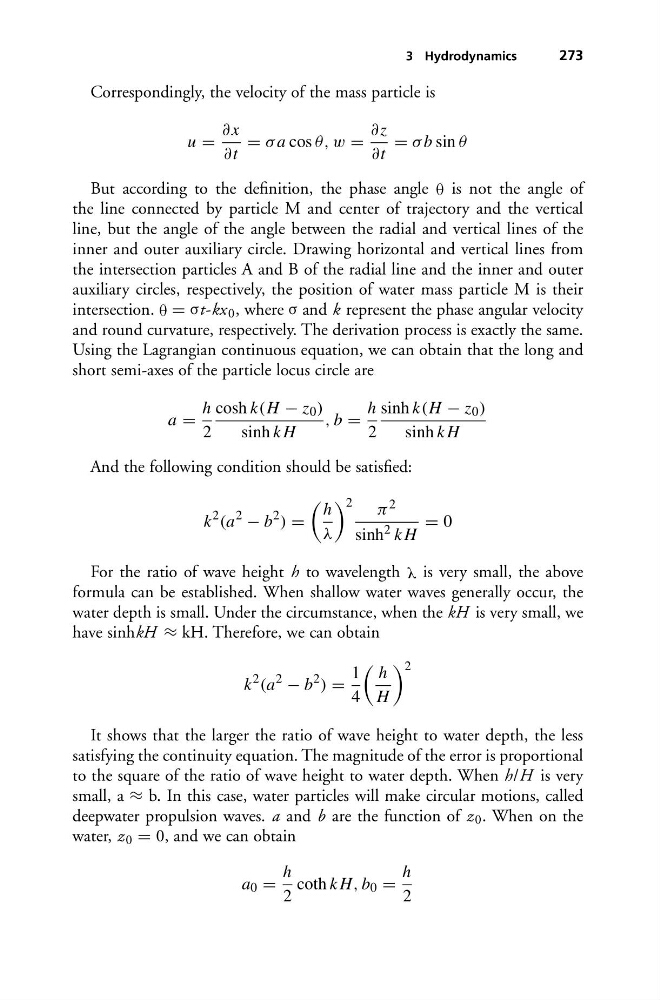
Correspondingly, the velocity of the mass particle is
u =
∂ x
∂t
= σ a cos θ, w =
∂z
∂t
= σ b sin θ
But according to the definition, the phase angle θ is not the angle of
the line connected by particle M and center of trajectory and the vertical
line, but the angle of the angle between the radial and vertical lines of the
inner and outer auxiliary circle. Drawing horizontal and vertical lines from
the intersection particles A and B of the radial line and the inner and outer
auxiliary circles, respectively, the position of water mass particle M is their
intersection. θ = σt-kx 0 , where σ and k represent the phase angular velocity
and round curvature, respectively. The derivation process is exactly the same.
Using the Lagrangian continuous equation, we can obtain that the long and
short semi-axes of the particle locus circle are
a =
h
2
cosh k(H − z 0 )
sinh k H
, b =
h
2
sinh k(H − z 0 )
sinh k H
And the following condition should be satisfied:
k
2
(a
2
− b
2
) =
h
λ
2 π 2
sinh 2 k H
= 0
For the ratio of wave height h to wavelength λ is very small, the above
formula can be established. When shallow water waves generally occur, the
water depth is small. Under the circumstance, when the kH is very small, we
have sinhkH ≈ kH. Therefore, we can obtain
k
2
(a
2
− b
2
) =
1
4
h
H
2
It shows that the larger the ratio of wave height to water depth, the less
satisfying the continuity equation. The magnitude of the error is proportional
to the square of the ratio of wave height to water depth. When h/H is very
small, a ≈ b. In this case, water particles will make circular motions, called
deepwater propulsion waves. a and b are the function of z 0 . When on the
water, z 0 = 0, and we can obtain
a 0 =
h
2
coth k H, b 0 =
h
2
273
Correspondingly, the velocity of the mass particle is
u =
∂ x
∂t
= σ a cos θ, w =
∂z
∂t
= σ b sin θ
But according to the definition, the phase angle θ is not the angle of
the line connected by particle M and center of trajectory and the vertical
line, but the angle of the angle between the radial and vertical lines of the
inner and outer auxiliary circle. Drawing horizontal and vertical lines from
the intersection particles A and B of the radial line and the inner and outer
auxiliary circles, respectively, the position of water mass particle M is their
intersection. θ = σt-kx 0 , where σ and k represent the phase angular velocity
and round curvature, respectively. The derivation process is exactly the same.
Using the Lagrangian continuous equation, we can obtain that the long and
short semi-axes of the particle locus circle are
a =
h
2
cosh k(H − z 0 )
sinh k H
, b =
h
2
sinh k(H − z 0 )
sinh k H
And the following condition should be satisfied:
k
2
(a
2
− b
2
) =
h
λ
2 π 2
sinh 2 k H
= 0
For the ratio of wave height h to wavelength λ is very small, the above
formula can be established. When shallow water waves generally occur, the
water depth is small. Under the circumstance, when the kH is very small, we
have sinhkH ≈ kH. Therefore, we can obtain
k
2
(a
2
− b
2
) =
1
4
h
H
2
It shows that the larger the ratio of wave height to water depth, the less
satisfying the continuity equation. The magnitude of the error is proportional
to the square of the ratio of wave height to water depth. When h/H is very
small, a ≈ b. In this case, water particles will make circular motions, called
deepwater propulsion waves. a and b are the function of z 0 . When on the
water, z 0 = 0, and we can obtain
a 0 =
h
2
coth k H, b 0 =
h
2