

272
P. Liu
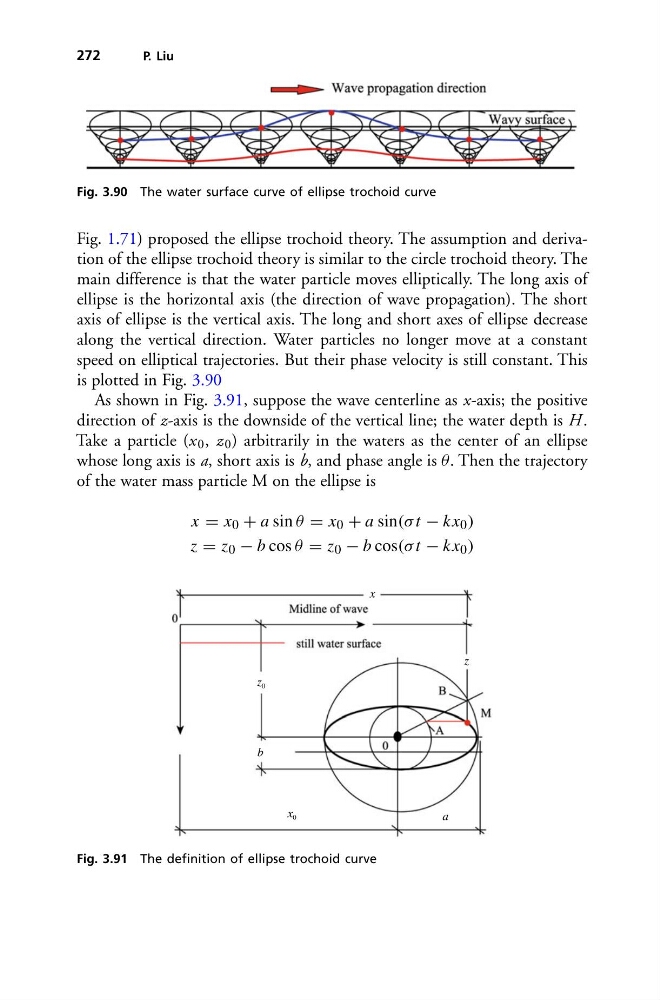
Fig. 3.90 The water surface curve of ellipse trochoid curve
Fig. 1.71) proposed the ellipse trochoid theory. The assumption and derivation of the ellipse trochoid theory is similar to the circle trochoid theory. The
main difference is that the water particle moves elliptically. The long axis of
ellipse is the horizontal axis (the direction of wave propagation). The short
axis of ellipse is the vertical axis. The long and short axes of ellipse decrease
along the vertical direction. Water particles no longer move at a constant
speed on elliptical trajectories. But their phase velocity is still constant. This
is plotted in Fig. 3.90
As shown in Fig. 3.91, suppose the wave centerline as x-axis; the positive
direction of z-axis is the downside of the vertical line; the water depth is H .
Take a particle (x 0 , z 0 ) arbitrarily in the waters as the center of an ellipse
whose long axis is a, short axis is b, and phase angle is θ. Then the trajectory
of the water mass particle M on the ellipse is
x = x 0 + a sin θ = x 0 + a sin(σ t − kx 0 )
z = z 0 − b cos θ = z 0 − b cos(σ t − kx 0 )
z 0
b
x
z
a
x 0
Fig. 3.91 The definition of ellipse trochoid curve
P. Liu
Fig. 3.90 The water surface curve of ellipse trochoid curve
Fig. 1.71) proposed the ellipse trochoid theory. The assumption and derivation of the ellipse trochoid theory is similar to the circle trochoid theory. The
main difference is that the water particle moves elliptically. The long axis of
ellipse is the horizontal axis (the direction of wave propagation). The short
axis of ellipse is the vertical axis. The long and short axes of ellipse decrease
along the vertical direction. Water particles no longer move at a constant
speed on elliptical trajectories. But their phase velocity is still constant. This
is plotted in Fig. 3.90
As shown in Fig. 3.91, suppose the wave centerline as x-axis; the positive
direction of z-axis is the downside of the vertical line; the water depth is H .
Take a particle (x 0 , z 0 ) arbitrarily in the waters as the center of an ellipse
whose long axis is a, short axis is b, and phase angle is θ. Then the trajectory
of the water mass particle M on the ellipse is
x = x 0 + a sin θ = x 0 + a sin(σ t − kx 0 )
z = z 0 − b cos θ = z 0 − b cos(σ t − kx 0 )
z 0
b
x
z
a
x 0
Fig. 3.91 The definition of ellipse trochoid curve