

262
P. Liu
dz
dt
= w =
∂ϕ
∂z
=
h
2
gk
ω
sinh k(z + H )
cosh k H
sin(kx − ωt)
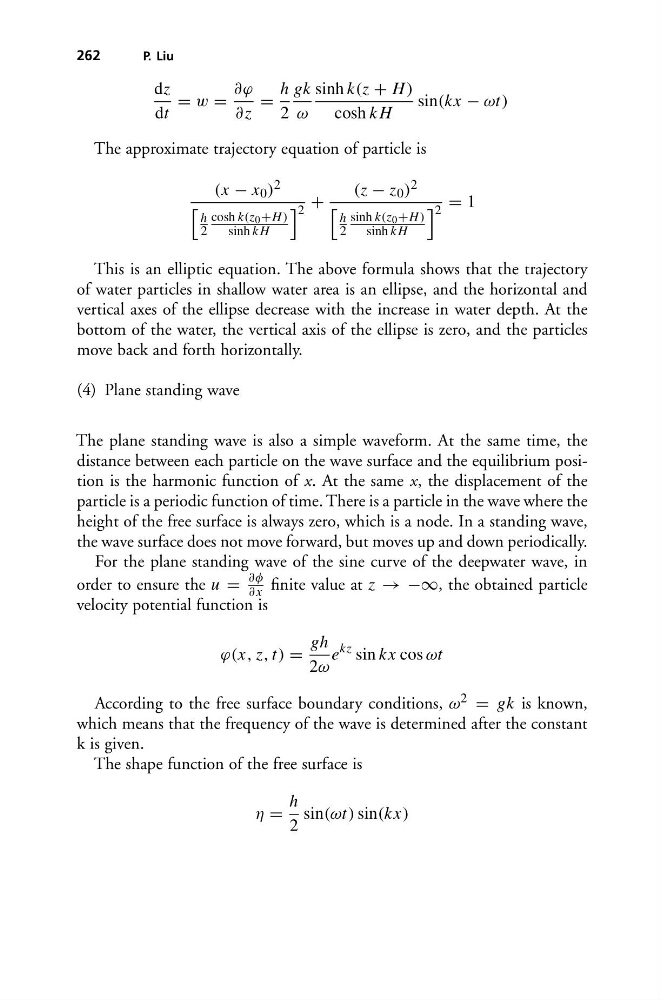
The approximate trajectory equation of particle is
(x − x 0 ) 2
h
2
cosh k(z 0 +H )
sinh k H
2 +
(z − z 0 ) 2
h
2
sinh k(z 0 +H )
sinh k H
2 = 1
This is an elliptic equation. The above formula shows that the trajectory
of water particles in shallow water area is an ellipse, and the horizontal and
vertical axes of the ellipse decrease with the increase in water depth. At the
bottom of the water, the vertical axis of the ellipse is zero, and the particles
move back and forth horizontally.
(4) Plane standing wave
The plane standing wave is also a simple waveform. At the same time, the
distance between each particle on the wave surface and the equilibrium position is the harmonic function of x. At the same x, the displacement of the
particle is a periodic function of time. There is a particle in the wave where the
height of the free surface is always zero, which is a node. In a standing wave,
the wave surface does not move forward, but moves up and down periodically.
For the plane standing wave of the sine curve of the deepwater wave, in
order to ensure the u =
∂φ
∂ x finite value at z → −∞, the obtained particle
velocity potential function is
ϕ(x, z, t) =
gh
2ω
e
kz sin kx cos ωt
According to the free surface boundary conditions, ω 2 = gk is known,
which means that the frequency of the wave is determined after the constant
k is given.
The shape function of the free surface is
η =
h
2
sin(ωt) sin(kx)
P. Liu
dz
dt
= w =
∂ϕ
∂z
=
h
2
gk
ω
sinh k(z + H )
cosh k H
sin(kx − ωt)
The approximate trajectory equation of particle is
(x − x 0 ) 2
h
2
cosh k(z 0 +H )
sinh k H
2 +
(z − z 0 ) 2
h
2
sinh k(z 0 +H )
sinh k H
2 = 1
This is an elliptic equation. The above formula shows that the trajectory
of water particles in shallow water area is an ellipse, and the horizontal and
vertical axes of the ellipse decrease with the increase in water depth. At the
bottom of the water, the vertical axis of the ellipse is zero, and the particles
move back and forth horizontally.
(4) Plane standing wave
The plane standing wave is also a simple waveform. At the same time, the
distance between each particle on the wave surface and the equilibrium position is the harmonic function of x. At the same x, the displacement of the
particle is a periodic function of time. There is a particle in the wave where the
height of the free surface is always zero, which is a node. In a standing wave,
the wave surface does not move forward, but moves up and down periodically.
For the plane standing wave of the sine curve of the deepwater wave, in
order to ensure the u =
∂φ
∂ x finite value at z → −∞, the obtained particle
velocity potential function is
ϕ(x, z, t) =
gh
2ω
e
kz sin kx cos ωt
According to the free surface boundary conditions, ω 2 = gk is known,
which means that the frequency of the wave is determined after the constant
k is given.
The shape function of the free surface is
η =
h
2
sin(ωt) sin(kx)