

3 Hydrodynamics
261
This formula indicates that the trajectory of the water particle in the deepwater area is a circle with the equilibrium position as the center and the
radius. The radius on the free surface is h/2. When the progressive wave propagates in a forward direction, each particle moves in a clockwise direction in
a circular motion. Because the radius is the amplitude and velocity of particle
fluctuations decay in the water depth direction by exponent e. The deeper
the free surface, the smaller the particle velocity and amplitude.
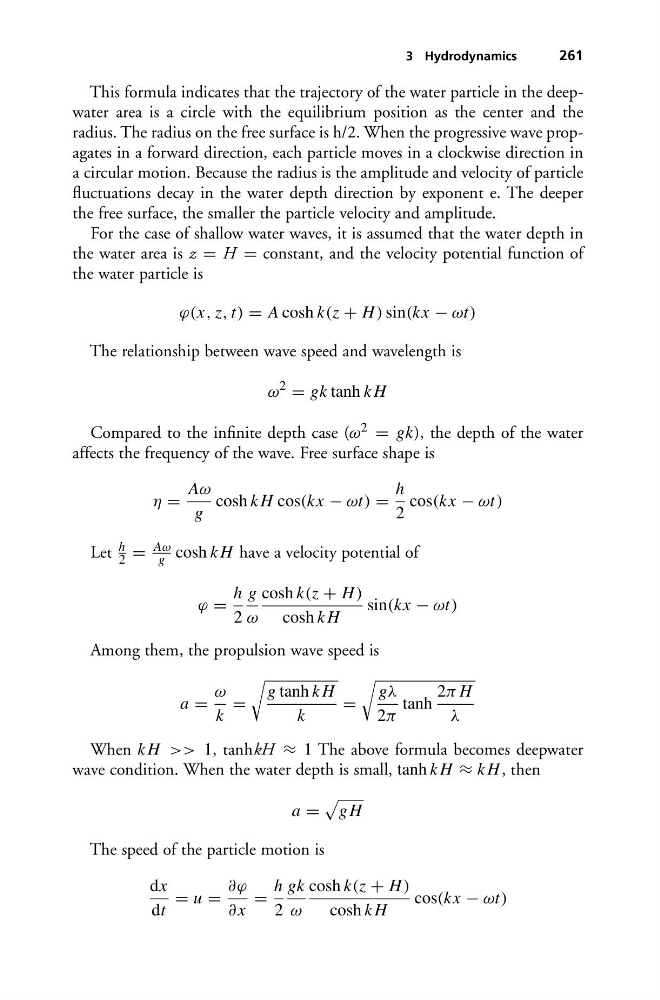
For the case of shallow water waves, it is assumed that the water depth in
the water area is z = H = constant, and the velocity potential function of
the water particle is
ϕ(x, z, t) = A cosh k(z + H ) sin(kx − ωt)
The relationship between wave speed and wavelength is
ω
2
= gk tanh k H
Compared to the infinite depth case (ω 2 = gk), the depth of the water
affects the frequency of the wave. Free surface shape is
η =
Aω
g
cosh k H cos(kx − ωt) =
h
2
cos(kx − ωt)
Let
h
2 =
Aω
g cosh k H have a velocity potential of
ϕ =
h
2
g
ω
cosh k(z + H )
cosh k H
sin(kx − ωt)
Among them, the propulsion wave speed is
a =
ω
k
=
g tanh k H
k
=
gλ
2π
tanh
2π H
λ
When k H >> 1, tanhkH ≈ 1 The above formula becomes deepwater
wave condition. When the water depth is small, tanh k H ≈ k H, then
a =
g H
The speed of the particle motion is
dx
dt
= u =
∂ϕ
∂ x
=
h
2
gk
ω
cosh k(z + H )
cosh k H
cos(kx − ωt)
261
This formula indicates that the trajectory of the water particle in the deepwater area is a circle with the equilibrium position as the center and the
radius. The radius on the free surface is h/2. When the progressive wave propagates in a forward direction, each particle moves in a clockwise direction in
a circular motion. Because the radius is the amplitude and velocity of particle
fluctuations decay in the water depth direction by exponent e. The deeper
the free surface, the smaller the particle velocity and amplitude.
For the case of shallow water waves, it is assumed that the water depth in
the water area is z = H = constant, and the velocity potential function of
the water particle is
ϕ(x, z, t) = A cosh k(z + H ) sin(kx − ωt)
The relationship between wave speed and wavelength is
ω
2
= gk tanh k H
Compared to the infinite depth case (ω 2 = gk), the depth of the water
affects the frequency of the wave. Free surface shape is
η =
Aω
g
cosh k H cos(kx − ωt) =
h
2
cos(kx − ωt)
Let
h
2 =
Aω
g cosh k H have a velocity potential of
ϕ =
h
2
g
ω
cosh k(z + H )
cosh k H
sin(kx − ωt)
Among them, the propulsion wave speed is
a =
ω
k
=
g tanh k H
k
=
gλ
2π
tanh
2π H
λ
When k H >> 1, tanhkH ≈ 1 The above formula becomes deepwater
wave condition. When the water depth is small, tanh k H ≈ k H, then
a =
g H
The speed of the particle motion is
dx
dt
= u =
∂ϕ
∂ x
=
h
2
gk
ω
cosh k(z + H )
cosh k H
cos(kx − ωt)