

242
P. Liu
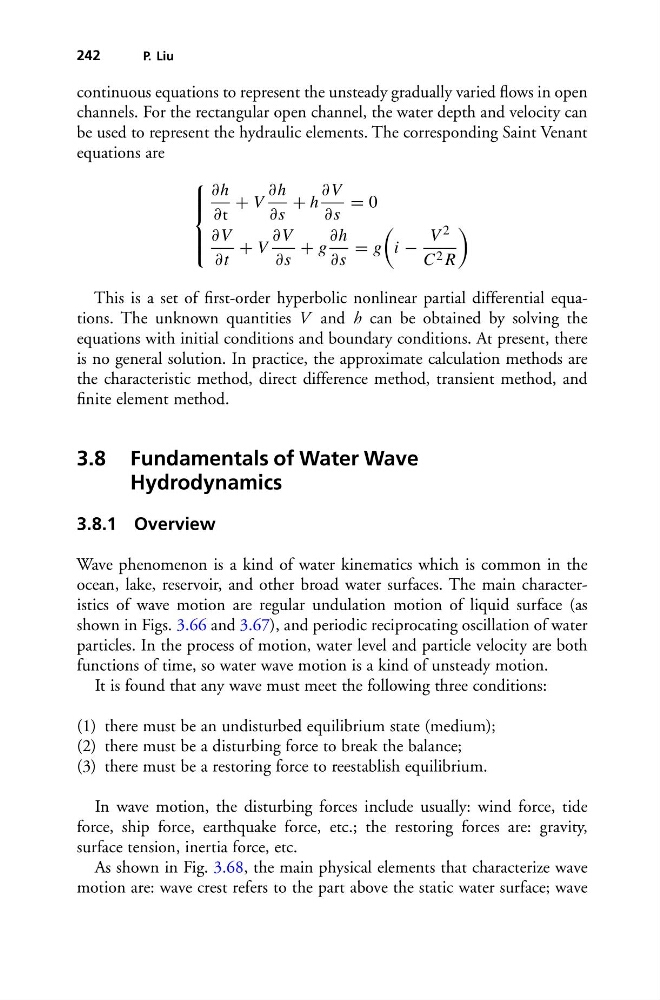
continuous equations to represent the unsteady gradually varied flows in open
channels. For the rectangular open channel, the water depth and velocity can
be used to represent the hydraulic elements. The corresponding Saint Venant
equations are
⎧
⎪ ⎪ ⎨
⎪ ⎪ ⎩
∂h
∂t
+ V
∂h
∂s
+ h
∂ V
∂s
= 0
∂ V
∂t
+ V
∂ V
∂s
+ g
∂h
∂s
= g
i −
V 2
C 2 R
This is a set of first-order hyperbolic nonlinear partial differential equations. The unknown quantities V and h can be obtained by solving the
equations with initial conditions and boundary conditions. At present, there
is no general solution. In practice, the approximate calculation methods are
the characteristic method, direct difference method, transient method, and
finite element method.
3.8 Fundamentals of Water Wave
Hydrodynamics
3.8.1 Overview
Wave phenomenon is a kind of water kinematics which is common in the
ocean, lake, reservoir, and other broad water surfaces. The main characteristics of wave motion are regular undulation motion of liquid surface (as
shown in Figs. 3.66 and 3.67), and periodic reciprocating oscillation of water
particles. In the process of motion, water level and particle velocity are both
functions of time, so water wave motion is a kind of unsteady motion.
It is found that any wave must meet the following three conditions:
(1) there must be an undisturbed equilibrium state (medium);
(2) there must be a disturbing force to break the balance;
(3) there must be a restoring force to reestablish equilibrium.
In wave motion, the disturbing forces include usually: wind force, tide
force, ship force, earthquake force, etc.; the restoring forces are: gravity,
surface tension, inertia force, etc.
As shown in Fig. 3.68, the main physical elements that characterize wave
motion are: wave crest refers to the part above the static water surface; wave
P. Liu
continuous equations to represent the unsteady gradually varied flows in open
channels. For the rectangular open channel, the water depth and velocity can
be used to represent the hydraulic elements. The corresponding Saint Venant
equations are
⎧
⎪ ⎪ ⎨
⎪ ⎪ ⎩
∂h
∂t
+ V
∂h
∂s
+ h
∂ V
∂s
= 0
∂ V
∂t
+ V
∂ V
∂s
+ g
∂h
∂s
= g
i −
V 2
C 2 R
This is a set of first-order hyperbolic nonlinear partial differential equations. The unknown quantities V and h can be obtained by solving the
equations with initial conditions and boundary conditions. At present, there
is no general solution. In practice, the approximate calculation methods are
the characteristic method, direct difference method, transient method, and
finite element method.
3.8 Fundamentals of Water Wave
Hydrodynamics
3.8.1 Overview
Wave phenomenon is a kind of water kinematics which is common in the
ocean, lake, reservoir, and other broad water surfaces. The main characteristics of wave motion are regular undulation motion of liquid surface (as
shown in Figs. 3.66 and 3.67), and periodic reciprocating oscillation of water
particles. In the process of motion, water level and particle velocity are both
functions of time, so water wave motion is a kind of unsteady motion.
It is found that any wave must meet the following three conditions:
(1) there must be an undisturbed equilibrium state (medium);
(2) there must be a disturbing force to break the balance;
(3) there must be a restoring force to reestablish equilibrium.
In wave motion, the disturbing forces include usually: wind force, tide
force, ship force, earthquake force, etc.; the restoring forces are: gravity,
surface tension, inertia force, etc.
As shown in Fig. 3.68, the main physical elements that characterize wave
motion are: wave crest refers to the part above the static water surface; wave