

3 Hydrodynamics
221
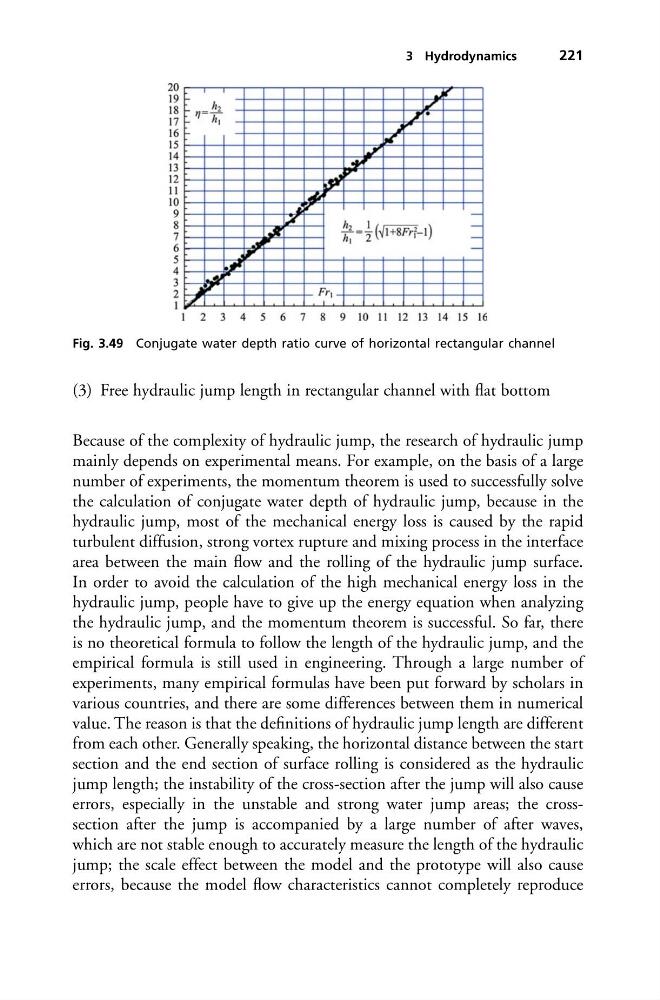
Fig. 3.49 Conjugate water depth ratio curve of horizontal rectangular channel
(3) Free hydraulic jump length in rectangular channel with flat bottom
Because of the complexity of hydraulic jump, the research of hydraulic jump
mainly depends on experimental means. For example, on the basis of a large
number of experiments, the momentum theorem is used to successfully solve
the calculation of conjugate water depth of hydraulic jump, because in the
hydraulic jump, most of the mechanical energy loss is caused by the rapid
turbulent diffusion, strong vortex rupture and mixing process in the interface
area between the main flow and the rolling of the hydraulic jump surface.
In order to avoid the calculation of the high mechanical energy loss in the
hydraulic jump, people have to give up the energy equation when analyzing
the hydraulic jump, and the momentum theorem is successful. So far, there
is no theoretical formula to follow the length of the hydraulic jump, and the
empirical formula is still used in engineering. Through a large number of
experiments, many empirical formulas have been put forward by scholars in
various countries, and there are some differences between them in numerical
value. The reason is that the definitions of hydraulic jump length are different
from each other. Generally speaking, the horizontal distance between the start
section and the end section of surface rolling is considered as the hydraulic
jump length; the instability of the cross-section after the jump will also cause
errors, especially in the unstable and strong water jump areas; the crosssection after the jump is accompanied by a large number of after waves,
which are not stable enough to accurately measure the length of the hydraulic
jump; the scale effect between the model and the prototype will also cause
errors, because the model flow characteristics cannot completely reproduce
221
Fig. 3.49 Conjugate water depth ratio curve of horizontal rectangular channel
(3) Free hydraulic jump length in rectangular channel with flat bottom
Because of the complexity of hydraulic jump, the research of hydraulic jump
mainly depends on experimental means. For example, on the basis of a large
number of experiments, the momentum theorem is used to successfully solve
the calculation of conjugate water depth of hydraulic jump, because in the
hydraulic jump, most of the mechanical energy loss is caused by the rapid
turbulent diffusion, strong vortex rupture and mixing process in the interface
area between the main flow and the rolling of the hydraulic jump surface.
In order to avoid the calculation of the high mechanical energy loss in the
hydraulic jump, people have to give up the energy equation when analyzing
the hydraulic jump, and the momentum theorem is successful. So far, there
is no theoretical formula to follow the length of the hydraulic jump, and the
empirical formula is still used in engineering. Through a large number of
experiments, many empirical formulas have been put forward by scholars in
various countries, and there are some differences between them in numerical
value. The reason is that the definitions of hydraulic jump length are different
from each other. Generally speaking, the horizontal distance between the start
section and the end section of surface rolling is considered as the hydraulic
jump length; the instability of the cross-section after the jump will also cause
errors, especially in the unstable and strong water jump areas; the crosssection after the jump is accompanied by a large number of after waves,
which are not stable enough to accurately measure the length of the hydraulic
jump; the scale effect between the model and the prototype will also cause
errors, because the model flow characteristics cannot completely reproduce