

3 Hydrodynamics
219
C ha
1-1
2-2
h 1 P 1
V 1
V 2
C
C
P 2
h 2
h 1
J min
0
J
1
2
J(h)
B
dJ/dh<0
dJ/dh>0
A
h 2
h
h c
h c
Lj
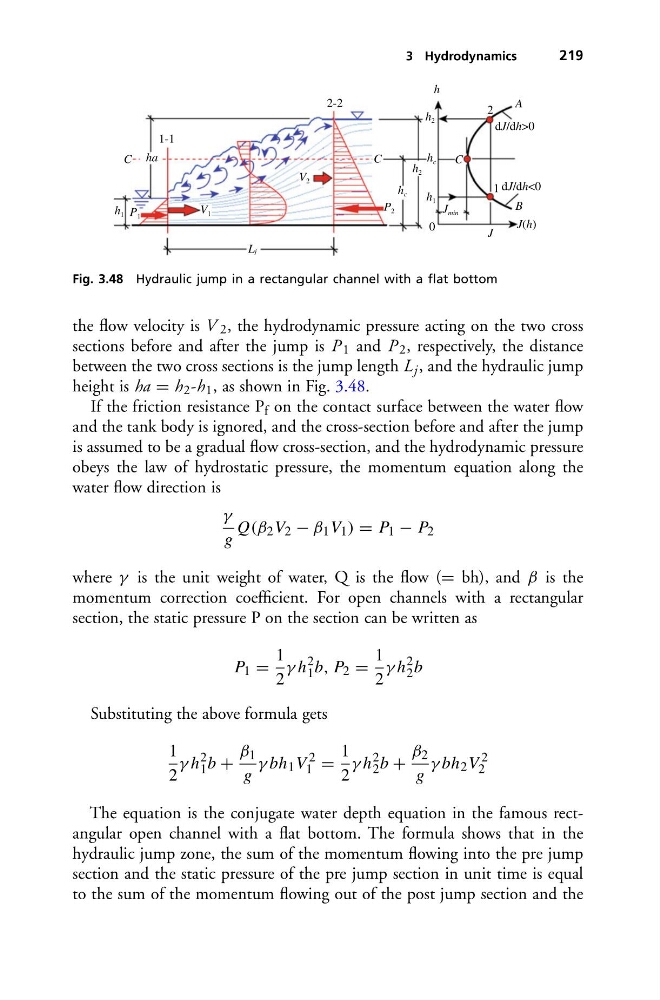
Fig. 3.48 Hydraulic jump in a rectangular channel with a flat bottom
the flow velocity is V 2 , the hydrodynamic pressure acting on the two cross
sections before and after the jump is P 1 and P 2 , respectively, the distance
between the two cross sections is the jump length L j , and the hydraulic jump
height is ha = h 2 -h 1 , as shown in Fig. 3.48.
If the friction resistance P f on the contact surface between the water flow
and the tank body is ignored, and the cross-section before and after the jump
is assumed to be a gradual flow cross-section, and the hydrodynamic pressure
obeys the law of hydrostatic pressure, the momentum equation along the
water flow direction is
γ
g
Q(β 2 V 2 − β 1 V 1 ) = P 1 − P 2
where γ is the unit weight of water, Q is the flow (= bh), and β is the
momentum correction coefficient. For open channels with a rectangular
section, the static pressure P on the section can be written as
P 1 =
1
2
γ h
2
1 b, P 2 =
1
2
γ h
2
2 b
Substituting the above formula gets
1
2
γ h
2
1 b +
β 1
g
γ bh 1 V
2
1 =
1
2
γ h
2
2 b +
β 2
g
γ bh 2 V
2
2
The equation is the conjugate water depth equation in the famous rectangular open channel with a flat bottom. The formula shows that in the
hydraulic jump zone, the sum of the momentum flowing into the pre jump
section and the static pressure of the pre jump section in unit time is equal
to the sum of the momentum flowing out of the post jump section and the
219
C ha
1-1
2-2
h 1 P 1
V 1
V 2
C
C
P 2
h 2
h 1
J min
0
J
1
2
J(h)
B
dJ/dh<0
dJ/dh>0
A
h 2
h
h c
h c
Lj
Fig. 3.48 Hydraulic jump in a rectangular channel with a flat bottom
the flow velocity is V 2 , the hydrodynamic pressure acting on the two cross
sections before and after the jump is P 1 and P 2 , respectively, the distance
between the two cross sections is the jump length L j , and the hydraulic jump
height is ha = h 2 -h 1 , as shown in Fig. 3.48.
If the friction resistance P f on the contact surface between the water flow
and the tank body is ignored, and the cross-section before and after the jump
is assumed to be a gradual flow cross-section, and the hydrodynamic pressure
obeys the law of hydrostatic pressure, the momentum equation along the
water flow direction is
γ
g
Q(β 2 V 2 − β 1 V 1 ) = P 1 − P 2
where γ is the unit weight of water, Q is the flow (= bh), and β is the
momentum correction coefficient. For open channels with a rectangular
section, the static pressure P on the section can be written as
P 1 =
1
2
γ h
2
1 b, P 2 =
1
2
γ h
2
2 b
Substituting the above formula gets
1
2
γ h
2
1 b +
β 1
g
γ bh 1 V
2
1 =
1
2
γ h
2
2 b +
β 2
g
γ bh 2 V
2
2
The equation is the conjugate water depth equation in the famous rectangular open channel with a flat bottom. The formula shows that in the
hydraulic jump zone, the sum of the momentum flowing into the pre jump
section and the static pressure of the pre jump section in unit time is equal
to the sum of the momentum flowing out of the post jump section and the