

218
P. Liu
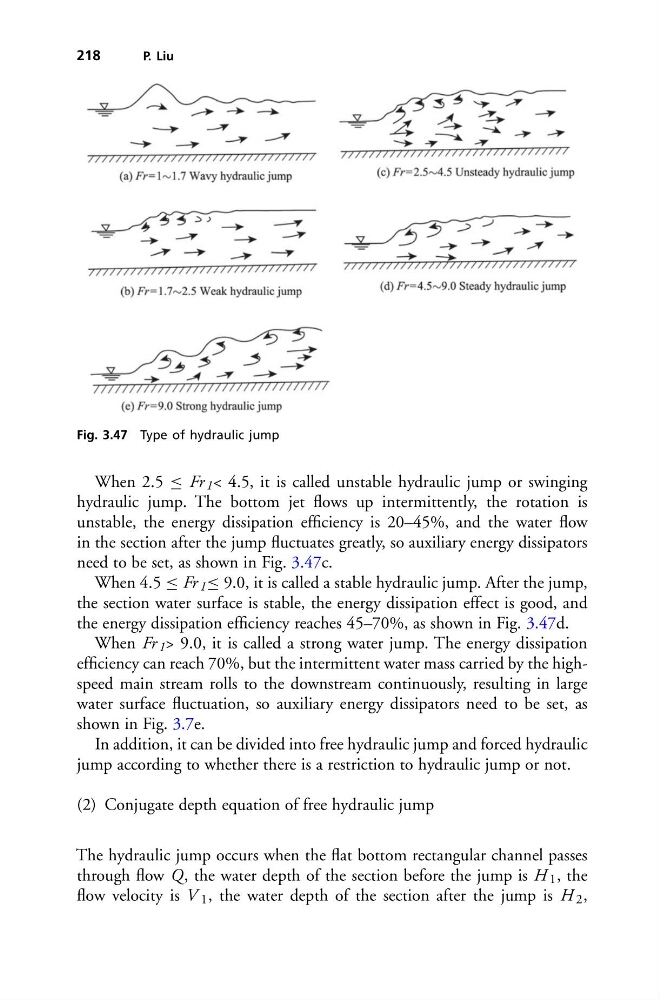
Fig. 3.47 Type of hydraulic jump
When 2.5 ≤ Fr 1 < 4.5, it is called unstable hydraulic jump or swinging
hydraulic jump. The bottom jet flows up intermittently, the rotation is
unstable, the energy dissipation efficiency is 20–45%, and the water flow
in the section after the jump fluctuates greatly, so auxiliary energy dissipators
need to be set, as shown in Fig. 3.47c.
When 4.5 ≤ Fr 1 ≤ 9.0, it is called a stable hydraulic jump. After the jump,
the section water surface is stable, the energy dissipation effect is good, and
the energy dissipation efficiency reaches 45–70%, as shown in Fig. 3.47d.
When Fr 1 > 9.0, it is called a strong water jump. The energy dissipation
efficiency can reach 70%, but the intermittent water mass carried by the highspeed main stream rolls to the downstream continuously, resulting in large
water surface fluctuation, so auxiliary energy dissipators need to be set, as
shown in Fig. 3.7e.
In addition, it can be divided into free hydraulic jump and forced hydraulic
jump according to whether there is a restriction to hydraulic jump or not.
(2) Conjugate depth equation of free hydraulic jump
The hydraulic jump occurs when the flat bottom rectangular channel passes
through flow Q, the water depth of the section before the jump is H 1 , the
flow velocity is V 1 , the water depth of the section after the jump is H 2 ,
P. Liu
Fig. 3.47 Type of hydraulic jump
When 2.5 ≤ Fr 1 < 4.5, it is called unstable hydraulic jump or swinging
hydraulic jump. The bottom jet flows up intermittently, the rotation is
unstable, the energy dissipation efficiency is 20–45%, and the water flow
in the section after the jump fluctuates greatly, so auxiliary energy dissipators
need to be set, as shown in Fig. 3.47c.
When 4.5 ≤ Fr 1 ≤ 9.0, it is called a stable hydraulic jump. After the jump,
the section water surface is stable, the energy dissipation effect is good, and
the energy dissipation efficiency reaches 45–70%, as shown in Fig. 3.47d.
When Fr 1 > 9.0, it is called a strong water jump. The energy dissipation
efficiency can reach 70%, but the intermittent water mass carried by the highspeed main stream rolls to the downstream continuously, resulting in large
water surface fluctuation, so auxiliary energy dissipators need to be set, as
shown in Fig. 3.7e.
In addition, it can be divided into free hydraulic jump and forced hydraulic
jump according to whether there is a restriction to hydraulic jump or not.
(2) Conjugate depth equation of free hydraulic jump
The hydraulic jump occurs when the flat bottom rectangular channel passes
through flow Q, the water depth of the section before the jump is H 1 , the
flow velocity is V 1 , the water depth of the section after the jump is H 2 ,