

206
P. Liu
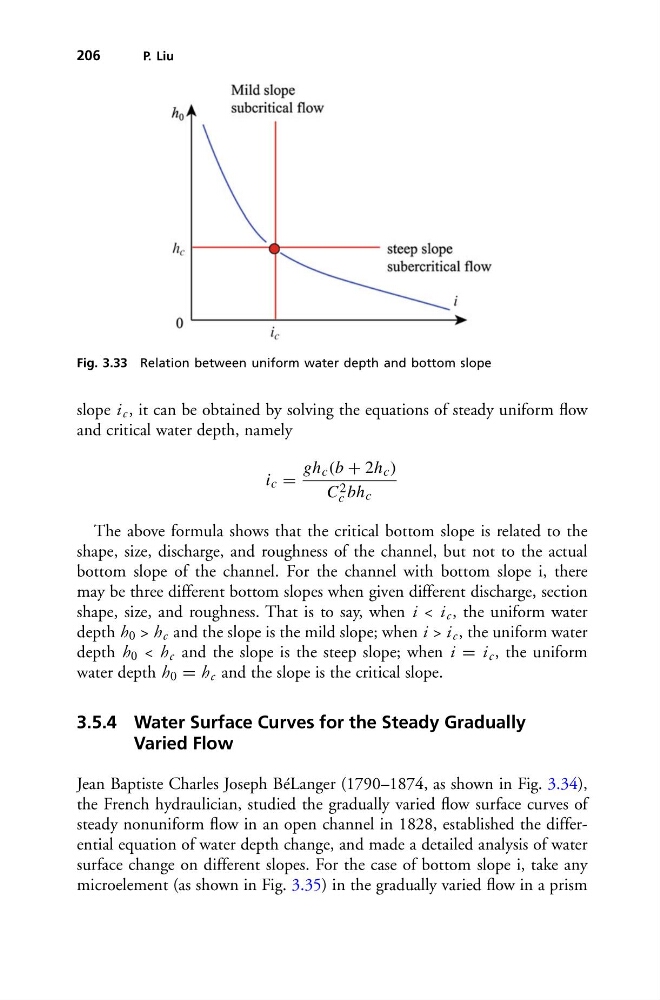
Fig. 3.33 Relation between uniform water depth and bottom slope
slope i c , it can be obtained by solving the equations of steady uniform flow
and critical water depth, namely
i c =
gh c (b + 2h c )
C 2
c bh c
The above formula shows that the critical bottom slope is related to the
shape, size, discharge, and roughness of the channel, but not to the actual
bottom slope of the channel. For the channel with bottom slope i, there
may be three different bottom slopes when given different discharge, section
shape, size, and roughness. That is to say, when i < i c , the uniform water
depth h 0 > h c and the slope is the mild slope; when i > i c , the uniform water
depth h 0 < h c and the slope is the steep slope; when i = i c , the uniform
water depth h 0 = h c and the slope is the critical slope.
3.5.4 Water Surface Curves for the Steady Gradually
Varied Flow
Jean Baptiste Charles Joseph BéLanger (1790–1874, as shown in Fig. 3.34),
the French hydraulician, studied the gradually varied flow surface curves of
steady nonuniform flow in an open channel in 1828, established the differential equation of water depth change, and made a detailed analysis of water
surface change on different slopes. For the case of bottom slope i, take any
microelement (as shown in Fig. 3.35) in the gradually varied flow in a prism
P. Liu
Fig. 3.33 Relation between uniform water depth and bottom slope
slope i c , it can be obtained by solving the equations of steady uniform flow
and critical water depth, namely
i c =
gh c (b + 2h c )
C 2
c bh c
The above formula shows that the critical bottom slope is related to the
shape, size, discharge, and roughness of the channel, but not to the actual
bottom slope of the channel. For the channel with bottom slope i, there
may be three different bottom slopes when given different discharge, section
shape, size, and roughness. That is to say, when i < i c , the uniform water
depth h 0 > h c and the slope is the mild slope; when i > i c , the uniform water
depth h 0 < h c and the slope is the steep slope; when i = i c , the uniform
water depth h 0 = h c and the slope is the critical slope.
3.5.4 Water Surface Curves for the Steady Gradually
Varied Flow
Jean Baptiste Charles Joseph BéLanger (1790–1874, as shown in Fig. 3.34),
the French hydraulician, studied the gradually varied flow surface curves of
steady nonuniform flow in an open channel in 1828, established the differential equation of water depth change, and made a detailed analysis of water
surface change on different slopes. For the case of bottom slope i, take any
microelement (as shown in Fig. 3.35) in the gradually varied flow in a prism