

3 Hydrodynamics
205
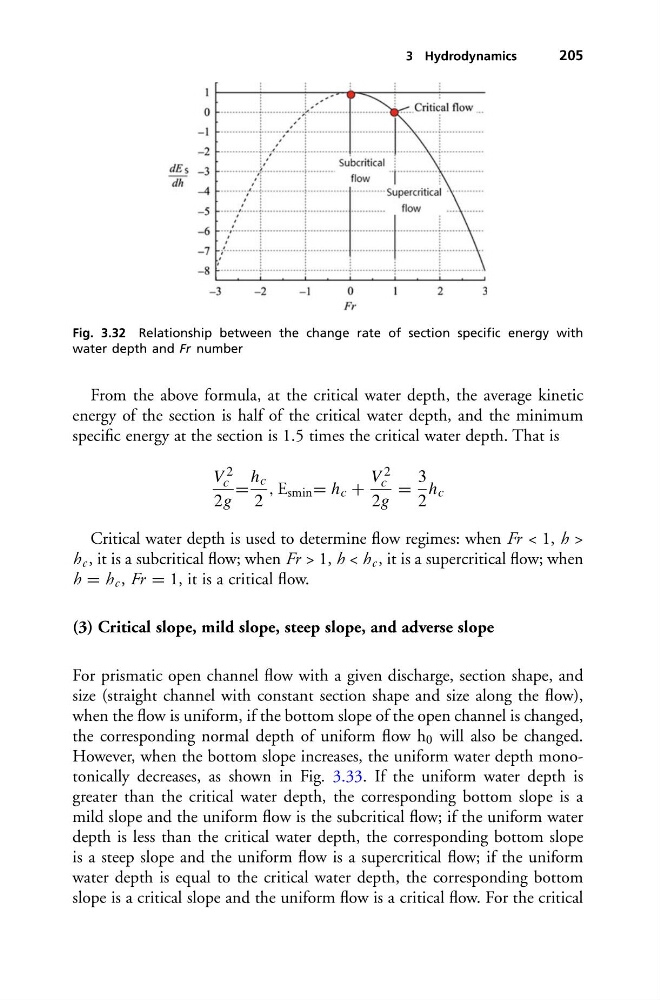
Fig. 3.32 Relationship between the change rate of section specific energy with
water depth and Fr number
From the above formula, at the critical water depth, the average kinetic
energy of the section is half of the critical water depth, and the minimum
specific energy at the section is 1.5 times the critical water depth. That is
V 2
c
2g
=
h c
2
, E smin = h c +
V 2
c
2g
=
3
2
h c
Critical water depth is used to determine flow regimes: when Fr < 1, h >
h c , it is a subcritical flow; when Fr > 1, h < h c , it is a supercritical flow; when
h = h c , Fr = 1, it is a critical flow.
(3) Critical slope, mild slope, steep slope, and adverse slope
For prismatic open channel flow with a given discharge, section shape, and
size (straight channel with constant section shape and size along the flow),
when the flow is uniform, if the bottom slope of the open channel is changed,
the corresponding normal depth of uniform flow h 0 will also be changed.
However, when the bottom slope increases, the uniform water depth monotonically decreases, as shown in Fig. 3.33. If the uniform water depth is
greater than the critical water depth, the corresponding bottom slope is a
mild slope and the uniform flow is the subcritical flow; if the uniform water
depth is less than the critical water depth, the corresponding bottom slope
is a steep slope and the uniform flow is a supercritical flow; if the uniform
water depth is equal to the critical water depth, the corresponding bottom
slope is a critical slope and the uniform flow is a critical flow. For the critical
205
Fig. 3.32 Relationship between the change rate of section specific energy with
water depth and Fr number
From the above formula, at the critical water depth, the average kinetic
energy of the section is half of the critical water depth, and the minimum
specific energy at the section is 1.5 times the critical water depth. That is
V 2
c
2g
=
h c
2
, E smin = h c +
V 2
c
2g
=
3
2
h c
Critical water depth is used to determine flow regimes: when Fr < 1, h >
h c , it is a subcritical flow; when Fr > 1, h < h c , it is a supercritical flow; when
h = h c , Fr = 1, it is a critical flow.
(3) Critical slope, mild slope, steep slope, and adverse slope
For prismatic open channel flow with a given discharge, section shape, and
size (straight channel with constant section shape and size along the flow),
when the flow is uniform, if the bottom slope of the open channel is changed,
the corresponding normal depth of uniform flow h 0 will also be changed.
However, when the bottom slope increases, the uniform water depth monotonically decreases, as shown in Fig. 3.33. If the uniform water depth is
greater than the critical water depth, the corresponding bottom slope is a
mild slope and the uniform flow is the subcritical flow; if the uniform water
depth is less than the critical water depth, the corresponding bottom slope
is a steep slope and the uniform flow is a supercritical flow; if the uniform
water depth is equal to the critical water depth, the corresponding bottom
slope is a critical slope and the uniform flow is a critical flow. For the critical