

3 Hydrodynamics
183
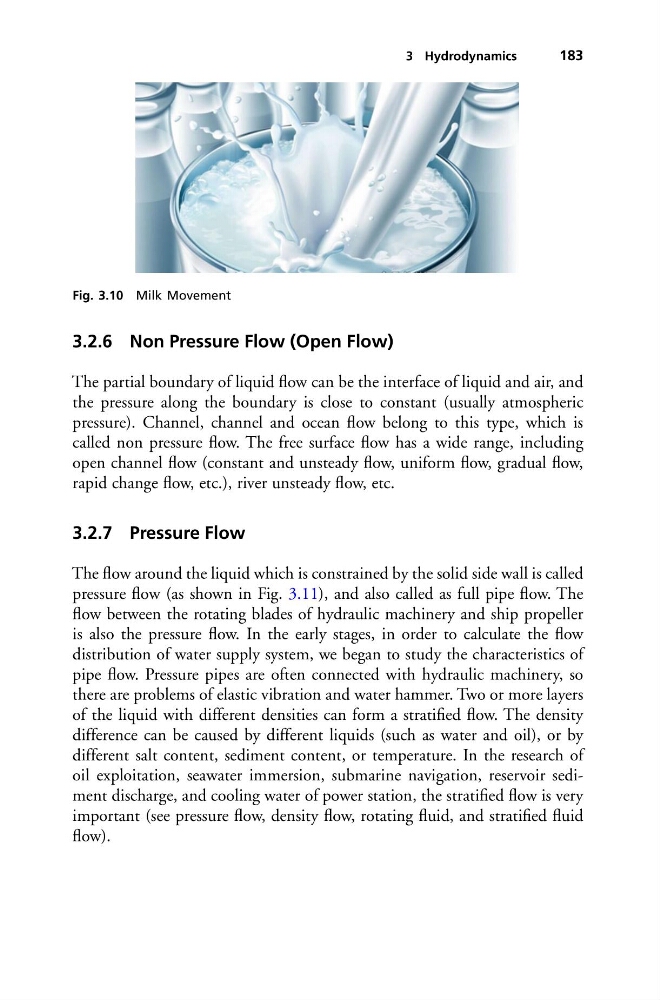
Fig. 3.10 Milk Movement
3.2.6 Non Pressure Flow (Open Flow)
The partial boundary of liquid flow can be the interface of liquid and air, and
the pressure along the boundary is close to constant (usually atmospheric
pressure). Channel, channel and ocean flow belong to this type, which is
called non pressure flow. The free surface flow has a wide range, including
open channel flow (constant and unsteady flow, uniform flow, gradual flow,
rapid change flow, etc.), river unsteady flow, etc.
3.2.7 Pressure Flow
The flow around the liquid which is constrained by the solid side wall is called
pressure flow (as shown in Fig. 3.11), and also called as full pipe flow. The
flow between the rotating blades of hydraulic machinery and ship propeller
is also the pressure flow. In the early stages, in order to calculate the flow
distribution of water supply system, we began to study the characteristics of
pipe flow. Pressure pipes are often connected with hydraulic machinery, so
there are problems of elastic vibration and water hammer. Two or more layers
of the liquid with different densities can form a stratified flow. The density
difference can be caused by different liquids (such as water and oil), or by
different salt content, sediment content, or temperature. In the research of
oil exploitation, seawater immersion, submarine navigation, reservoir sediment discharge, and cooling water of power station, the stratified flow is very
important (see pressure flow, density flow, rotating fluid, and stratified fluid
flow).
183
Fig. 3.10 Milk Movement
3.2.6 Non Pressure Flow (Open Flow)
The partial boundary of liquid flow can be the interface of liquid and air, and
the pressure along the boundary is close to constant (usually atmospheric
pressure). Channel, channel and ocean flow belong to this type, which is
called non pressure flow. The free surface flow has a wide range, including
open channel flow (constant and unsteady flow, uniform flow, gradual flow,
rapid change flow, etc.), river unsteady flow, etc.
3.2.7 Pressure Flow
The flow around the liquid which is constrained by the solid side wall is called
pressure flow (as shown in Fig. 3.11), and also called as full pipe flow. The
flow between the rotating blades of hydraulic machinery and ship propeller
is also the pressure flow. In the early stages, in order to calculate the flow
distribution of water supply system, we began to study the characteristics of
pipe flow. Pressure pipes are often connected with hydraulic machinery, so
there are problems of elastic vibration and water hammer. Two or more layers
of the liquid with different densities can form a stratified flow. The density
difference can be caused by different liquids (such as water and oil), or by
different salt content, sediment content, or temperature. In the research of
oil exploitation, seawater immersion, submarine navigation, reservoir sediment discharge, and cooling water of power station, the stratified flow is very
important (see pressure flow, density flow, rotating fluid, and stratified fluid
flow).