

2 Aerodynamics
173
are the guarantee for civil aircraft to obtain excellent cruise performance,
takeoff and landing performance, and economy. Since comet in 1952, the
development of large civil aircraft is almost inseparable from the progress of
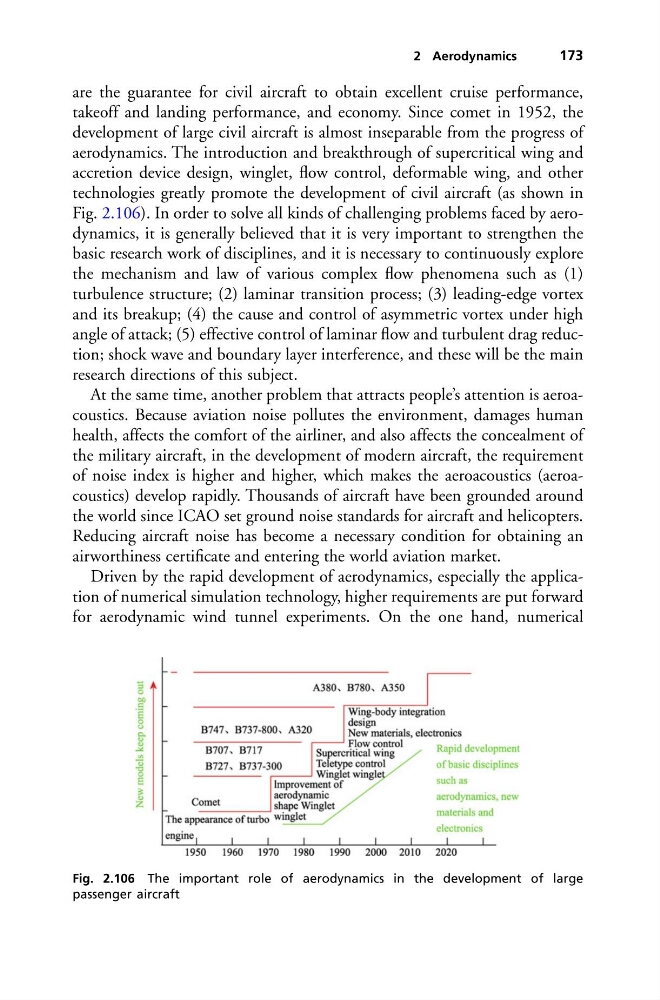
aerodynamics. The introduction and breakthrough of supercritical wing and
accretion device design, winglet, flow control, deformable wing, and other
technologies greatly promote the development of civil aircraft (as shown in
Fig. 2.106). In order to solve all kinds of challenging problems faced by aerodynamics, it is generally believed that it is very important to strengthen the
basic research work of disciplines, and it is necessary to continuously explore
the mechanism and law of various complex flow phenomena such as (1)
turbulence structure; (2) laminar transition process; (3) leading-edge vortex
and its breakup; (4) the cause and control of asymmetric vortex under high
angle of attack; (5) effective control of laminar flow and turbulent drag reduction; shock wave and boundary layer interference, and these will be the main
research directions of this subject.
At the same time, another problem that attracts people’s attention is aeroacoustics. Because aviation noise pollutes the environment, damages human
health, affects the comfort of the airliner, and also affects the concealment of
the military aircraft, in the development of modern aircraft, the requirement
of noise index is higher and higher, which makes the aeroacoustics (aeroacoustics) develop rapidly. Thousands of aircraft have been grounded around
the world since ICAO set ground noise standards for aircraft and helicopters.
Reducing aircraft noise has become a necessary condition for obtaining an
airworthiness certificate and entering the world aviation market.
Driven by the rapid development of aerodynamics, especially the application of numerical simulation technology, higher requirements are put forward
for aerodynamic wind tunnel experiments. On the one hand, numerical
Fig. 2.106 The important role of aerodynamics in the development of large
passenger aircraft
173
are the guarantee for civil aircraft to obtain excellent cruise performance,
takeoff and landing performance, and economy. Since comet in 1952, the
development of large civil aircraft is almost inseparable from the progress of
aerodynamics. The introduction and breakthrough of supercritical wing and
accretion device design, winglet, flow control, deformable wing, and other
technologies greatly promote the development of civil aircraft (as shown in
Fig. 2.106). In order to solve all kinds of challenging problems faced by aerodynamics, it is generally believed that it is very important to strengthen the
basic research work of disciplines, and it is necessary to continuously explore
the mechanism and law of various complex flow phenomena such as (1)
turbulence structure; (2) laminar transition process; (3) leading-edge vortex
and its breakup; (4) the cause and control of asymmetric vortex under high
angle of attack; (5) effective control of laminar flow and turbulent drag reduction; shock wave and boundary layer interference, and these will be the main
research directions of this subject.
At the same time, another problem that attracts people’s attention is aeroacoustics. Because aviation noise pollutes the environment, damages human
health, affects the comfort of the airliner, and also affects the concealment of
the military aircraft, in the development of modern aircraft, the requirement
of noise index is higher and higher, which makes the aeroacoustics (aeroacoustics) develop rapidly. Thousands of aircraft have been grounded around
the world since ICAO set ground noise standards for aircraft and helicopters.
Reducing aircraft noise has become a necessary condition for obtaining an
airworthiness certificate and entering the world aviation market.
Driven by the rapid development of aerodynamics, especially the application of numerical simulation technology, higher requirements are put forward
for aerodynamic wind tunnel experiments. On the one hand, numerical
Fig. 2.106 The important role of aerodynamics in the development of large
passenger aircraft