

168
P. Liu
One of the main differences between supersonic flow and subsonic flow is
that the change in pressure gradient along the flow direction is the inverse
sign with the change in cross-sectional area along the flow direction.
For example, in the contraction pipe, the supersonic flow is compressed,
the pressure increases, and the velocity decreases; in the expansion pipe,
the supersonic flow is expanded, the airflow accelerates, and the pressure
decreases. For the subsonic flow, the flow characteristics in the contraction
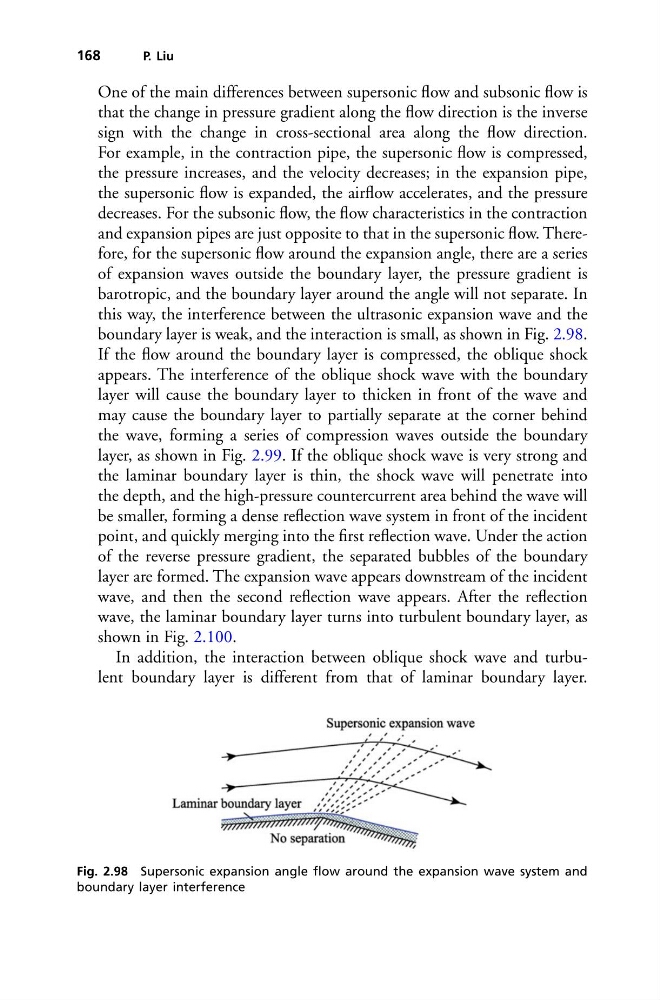
and expansion pipes are just opposite to that in the supersonic flow. Therefore, for the supersonic flow around the expansion angle, there are a series
of expansion waves outside the boundary layer, the pressure gradient is
barotropic, and the boundary layer around the angle will not separate. In
this way, the interference between the ultrasonic expansion wave and the
boundary layer is weak, and the interaction is small, as shown in Fig. 2.98.
If the flow around the boundary layer is compressed, the oblique shock
appears. The interference of the oblique shock wave with the boundary
layer will cause the boundary layer to thicken in front of the wave and
may cause the boundary layer to partially separate at the corner behind
the wave, forming a series of compression waves outside the boundary
layer, as shown in Fig. 2.99. If the oblique shock wave is very strong and
the laminar boundary layer is thin, the shock wave will penetrate into
the depth, and the high-pressure countercurrent area behind the wave will
be smaller, forming a dense reflection wave system in front of the incident
point, and quickly merging into the first reflection wave. Under the action
of the reverse pressure gradient, the separated bubbles of the boundary
layer are formed. The expansion wave appears downstream of the incident
wave, and then the second reflection wave appears. After the reflection
wave, the laminar boundary layer turns into turbulent boundary layer, as
shown in Fig. 2.100.
In addition, the interaction between oblique shock wave and turbulent boundary layer is different from that of laminar boundary layer.
Fig. 2.98 Supersonic expansion angle flow around the expansion wave system and
boundary layer interference
P. Liu
One of the main differences between supersonic flow and subsonic flow is
that the change in pressure gradient along the flow direction is the inverse
sign with the change in cross-sectional area along the flow direction.
For example, in the contraction pipe, the supersonic flow is compressed,
the pressure increases, and the velocity decreases; in the expansion pipe,
the supersonic flow is expanded, the airflow accelerates, and the pressure
decreases. For the subsonic flow, the flow characteristics in the contraction
and expansion pipes are just opposite to that in the supersonic flow. Therefore, for the supersonic flow around the expansion angle, there are a series
of expansion waves outside the boundary layer, the pressure gradient is
barotropic, and the boundary layer around the angle will not separate. In
this way, the interference between the ultrasonic expansion wave and the
boundary layer is weak, and the interaction is small, as shown in Fig. 2.98.
If the flow around the boundary layer is compressed, the oblique shock
appears. The interference of the oblique shock wave with the boundary
layer will cause the boundary layer to thicken in front of the wave and
may cause the boundary layer to partially separate at the corner behind
the wave, forming a series of compression waves outside the boundary
layer, as shown in Fig. 2.99. If the oblique shock wave is very strong and
the laminar boundary layer is thin, the shock wave will penetrate into
the depth, and the high-pressure countercurrent area behind the wave will
be smaller, forming a dense reflection wave system in front of the incident
point, and quickly merging into the first reflection wave. Under the action
of the reverse pressure gradient, the separated bubbles of the boundary
layer are formed. The expansion wave appears downstream of the incident
wave, and then the second reflection wave appears. After the reflection
wave, the laminar boundary layer turns into turbulent boundary layer, as
shown in Fig. 2.100.
In addition, the interaction between oblique shock wave and turbulent boundary layer is different from that of laminar boundary layer.
Fig. 2.98 Supersonic expansion angle flow around the expansion wave system and
boundary layer interference