

2 Aerodynamics
165
example, in the strong interference region, the definition and magnitude
of the boundary layer are not applicable, because the flow velocity gradient
and the normal velocity gradient have the same magnitude. The interference flow in the laminar or turbulent region is also obviously different. For
example, when the boundary conditions and shock intensity are the same,
the upstream propagation distance of the reverse pressure in the laminar
boundary layer is far from the turbulent boundary layer, and the laminar
boundary layer has weak resistance to flow separation. The interference
characteristics of positive shock and laminar boundary layer are related
to the Mach number, Reynolds number, and shock intensity outside the
boundary layer. According to the different shock intensity, three kinds of
interference may occur.
(1) Weak interference
In the transonic flow around the airfoil, the shock wave is relatively
weak in the upper wing area of the airfoil, which interferes with the
laminar boundary layer. The weak shock pressure increases the front
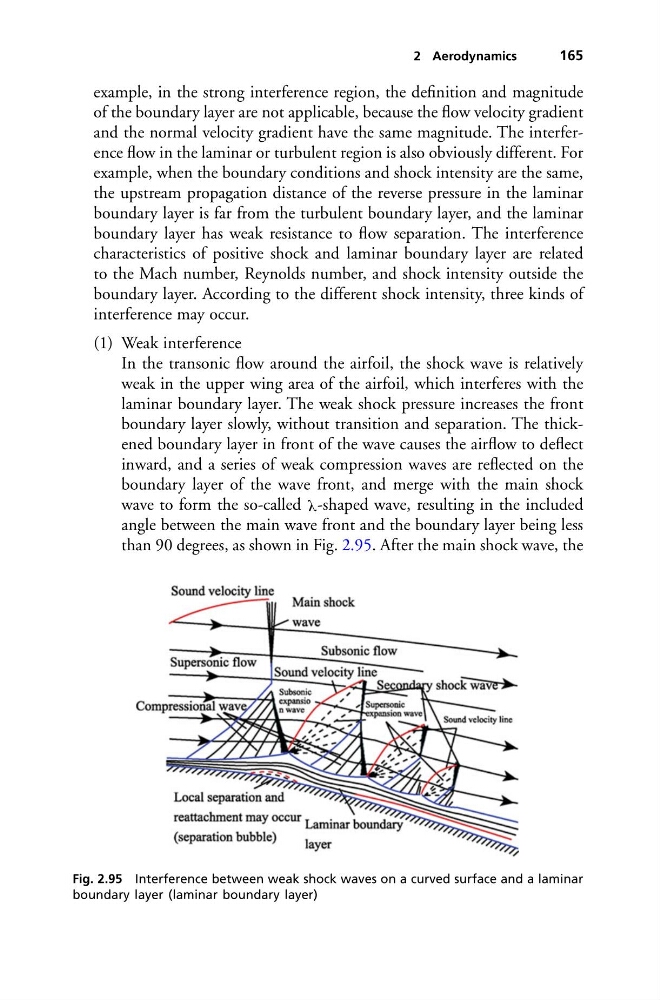
boundary layer slowly, without transition and separation. The thickened boundary layer in front of the wave causes the airflow to deflect
inward, and a series of weak compression waves are reflected on the
boundary layer of the wave front, and merge with the main shock
wave to form the so-called λ-shaped wave, resulting in the included
angle between the main wave front and the boundary layer being less
than 90 degrees, as shown in Fig. 2.95. After the main shock wave, the
Fig. 2.95 Interference between weak shock waves on a curved surface and a laminar
boundary layer (laminar boundary layer)
165
example, in the strong interference region, the definition and magnitude
of the boundary layer are not applicable, because the flow velocity gradient
and the normal velocity gradient have the same magnitude. The interference flow in the laminar or turbulent region is also obviously different. For
example, when the boundary conditions and shock intensity are the same,
the upstream propagation distance of the reverse pressure in the laminar
boundary layer is far from the turbulent boundary layer, and the laminar
boundary layer has weak resistance to flow separation. The interference
characteristics of positive shock and laminar boundary layer are related
to the Mach number, Reynolds number, and shock intensity outside the
boundary layer. According to the different shock intensity, three kinds of
interference may occur.
(1) Weak interference
In the transonic flow around the airfoil, the shock wave is relatively
weak in the upper wing area of the airfoil, which interferes with the
laminar boundary layer. The weak shock pressure increases the front
boundary layer slowly, without transition and separation. The thickened boundary layer in front of the wave causes the airflow to deflect
inward, and a series of weak compression waves are reflected on the
boundary layer of the wave front, and merge with the main shock
wave to form the so-called λ-shaped wave, resulting in the included
angle between the main wave front and the boundary layer being less
than 90 degrees, as shown in Fig. 2.95. After the main shock wave, the
Fig. 2.95 Interference between weak shock waves on a curved surface and a laminar
boundary layer (laminar boundary layer)