

164
P. Liu
of viscosity, so there are subsonic and supersonic regions in the layer,
and the shock pressurization outside the boundary layer will propagate
upstream to the front of the shock through the subsonic region in the
layer. This reverse pressure gradient from the downstream to the upstream
obviously changes the boundary layer state in the upstream of the shock
wave, resulting in the thickness of the boundary layer in the disturbed
area, changes in the distribution of velocity, temperature, pressure, and
density in the layer, the reduction in friction resistance, and the change in
the local shock structure near the wall.
In the transonic flow around airfoil, when the Mach number of the
incoming flow is greater than the critical Mach number, the supersonic
flow region will appear when the flow is around the upper wing surface.
Obviously, the supersonic region is connected with the downstream
subsonic flow by almost positive shock form. The shock acceleration
and deceleration behavior cannot be carried forward in the supersonic
region outside the boundary layer. However, when encountering the
subsonic boundary layer near the wall, the shock acceleration will propagate upstream along the upstream of the boundary layer, resulting in
the thickening of the boundary layer. In serious cases, it will cause the
separation of the boundary layer (the separation bubble or the end of the
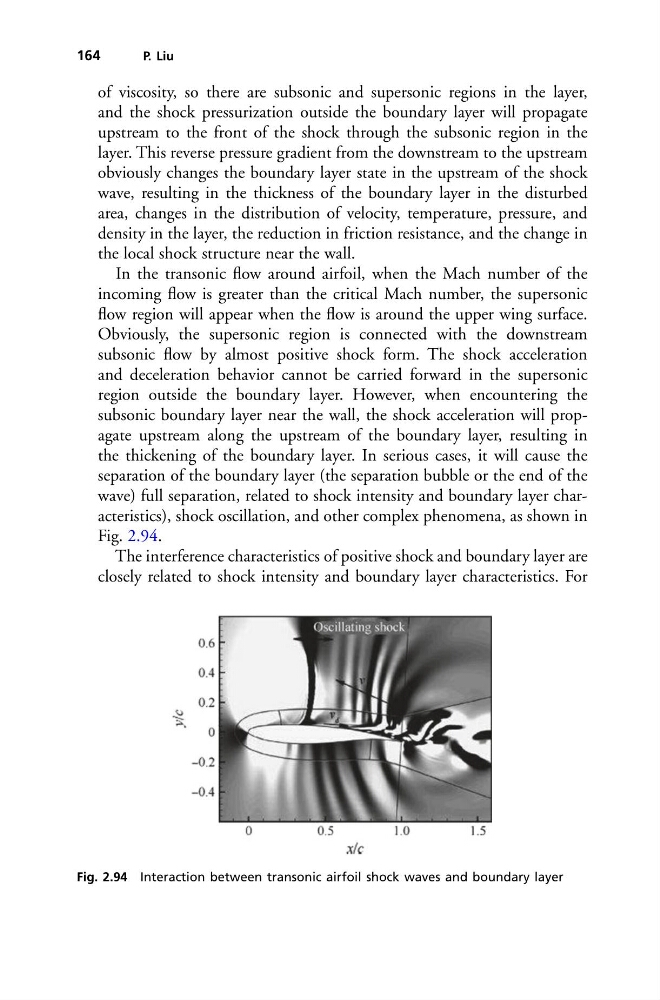
wave) full separation, related to shock intensity and boundary layer characteristics), shock oscillation, and other complex phenomena, as shown in
Fig. 2.94.
The interference characteristics of positive shock and boundary layer are
closely related to shock intensity and boundary layer characteristics. For
Fig. 2.94 Interaction between transonic airfoil shock waves and boundary layer
P. Liu
of viscosity, so there are subsonic and supersonic regions in the layer,
and the shock pressurization outside the boundary layer will propagate
upstream to the front of the shock through the subsonic region in the
layer. This reverse pressure gradient from the downstream to the upstream
obviously changes the boundary layer state in the upstream of the shock
wave, resulting in the thickness of the boundary layer in the disturbed
area, changes in the distribution of velocity, temperature, pressure, and
density in the layer, the reduction in friction resistance, and the change in
the local shock structure near the wall.
In the transonic flow around airfoil, when the Mach number of the
incoming flow is greater than the critical Mach number, the supersonic
flow region will appear when the flow is around the upper wing surface.
Obviously, the supersonic region is connected with the downstream
subsonic flow by almost positive shock form. The shock acceleration
and deceleration behavior cannot be carried forward in the supersonic
region outside the boundary layer. However, when encountering the
subsonic boundary layer near the wall, the shock acceleration will propagate upstream along the upstream of the boundary layer, resulting in
the thickening of the boundary layer. In serious cases, it will cause the
separation of the boundary layer (the separation bubble or the end of the
wave) full separation, related to shock intensity and boundary layer characteristics), shock oscillation, and other complex phenomena, as shown in
Fig. 2.94.
The interference characteristics of positive shock and boundary layer are
closely related to shock intensity and boundary layer characteristics. For
Fig. 2.94 Interaction between transonic airfoil shock waves and boundary layer