

2 Aerodynamics
155
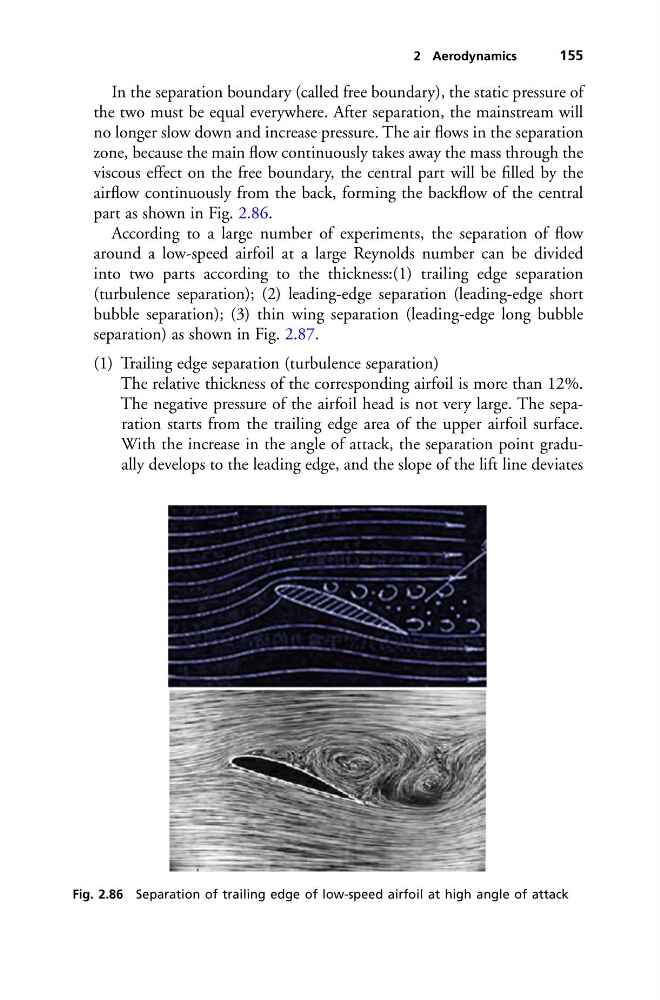
In the separation boundary (called free boundary), the static pressure of
the two must be equal everywhere. After separation, the mainstream will
no longer slow down and increase pressure. The air flows in the separation
zone, because the main flow continuously takes away the mass through the
viscous effect on the free boundary, the central part will be filled by the
airflow continuously from the back, forming the backflow of the central
part as shown in Fig. 2.86.
According to a large number of experiments, the separation of flow
around a low-speed airfoil at a large Reynolds number can be divided
into two parts according to the thickness:(1) trailing edge separation
(turbulence separation); (2) leading-edge separation (leading-edge short
bubble separation); (3) thin wing separation (leading-edge long bubble
separation) as shown in Fig. 2.87.
(1) Trailing edge separation (turbulence separation)
The relative thickness of the corresponding airfoil is more than 12%.
The negative pressure of the airfoil head is not very large. The separation starts from the trailing edge area of the upper airfoil surface.
With the increase in the angle of attack, the separation point gradually develops to the leading edge, and the slope of the lift line deviates
Fig. 2.86 Separation of trailing edge of low-speed airfoil at high angle of attack
155
In the separation boundary (called free boundary), the static pressure of
the two must be equal everywhere. After separation, the mainstream will
no longer slow down and increase pressure. The air flows in the separation
zone, because the main flow continuously takes away the mass through the
viscous effect on the free boundary, the central part will be filled by the
airflow continuously from the back, forming the backflow of the central
part as shown in Fig. 2.86.
According to a large number of experiments, the separation of flow
around a low-speed airfoil at a large Reynolds number can be divided
into two parts according to the thickness:(1) trailing edge separation
(turbulence separation); (2) leading-edge separation (leading-edge short
bubble separation); (3) thin wing separation (leading-edge long bubble
separation) as shown in Fig. 2.87.
(1) Trailing edge separation (turbulence separation)
The relative thickness of the corresponding airfoil is more than 12%.
The negative pressure of the airfoil head is not very large. The separation starts from the trailing edge area of the upper airfoil surface.
With the increase in the angle of attack, the separation point gradually develops to the leading edge, and the slope of the lift line deviates
Fig. 2.86 Separation of trailing edge of low-speed airfoil at high angle of attack