

154
P. Liu
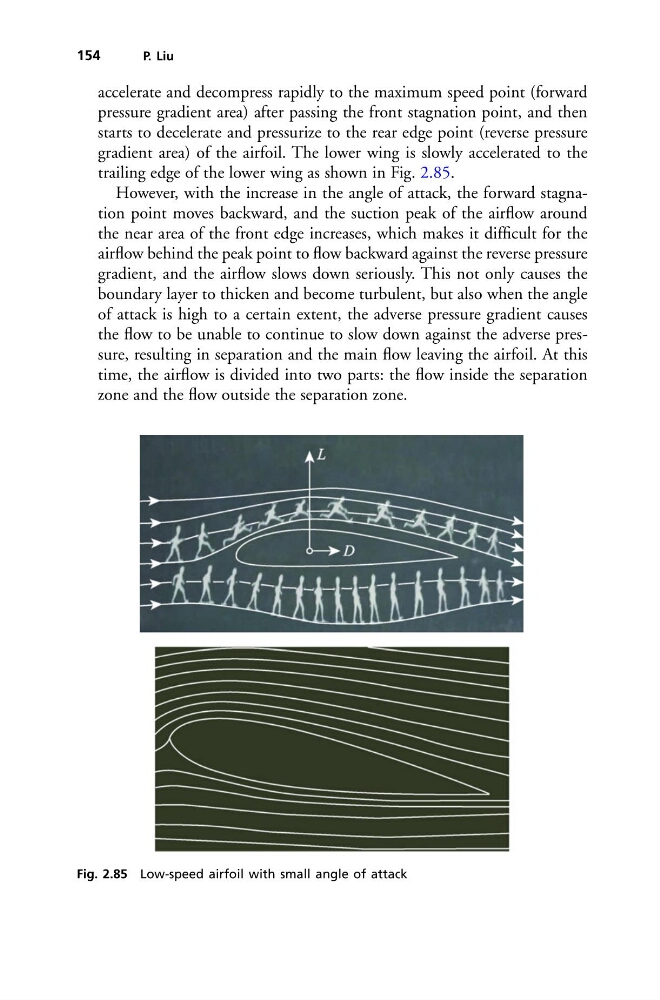
accelerate and decompress rapidly to the maximum speed point (forward
pressure gradient area) after passing the front stagnation point, and then
starts to decelerate and pressurize to the rear edge point (reverse pressure
gradient area) of the airfoil. The lower wing is slowly accelerated to the
trailing edge of the lower wing as shown in Fig. 2.85.
However, with the increase in the angle of attack, the forward stagnation point moves backward, and the suction peak of the airflow around
the near area of the front edge increases, which makes it difficult for the
airflow behind the peak point to flow backward against the reverse pressure
gradient, and the airflow slows down seriously. This not only causes the
boundary layer to thicken and become turbulent, but also when the angle
of attack is high to a certain extent, the adverse pressure gradient causes
the flow to be unable to continue to slow down against the adverse pressure, resulting in separation and the main flow leaving the airfoil. At this
time, the airflow is divided into two parts: the flow inside the separation
zone and the flow outside the separation zone.
Fig. 2.85 Low-speed airfoil with small angle of attack
P. Liu
accelerate and decompress rapidly to the maximum speed point (forward
pressure gradient area) after passing the front stagnation point, and then
starts to decelerate and pressurize to the rear edge point (reverse pressure
gradient area) of the airfoil. The lower wing is slowly accelerated to the
trailing edge of the lower wing as shown in Fig. 2.85.
However, with the increase in the angle of attack, the forward stagnation point moves backward, and the suction peak of the airflow around
the near area of the front edge increases, which makes it difficult for the
airflow behind the peak point to flow backward against the reverse pressure
gradient, and the airflow slows down seriously. This not only causes the
boundary layer to thicken and become turbulent, but also when the angle
of attack is high to a certain extent, the adverse pressure gradient causes
the flow to be unable to continue to slow down against the adverse pressure, resulting in separation and the main flow leaving the airfoil. At this
time, the airflow is divided into two parts: the flow inside the separation
zone and the flow outside the separation zone.
Fig. 2.85 Low-speed airfoil with small angle of attack