

2 Aerodynamics
147
scale of the moving sound source. ρ 0 is the density of the environment
medium, and a 0 is the sound velocity of the environment medium.
Dipole sound source is a kind of aerodynamic sound source formed
by unsteady aerodynamic force between fluid and object when there are
obstacles in the fluid. Dipole noise, also known as load noise, belongs to
surface acoustic source, which is caused by the stress change in the surface
of the object acting on the adjacent fluid. The dipole can be described by
two monopoles with equal size and opposite phase. The common dipole
is a small ball with constant shape and volume. Any object with lowfrequency vibration is a dipole. For example, aircraft, propeller, helicopter,
and turbine flying in the turbulent atmosphere will produce dipole noise.
When integrating along the whole spherical boundary, the net flow of the
fluid always shows zero, because the flow-in equals the flow-out. However,
since the inflow and outflow flow are in the same direction and their
momentum is additive, there is a net momentum in the system. According
to Newton’s second law, a force related to a dipole can be found. The
second way to describe a dipole is to think of it as a ball driven by an
oscillating force. Under these two descriptions, the fluid motion on the
observation boundary is equivalent. There is radial flow along the change
in momentum or the axial direction of the force. It can be inferred that the
compressible motion or acoustic motion is the largest. There is no radial
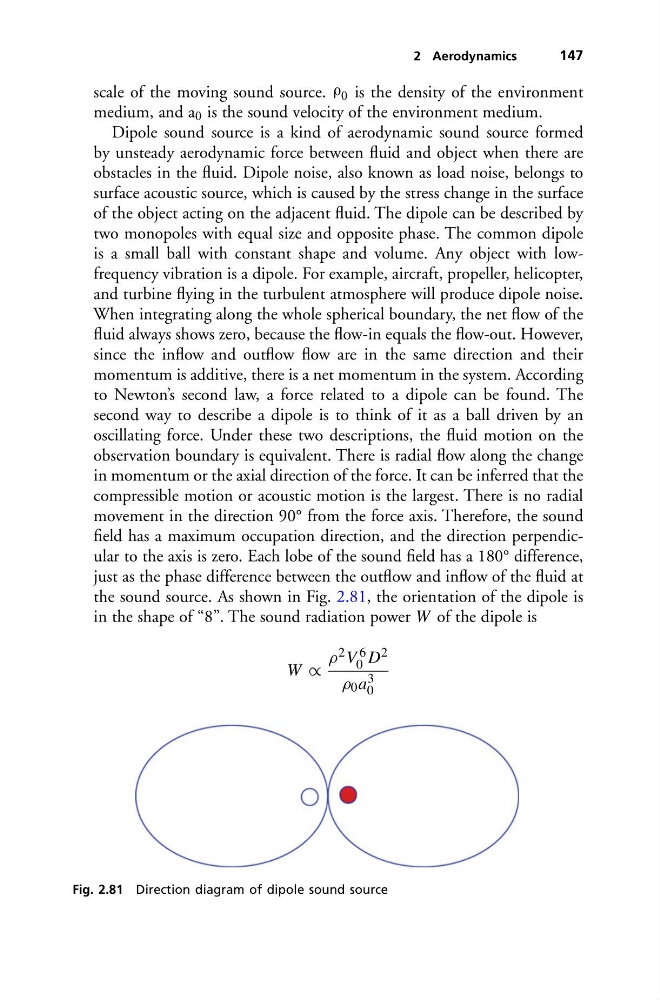
movement in the direction 90° from the force axis. Therefore, the sound
field has a maximum occupation direction, and the direction perpendicular to the axis is zero. Each lobe of the sound field has a 180° difference,
just as the phase difference between the outflow and inflow of the fluid at
the sound source. As shown in Fig. 2.81, the orientation of the dipole is
in the shape of “8”. The sound radiation power W of the dipole is
W ∝
ρ 2 V 6
0 D 2
ρ 0 a 3
0
Fig. 2.81 Direction diagram of dipole sound source
147
scale of the moving sound source. ρ 0 is the density of the environment
medium, and a 0 is the sound velocity of the environment medium.
Dipole sound source is a kind of aerodynamic sound source formed
by unsteady aerodynamic force between fluid and object when there are
obstacles in the fluid. Dipole noise, also known as load noise, belongs to
surface acoustic source, which is caused by the stress change in the surface
of the object acting on the adjacent fluid. The dipole can be described by
two monopoles with equal size and opposite phase. The common dipole
is a small ball with constant shape and volume. Any object with lowfrequency vibration is a dipole. For example, aircraft, propeller, helicopter,
and turbine flying in the turbulent atmosphere will produce dipole noise.
When integrating along the whole spherical boundary, the net flow of the
fluid always shows zero, because the flow-in equals the flow-out. However,
since the inflow and outflow flow are in the same direction and their
momentum is additive, there is a net momentum in the system. According
to Newton’s second law, a force related to a dipole can be found. The
second way to describe a dipole is to think of it as a ball driven by an
oscillating force. Under these two descriptions, the fluid motion on the
observation boundary is equivalent. There is radial flow along the change
in momentum or the axial direction of the force. It can be inferred that the
compressible motion or acoustic motion is the largest. There is no radial
movement in the direction 90° from the force axis. Therefore, the sound
field has a maximum occupation direction, and the direction perpendicular to the axis is zero. Each lobe of the sound field has a 180° difference,
just as the phase difference between the outflow and inflow of the fluid at
the sound source. As shown in Fig. 2.81, the orientation of the dipole is
in the shape of “8”. The sound radiation power W of the dipole is
W ∝
ρ 2 V 6
0 D 2
ρ 0 a 3
0
Fig. 2.81 Direction diagram of dipole sound source