

146
P. Liu
it can also be generated by moving objects. Monopole sound source generated by moving objects is also called thickness noise, which is a kind of
surface sound source. It is caused by the mass change in the object surface
caused by the movement or vibration of the object. The typical monopole
sources are the pulse jet of high-speed airflow periodically discharged
through the nozzle, the flute of stable airflow periodically modulated, and
the thickness noise of propeller, rotor, and other moving parts which make
the air displace periodically. Monopole source can also be considered as a
point source of pulsating mass. If the center of a balloon is placed on
this point source, we can observe that the balloon expands or contracts
as the gas enters or exits. This motion is always purely radial, and the
surrounding gas is compressed or expanded to adapt to its motion, which
is the formation of a spherically symmetric sound field. Setting a mathematical spherical boundary around the sound source, we can observe the
outflow and inflow of the accumulated net flow through the boundary,
which is called monopole (point sound source). The amplitude and phase
of the sound field are the same at each point on the spherical surface, and
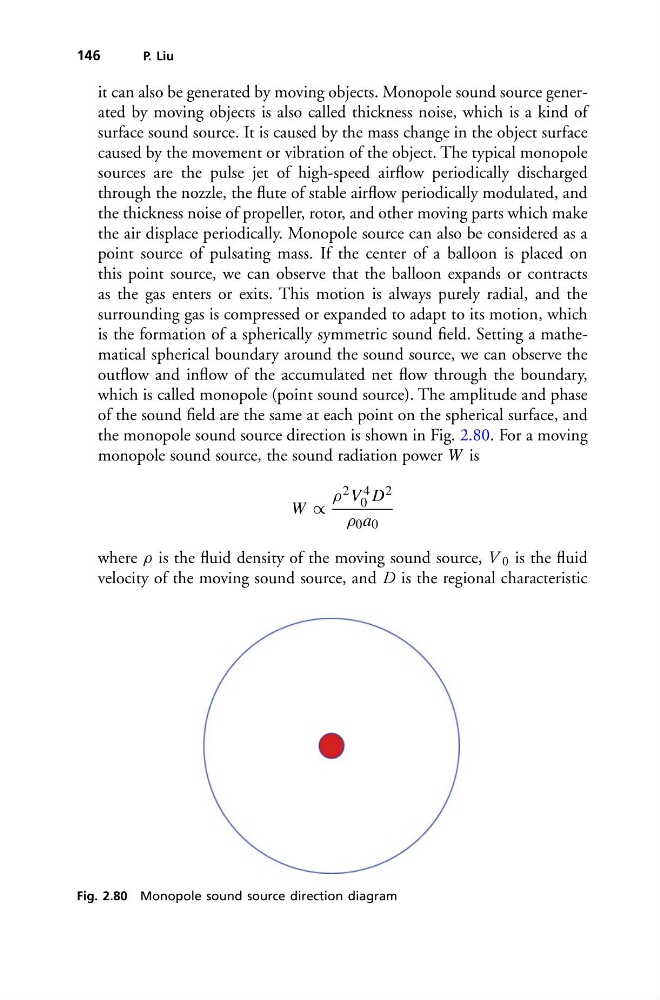
the monopole sound source direction is shown in Fig. 2.80. For a moving
monopole sound source, the sound radiation power W is
W ∝
ρ 2 V 4
0 D 2
ρ 0 a 0
where ρ is the fluid density of the moving sound source, V 0 is the fluid
velocity of the moving sound source, and D is the regional characteristic
Fig. 2.80 Monopole sound source direction diagram
P. Liu
it can also be generated by moving objects. Monopole sound source generated by moving objects is also called thickness noise, which is a kind of
surface sound source. It is caused by the mass change in the object surface
caused by the movement or vibration of the object. The typical monopole
sources are the pulse jet of high-speed airflow periodically discharged
through the nozzle, the flute of stable airflow periodically modulated, and
the thickness noise of propeller, rotor, and other moving parts which make
the air displace periodically. Monopole source can also be considered as a
point source of pulsating mass. If the center of a balloon is placed on
this point source, we can observe that the balloon expands or contracts
as the gas enters or exits. This motion is always purely radial, and the
surrounding gas is compressed or expanded to adapt to its motion, which
is the formation of a spherically symmetric sound field. Setting a mathematical spherical boundary around the sound source, we can observe the
outflow and inflow of the accumulated net flow through the boundary,
which is called monopole (point sound source). The amplitude and phase
of the sound field are the same at each point on the spherical surface, and
the monopole sound source direction is shown in Fig. 2.80. For a moving
monopole sound source, the sound radiation power W is
W ∝
ρ 2 V 4
0 D 2
ρ 0 a 0
where ρ is the fluid density of the moving sound source, V 0 is the fluid
velocity of the moving sound source, and D is the regional characteristic
Fig. 2.80 Monopole sound source direction diagram