

130
P. Liu
according to the sudden change in shock gas density. The shock wave of
ideal gas has no thickness and is a mathematical discontinuity. The actual
gas has viscosity and heat transfer, which makes the shock wave continuous, but the process is still very rapid. Therefore, the actual shock wave
has thickness, but the value is very small. Only in a certain multiple of the
free path of gas molecules, the larger the relative supersonic Mach number
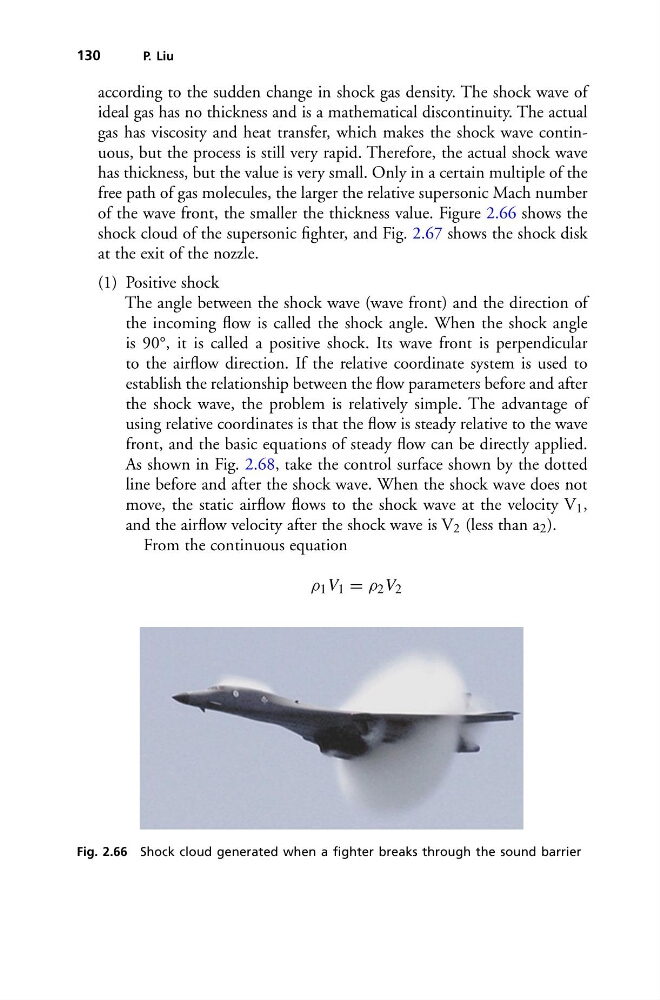
of the wave front, the smaller the thickness value. Figure 2.66 shows the
shock cloud of the supersonic fighter, and Fig. 2.67 shows the shock disk
at the exit of the nozzle.
(1) Positive shock
The angle between the shock wave (wave front) and the direction of
the incoming flow is called the shock angle. When the shock angle
is 90°, it is called a positive shock. Its wave front is perpendicular
to the airflow direction. If the relative coordinate system is used to
establish the relationship between the flow parameters before and after
the shock wave, the problem is relatively simple. The advantage of
using relative coordinates is that the flow is steady relative to the wave
front, and the basic equations of steady flow can be directly applied.
As shown in Fig. 2.68, take the control surface shown by the dotted
line before and after the shock wave. When the shock wave does not
move, the static airflow flows to the shock wave at the velocity V 1 ,
and the airflow velocity after the shock wave is V 2 (less than a 2 ).
From the continuous equation
ρ 1 V 1 = ρ 2 V 2
Fig. 2.66 Shock cloud generated when a fighter breaks through the sound barrier
P. Liu
according to the sudden change in shock gas density. The shock wave of
ideal gas has no thickness and is a mathematical discontinuity. The actual
gas has viscosity and heat transfer, which makes the shock wave continuous, but the process is still very rapid. Therefore, the actual shock wave
has thickness, but the value is very small. Only in a certain multiple of the
free path of gas molecules, the larger the relative supersonic Mach number
of the wave front, the smaller the thickness value. Figure 2.66 shows the
shock cloud of the supersonic fighter, and Fig. 2.67 shows the shock disk
at the exit of the nozzle.
(1) Positive shock
The angle between the shock wave (wave front) and the direction of
the incoming flow is called the shock angle. When the shock angle
is 90°, it is called a positive shock. Its wave front is perpendicular
to the airflow direction. If the relative coordinate system is used to
establish the relationship between the flow parameters before and after
the shock wave, the problem is relatively simple. The advantage of
using relative coordinates is that the flow is steady relative to the wave
front, and the basic equations of steady flow can be directly applied.
As shown in Fig. 2.68, take the control surface shown by the dotted
line before and after the shock wave. When the shock wave does not
move, the static airflow flows to the shock wave at the velocity V 1 ,
and the airflow velocity after the shock wave is V 2 (less than a 2 ).
From the continuous equation
ρ 1 V 1 = ρ 2 V 2
Fig. 2.66 Shock cloud generated when a fighter breaks through the sound barrier