

2 Aerodynamics
129
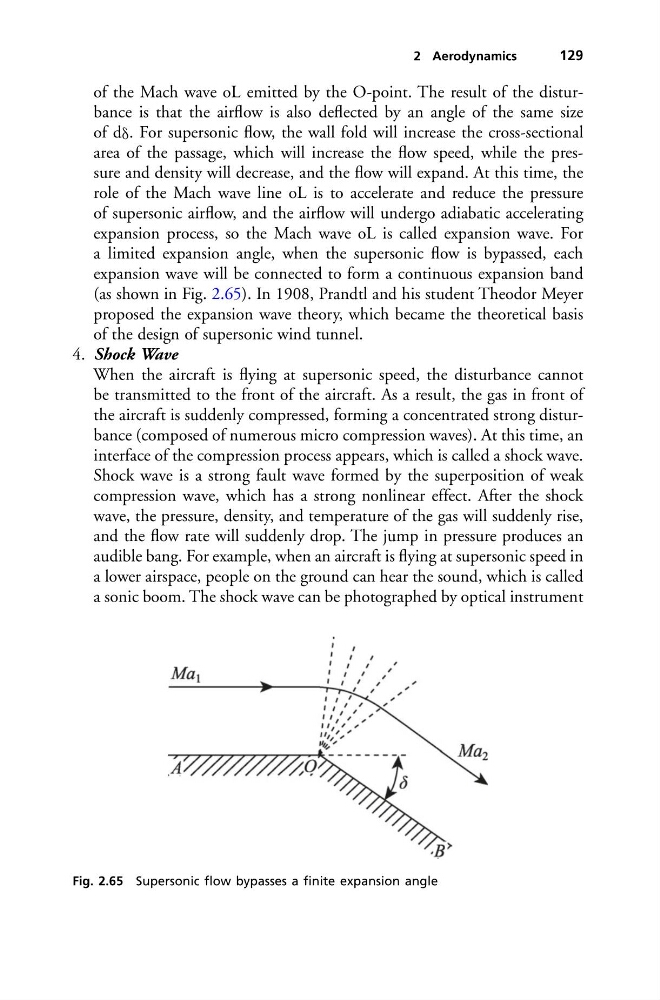
of the Mach wave oL emitted by the O-point. The result of the disturbance is that the airflow is also deflected by an angle of the same size
of dδ. For supersonic flow, the wall fold will increase the cross-sectional
area of the passage, which will increase the flow speed, while the pressure and density will decrease, and the flow will expand. At this time, the
role of the Mach wave line oL is to accelerate and reduce the pressure
of supersonic airflow, and the airflow will undergo adiabatic accelerating
expansion process, so the Mach wave oL is called expansion wave. For
a limited expansion angle, when the supersonic flow is bypassed, each
expansion wave will be connected to form a continuous expansion band
(as shown in Fig. 2.65). In 1908, Prandtl and his student Theodor Meyer
proposed the expansion wave theory, which became the theoretical basis
of the design of supersonic wind tunnel.
4. Shock Wave
When the aircraft is flying at supersonic speed, the disturbance cannot
be transmitted to the front of the aircraft. As a result, the gas in front of
the aircraft is suddenly compressed, forming a concentrated strong disturbance (composed of numerous micro compression waves). At this time, an
interface of the compression process appears, which is called a shock wave.
Shock wave is a strong fault wave formed by the superposition of weak
compression wave, which has a strong nonlinear effect. After the shock
wave, the pressure, density, and temperature of the gas will suddenly rise,
and the flow rate will suddenly drop. The jump in pressure produces an
audible bang. For example, when an aircraft is flying at supersonic speed in
a lower airspace, people on the ground can hear the sound, which is called
a sonic boom. The shock wave can be photographed by optical instrument
Fig. 2.65 Supersonic flow bypasses a finite expansion angle
129
of the Mach wave oL emitted by the O-point. The result of the disturbance is that the airflow is also deflected by an angle of the same size
of dδ. For supersonic flow, the wall fold will increase the cross-sectional
area of the passage, which will increase the flow speed, while the pressure and density will decrease, and the flow will expand. At this time, the
role of the Mach wave line oL is to accelerate and reduce the pressure
of supersonic airflow, and the airflow will undergo adiabatic accelerating
expansion process, so the Mach wave oL is called expansion wave. For
a limited expansion angle, when the supersonic flow is bypassed, each
expansion wave will be connected to form a continuous expansion band
(as shown in Fig. 2.65). In 1908, Prandtl and his student Theodor Meyer
proposed the expansion wave theory, which became the theoretical basis
of the design of supersonic wind tunnel.
4. Shock Wave
When the aircraft is flying at supersonic speed, the disturbance cannot
be transmitted to the front of the aircraft. As a result, the gas in front of
the aircraft is suddenly compressed, forming a concentrated strong disturbance (composed of numerous micro compression waves). At this time, an
interface of the compression process appears, which is called a shock wave.
Shock wave is a strong fault wave formed by the superposition of weak
compression wave, which has a strong nonlinear effect. After the shock
wave, the pressure, density, and temperature of the gas will suddenly rise,
and the flow rate will suddenly drop. The jump in pressure produces an
audible bang. For example, when an aircraft is flying at supersonic speed in
a lower airspace, people on the ground can hear the sound, which is called
a sonic boom. The shock wave can be photographed by optical instrument
Fig. 2.65 Supersonic flow bypasses a finite expansion angle