

116
P. Liu
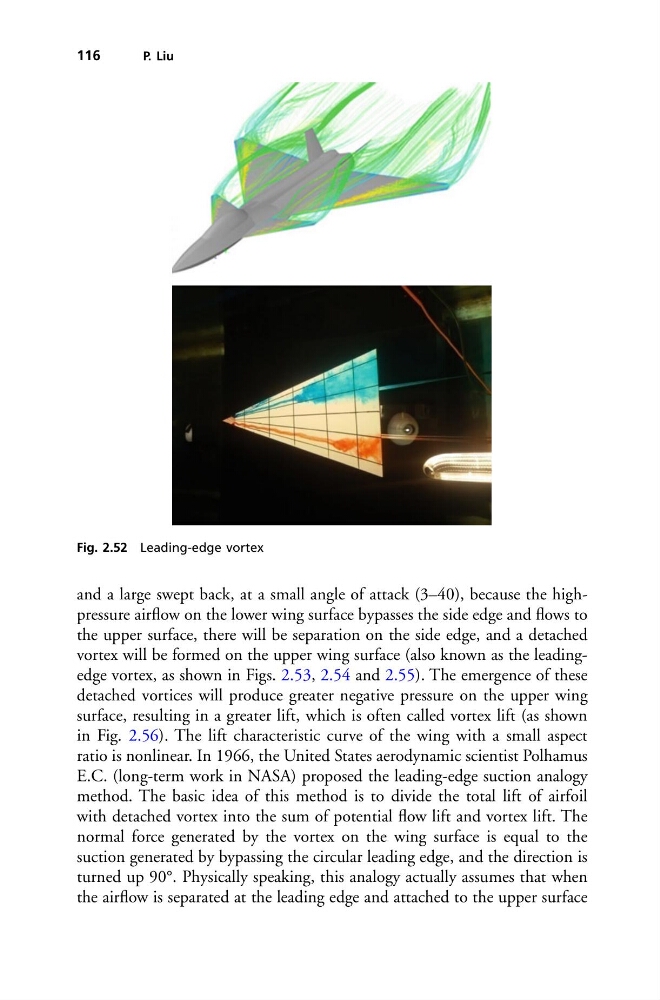
Fig. 2.52 Leading-edge vortex
and a large swept back, at a small angle of attack (3–40), because the highpressure airflow on the lower wing surface bypasses the side edge and flows to
the upper surface, there will be separation on the side edge, and a detached
vortex will be formed on the upper wing surface (also known as the leadingedge vortex, as shown in Figs. 2.53, 2.54 and 2.55). The emergence of these
detached vortices will produce greater negative pressure on the upper wing
surface, resulting in a greater lift, which is often called vortex lift (as shown
in Fig. 2.56). The lift characteristic curve of the wing with a small aspect
ratio is nonlinear. In 1966, the United States aerodynamic scientist Polhamus
E.C. (long-term work in NASA) proposed the leading-edge suction analogy
method. The basic idea of this method is to divide the total lift of airfoil
with detached vortex into the sum of potential flow lift and vortex lift. The
normal force generated by the vortex on the wing surface is equal to the
suction generated by bypassing the circular leading edge, and the direction is
turned up 90°. Physically speaking, this analogy actually assumes that when
the airflow is separated at the leading edge and attached to the upper surface
P. Liu
Fig. 2.52 Leading-edge vortex
and a large swept back, at a small angle of attack (3–40), because the highpressure airflow on the lower wing surface bypasses the side edge and flows to
the upper surface, there will be separation on the side edge, and a detached
vortex will be formed on the upper wing surface (also known as the leadingedge vortex, as shown in Figs. 2.53, 2.54 and 2.55). The emergence of these
detached vortices will produce greater negative pressure on the upper wing
surface, resulting in a greater lift, which is often called vortex lift (as shown
in Fig. 2.56). The lift characteristic curve of the wing with a small aspect
ratio is nonlinear. In 1966, the United States aerodynamic scientist Polhamus
E.C. (long-term work in NASA) proposed the leading-edge suction analogy
method. The basic idea of this method is to divide the total lift of airfoil
with detached vortex into the sum of potential flow lift and vortex lift. The
normal force generated by the vortex on the wing surface is equal to the
suction generated by bypassing the circular leading edge, and the direction is
turned up 90°. Physically speaking, this analogy actually assumes that when
the airflow is separated at the leading edge and attached to the upper surface