

2 Aerodynamics
103
incompressible viscous flow around airfoil, the diffusion equation of the
vorticity is
∂∂
∂t
+ u
∂∂
∂ x
+ v
∂∂
∂ y
= ν
∂ 2
∂ x 2 +
∂ 2
∂ y 2
In the steady boundary layer flow, the above equation can be simplified
as
u
∂∂
∂ x
+ v
∂∂
∂ y
= ν
∂ 2
∂ y 2
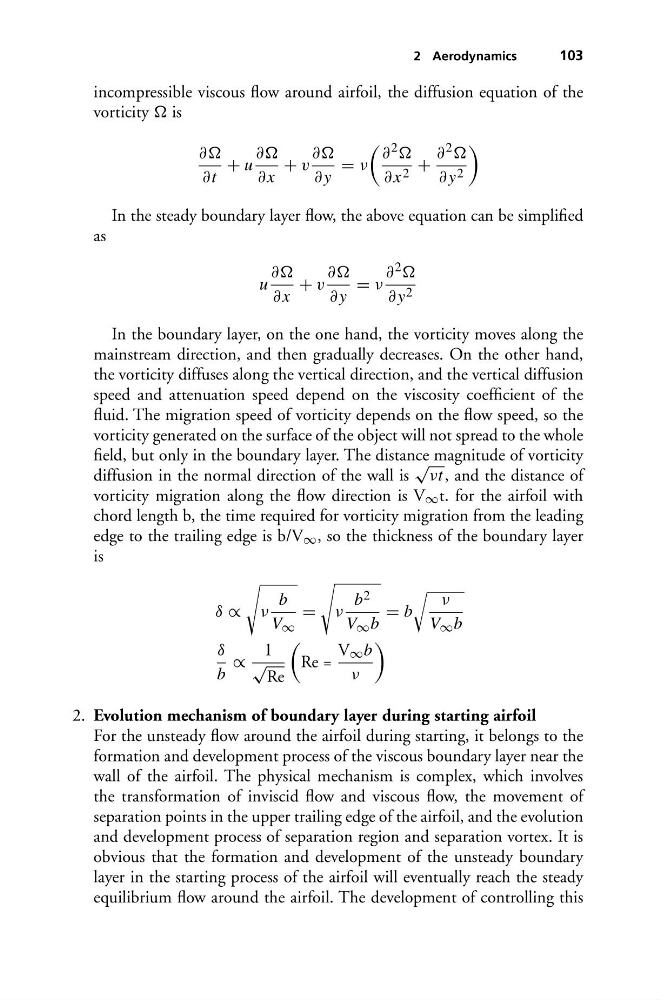
In the boundary layer, on the one hand, the vorticity moves along the
mainstream direction, and then gradually decreases. On the other hand,
the vorticity diffuses along the vertical direction, and the vertical diffusion
speed and attenuation speed depend on the viscosity coefficient of the
fluid. The migration speed of vorticity depends on the flow speed, so the
vorticity generated on the surface of the object will not spread to the whole
field, but only in the boundary layer. The distance magnitude of vorticity
diffusion in the normal direction of the wall is
√ νt, and the distance of
vorticity migration along the flow direction is V ∞ t. for the airfoil with
chord length b, the time required for vorticity migration from the leading
edge to the trailing edge is b/V ∞ , so the thickness of the boundary layer
is
δ ∝
ν
b
V ∞
=
ν
b 2
V ∞ b
= b
ν
V ∞ b
δ
b
∝
1
√
Re
Re =
V ∞ b
ν
2. Evolution mechanism of boundary layer during starting airfoil
For the unsteady flow around the airfoil during starting, it belongs to the
formation and development process of the viscous boundary layer near the
wall of the airfoil. The physical mechanism is complex, which involves
the transformation of inviscid flow and viscous flow, the movement of
separation points in the upper trailing edge of the airfoil, and the evolution
and development process of separation region and separation vortex. It is
obvious that the formation and development of the unsteady boundary
layer in the starting process of the airfoil will eventually reach the steady
equilibrium flow around the airfoil. The development of controlling this
103
incompressible viscous flow around airfoil, the diffusion equation of the
vorticity is
∂∂
∂t
+ u
∂∂
∂ x
+ v
∂∂
∂ y
= ν
∂ 2
∂ x 2 +
∂ 2
∂ y 2
In the steady boundary layer flow, the above equation can be simplified
as
u
∂∂
∂ x
+ v
∂∂
∂ y
= ν
∂ 2
∂ y 2
In the boundary layer, on the one hand, the vorticity moves along the
mainstream direction, and then gradually decreases. On the other hand,
the vorticity diffuses along the vertical direction, and the vertical diffusion
speed and attenuation speed depend on the viscosity coefficient of the
fluid. The migration speed of vorticity depends on the flow speed, so the
vorticity generated on the surface of the object will not spread to the whole
field, but only in the boundary layer. The distance magnitude of vorticity
diffusion in the normal direction of the wall is
√ νt, and the distance of
vorticity migration along the flow direction is V ∞ t. for the airfoil with
chord length b, the time required for vorticity migration from the leading
edge to the trailing edge is b/V ∞ , so the thickness of the boundary layer
is
δ ∝
ν
b
V ∞
=
ν
b 2
V ∞ b
= b
ν
V ∞ b
δ
b
∝
1
√
Re
Re =
V ∞ b
ν
2. Evolution mechanism of boundary layer during starting airfoil
For the unsteady flow around the airfoil during starting, it belongs to the
formation and development process of the viscous boundary layer near the
wall of the airfoil. The physical mechanism is complex, which involves
the transformation of inviscid flow and viscous flow, the movement of
separation points in the upper trailing edge of the airfoil, and the evolution
and development process of separation region and separation vortex. It is
obvious that the formation and development of the unsteady boundary
layer in the starting process of the airfoil will eventually reach the steady
equilibrium flow around the airfoil. The development of controlling this