

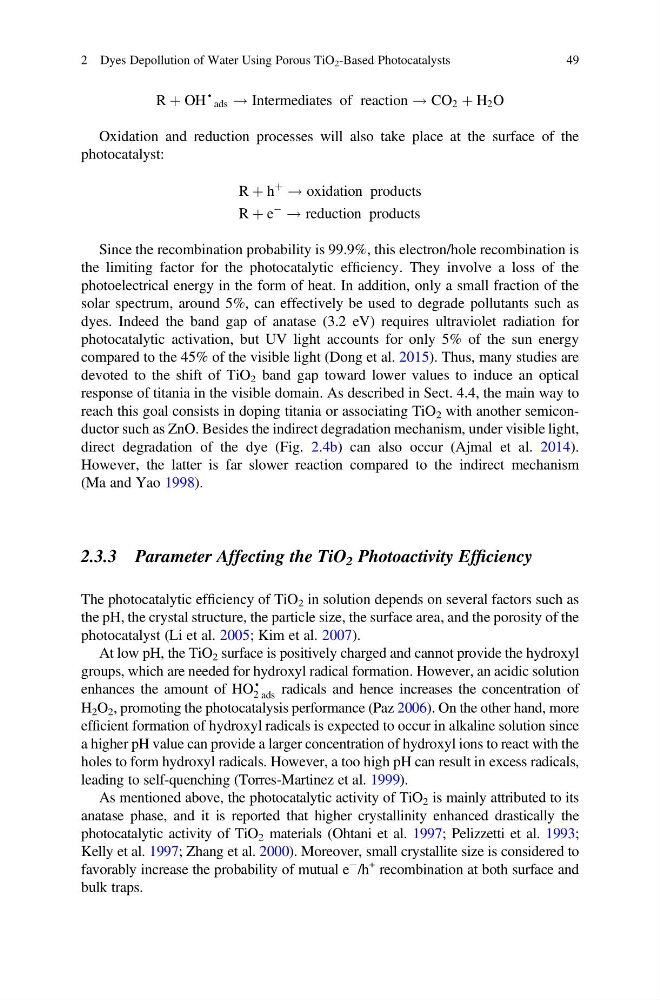
R þ OH
•
ads ! Intermediates of reaction ! CO 2 þ H 2 O
Oxidation and reduction processes will also take place at the surface of the
photocatalyst:
R þ h
þ
! oxidation products
R þ e
À
! reduction products
Since the recombination probability is 99.9%, this electron/hole recombination is
the limiting factor for the photocatalytic efficiency. They involve a loss of the
photoelectrical energy in the form of heat. In addition, only a small fraction of the
solar spectrum, around 5%, can effectively be used to degrade pollutants such as
dyes. Indeed the band gap of anatase (3.2 eV) requires ultraviolet radiation for
photocatalytic activation, but UV light accounts for only 5% of the sun energy
compared to the 45% of the visible light (Dong et al. 2015). Thus, many studies are
devoted to the shift of TiO 2 band gap toward lower values to induce an optical
response of titania in the visible domain. As described in Sect. 4.4, the main way to
reach this goal consists in doping titania or associating TiO 2 with another semiconductor such as ZnO. Besides the indirect degradation mechanism, under visible light,
direct degradation of the dye (Fig. 2.4b) can also occur (Ajmal et al. 2014).
However, the latter is far slower reaction compared to the indirect mechanism
(Ma and Yao 1998).
2.3.3 Parameter Affecting the TiO 2 Photoactivity Efficiency
The photocatalytic efficiency of TiO 2 in solution depends on several factors such as
the pH, the crystal structure, the particle size, the surface area, and the porosity of the
photocatalyst (Li et al. 2005; Kim et al. 2007).
At low pH, the TiO 2 surface is positively charged and cannot provide the hydroxyl
groups, which are needed for hydroxyl radical formation. However, an acidic solution
enhances the amount of HO
•
2 ads radicals and hence increases the concentration of
H 2 O 2 , promoting the photocatalysis performance (Paz 2006). On the other hand, more
efficient formation of hydroxyl radicals is expected to occur in alkaline solution since
a higher pH value can provide a larger concentration of hydroxyl ions to react with the
holes to form hydroxyl radicals. However, a too high pH can result in excess radicals,
leading to self-quenching (Torres-Martinez et al. 1999).
As mentioned above, the photocatalytic activity of TiO 2 is mainly attributed to its
anatase phase, and it is reported that higher crystallinity enhanced drastically the
photocatalytic activity of TiO 2 materials (Ohtani et al. 1997; Pelizzetti et al. 1993;
Kelly et al. 1997; Zhang et al. 2000). Moreover, small crystallite size is considered to
favorably increase the probability of mutual e
À /h
+ recombination at both surface and
bulk traps.
2 Dyes Depollution of Water Using Porous TiO 2 -Based Photocatalysts
49
•
ads ! Intermediates of reaction ! CO 2 þ H 2 O
Oxidation and reduction processes will also take place at the surface of the
photocatalyst:
R þ h
þ
! oxidation products
R þ e
À
! reduction products
Since the recombination probability is 99.9%, this electron/hole recombination is
the limiting factor for the photocatalytic efficiency. They involve a loss of the
photoelectrical energy in the form of heat. In addition, only a small fraction of the
solar spectrum, around 5%, can effectively be used to degrade pollutants such as
dyes. Indeed the band gap of anatase (3.2 eV) requires ultraviolet radiation for
photocatalytic activation, but UV light accounts for only 5% of the sun energy
compared to the 45% of the visible light (Dong et al. 2015). Thus, many studies are
devoted to the shift of TiO 2 band gap toward lower values to induce an optical
response of titania in the visible domain. As described in Sect. 4.4, the main way to
reach this goal consists in doping titania or associating TiO 2 with another semiconductor such as ZnO. Besides the indirect degradation mechanism, under visible light,
direct degradation of the dye (Fig. 2.4b) can also occur (Ajmal et al. 2014).
However, the latter is far slower reaction compared to the indirect mechanism
(Ma and Yao 1998).
2.3.3 Parameter Affecting the TiO 2 Photoactivity Efficiency
The photocatalytic efficiency of TiO 2 in solution depends on several factors such as
the pH, the crystal structure, the particle size, the surface area, and the porosity of the
photocatalyst (Li et al. 2005; Kim et al. 2007).
At low pH, the TiO 2 surface is positively charged and cannot provide the hydroxyl
groups, which are needed for hydroxyl radical formation. However, an acidic solution
enhances the amount of HO
•
2 ads radicals and hence increases the concentration of
H 2 O 2 , promoting the photocatalysis performance (Paz 2006). On the other hand, more
efficient formation of hydroxyl radicals is expected to occur in alkaline solution since
a higher pH value can provide a larger concentration of hydroxyl ions to react with the
holes to form hydroxyl radicals. However, a too high pH can result in excess radicals,
leading to self-quenching (Torres-Martinez et al. 1999).
As mentioned above, the photocatalytic activity of TiO 2 is mainly attributed to its
anatase phase, and it is reported that higher crystallinity enhanced drastically the
photocatalytic activity of TiO 2 materials (Ohtani et al. 1997; Pelizzetti et al. 1993;
Kelly et al. 1997; Zhang et al. 2000). Moreover, small crystallite size is considered to
favorably increase the probability of mutual e
À /h
+ recombination at both surface and
bulk traps.
2 Dyes Depollution of Water Using Porous TiO 2 -Based Photocatalysts
49