

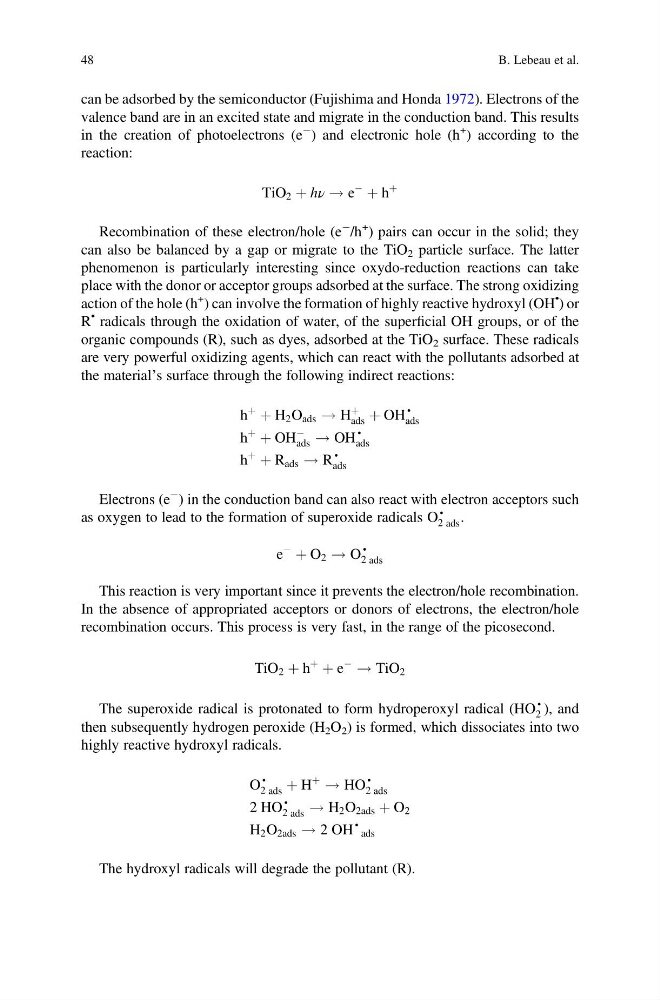
can be adsorbed by the semiconductor (Fujishima and Honda 1972). Electrons of the
valence band are in an excited state and migrate in the conduction band. This results
in the creation of photoelectrons (e
À ) and electronic hole (h
+
) according to the
reaction:
TiO 2 þ hν ! e
À
þ h
þ
Recombination of these electron/hole (e
À /h
+
) pairs can occur in the solid; they
can also be balanced by a gap or migrate to the TiO 2 particle surface. The latter
phenomenon is particularly interesting since oxydo-reduction reactions can take
place with the donor or acceptor groups adsorbed at the surface. The strong oxidizing
action of the hole (h
+
) can involve the formation of highly reactive hydroxyl (OH
•
) or
R
• radicals through the oxidation of water, of the superficial OH groups, or of the
organic compounds (R), such as dyes, adsorbed at the TiO 2 surface. These radicals
are very powerful oxidizing agents, which can react with the pollutants adsorbed at
the material’s surface through the following indirect reactions:
h
þ
þ H 2 O ads ! H
þ
ads þ OH
•
ads
h
þ
þ OH
À
ads ! OH
•
ads
h
þ
þ R ads ! R
•
ads
Electrons (e
À ) in the conduction band can also react with electron acceptors such
as oxygen to lead to the formation of superoxide radicals O
•
2 ads .
e
À
þ O 2 ! O
•
2 ads
This reaction is very important since it prevents the electron/hole recombination.
In the absence of appropriated acceptors or donors of electrons, the electron/hole
recombination occurs. This process is very fast, in the range of the picosecond.
TiO 2 þ h
þ
þ e
À
! TiO 2
The superoxide radical is protonated to form hydroperoxyl radical (HO
•
2 ), and
then subsequently hydrogen peroxide (H 2 O 2 ) is formed, which dissociates into two
highly reactive hydroxyl radicals.
O
•
2 ads þ H
þ
! HO
•
2 ads
2 HO
•
2 ads ! H 2 O 2ads þ O 2
H 2 O 2ads ! 2 OH
•
ads
The hydroxyl radicals will degrade the pollutant (R).
48
B. Lebeau et al.
valence band are in an excited state and migrate in the conduction band. This results
in the creation of photoelectrons (e
À ) and electronic hole (h
+
) according to the
reaction:
TiO 2 þ hν ! e
À
þ h
þ
Recombination of these electron/hole (e
À /h
+
) pairs can occur in the solid; they
can also be balanced by a gap or migrate to the TiO 2 particle surface. The latter
phenomenon is particularly interesting since oxydo-reduction reactions can take
place with the donor or acceptor groups adsorbed at the surface. The strong oxidizing
action of the hole (h
+
) can involve the formation of highly reactive hydroxyl (OH
•
) or
R
• radicals through the oxidation of water, of the superficial OH groups, or of the
organic compounds (R), such as dyes, adsorbed at the TiO 2 surface. These radicals
are very powerful oxidizing agents, which can react with the pollutants adsorbed at
the material’s surface through the following indirect reactions:
h
þ
þ H 2 O ads ! H
þ
ads þ OH
•
ads
h
þ
þ OH
À
ads ! OH
•
ads
h
þ
þ R ads ! R
•
ads
Electrons (e
À ) in the conduction band can also react with electron acceptors such
as oxygen to lead to the formation of superoxide radicals O
•
2 ads .
e
À
þ O 2 ! O
•
2 ads
This reaction is very important since it prevents the electron/hole recombination.
In the absence of appropriated acceptors or donors of electrons, the electron/hole
recombination occurs. This process is very fast, in the range of the picosecond.
TiO 2 þ h
þ
þ e
À
! TiO 2
The superoxide radical is protonated to form hydroperoxyl radical (HO
•
2 ), and
then subsequently hydrogen peroxide (H 2 O 2 ) is formed, which dissociates into two
highly reactive hydroxyl radicals.
O
•
2 ads þ H
þ
! HO
•
2 ads
2 HO
•
2 ads ! H 2 O 2ads þ O 2
H 2 O 2ads ! 2 OH
•
ads
The hydroxyl radicals will degrade the pollutant (R).
48
B. Lebeau et al.