

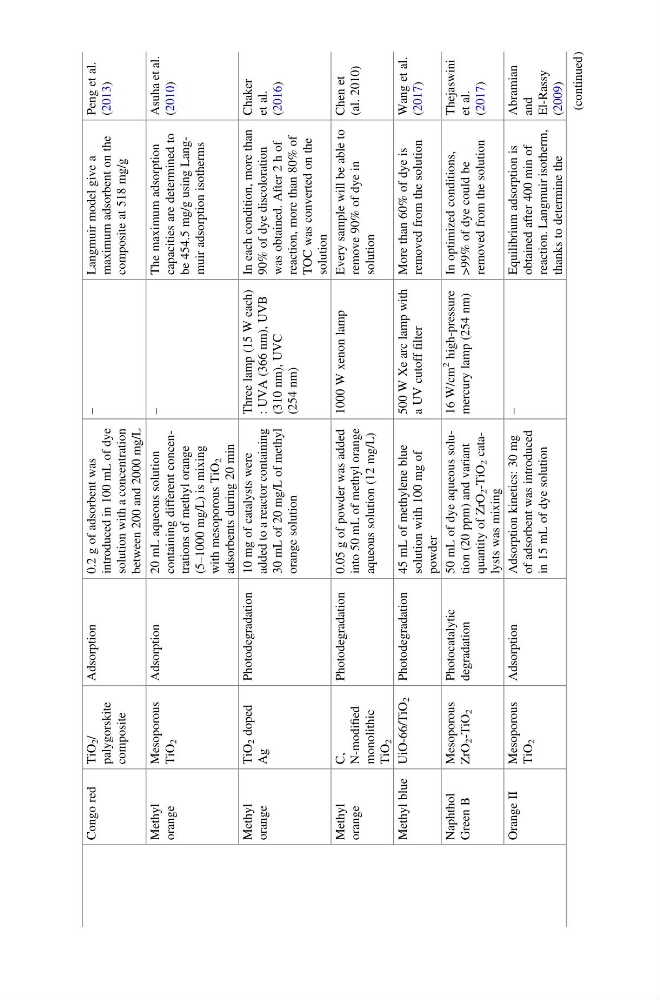
Congo red
TiO
2 /
palygorskite
composite
Adsorption
0.2 g of adsorbent was
introduced in 100 mL of dye
solution with a concentration
between 200 and 2000 mg/L
–
Langmuir model give a
maximum adsorbent on the
composite at 518 mg/g
Peng et al.
(2013)
Methyl
orange
Mesoporous
TiO
2
Adsorption
20 mL aqueous solution
containing different concentrations of methyl orange
(5–1000 mg/L) is mixing
with mesoporous TiO
2
adsorbents during 20 min
–
The maximum adsorption
capacities are determined to
be 454.5 mg/g using Langmuir adsorption isotherms
Asuha et al.
(2010)
Methyl
orange
TiO
2 doped
Ag
Photodegradation 10 mg of catalysts were
added to a reactor containing
30 mL of 20 mg/L of methyl
orange solution
Three lamp (15 W each)
: UVA (366 nm), UVB
(310 nm), UVC
(254 nm)
In each condition, more than
90% of dye discoloration
was obtained. After 2 h of
reaction, more than 80% of
TOC was converted on the
solution
Chaker
et al.
(2016)
Methyl
orange
C,
N-modified
monolithic
TiO
2
Photodegradation 0.05 g of powder was added
into 50 mL of methyl orange
aqueous solution (12 mg/L)
1000 W xenon lamp
Every sample will be able to
remove 90% of dye in
solution
Chen et
(al. 2010)
Methyl blue UiO-66/TiO
2
Photodegradation 45 mL of methylene blue
solution with 100 mg of
powder
500 W Xe arc lamp with
a UV cutoff
filter
More than 60% of dye is
removed from the solution
Wang et al.
(2017)
Naphthol
Green B
Mesoporous
ZrO
2 -TiO
2
Photocatalytic
degradation
50 mL of dye aqueous solution (20 ppm) and variant
quantity of ZrO
2 -TiO
2 catalysts was mixing
16 W/cm
2
high-pressure
mercury lamp (254 nm)
In optimized conditions,
>99% of dye could be
removed from the solution
Thejaswini
et al.
(2017)
Orange II
Mesoporous
TiO
2
Adsorption
Adsorption kinetics: 30 mg
of adsorbent was introduced
in 15 mL of dye solution
–
Equilibrium adsorption is
obtained after 400 min of
reaction. Langmuir isotherm,
thanks to determine the
Abramian
and
El-Rassy
(2009)
(continued)
TiO
2 /
palygorskite
composite
Adsorption
0.2 g of adsorbent was
introduced in 100 mL of dye
solution with a concentration
between 200 and 2000 mg/L
–
Langmuir model give a
maximum adsorbent on the
composite at 518 mg/g
Peng et al.
(2013)
Methyl
orange
Mesoporous
TiO
2
Adsorption
20 mL aqueous solution
containing different concentrations of methyl orange
(5–1000 mg/L) is mixing
with mesoporous TiO
2
adsorbents during 20 min
–
The maximum adsorption
capacities are determined to
be 454.5 mg/g using Langmuir adsorption isotherms
Asuha et al.
(2010)
Methyl
orange
TiO
2 doped
Ag
Photodegradation 10 mg of catalysts were
added to a reactor containing
30 mL of 20 mg/L of methyl
orange solution
Three lamp (15 W each)
: UVA (366 nm), UVB
(310 nm), UVC
(254 nm)
In each condition, more than
90% of dye discoloration
was obtained. After 2 h of
reaction, more than 80% of
TOC was converted on the
solution
Chaker
et al.
(2016)
Methyl
orange
C,
N-modified
monolithic
TiO
2
Photodegradation 0.05 g of powder was added
into 50 mL of methyl orange
aqueous solution (12 mg/L)
1000 W xenon lamp
Every sample will be able to
remove 90% of dye in
solution
Chen et
(al. 2010)
Methyl blue UiO-66/TiO
2
Photodegradation 45 mL of methylene blue
solution with 100 mg of
powder
500 W Xe arc lamp with
a UV cutoff
filter
More than 60% of dye is
removed from the solution
Wang et al.
(2017)
Naphthol
Green B
Mesoporous
ZrO
2 -TiO
2
Photocatalytic
degradation
50 mL of dye aqueous solution (20 ppm) and variant
quantity of ZrO
2 -TiO
2 catalysts was mixing
16 W/cm
2
high-pressure
mercury lamp (254 nm)
In optimized conditions,
>99% of dye could be
removed from the solution
Thejaswini
et al.
(2017)
Orange II
Mesoporous
TiO
2
Adsorption
Adsorption kinetics: 30 mg
of adsorbent was introduced
in 15 mL of dye solution
–
Equilibrium adsorption is
obtained after 400 min of
reaction. Langmuir isotherm,
thanks to determine the
Abramian
and
El-Rassy
(2009)
(continued)