

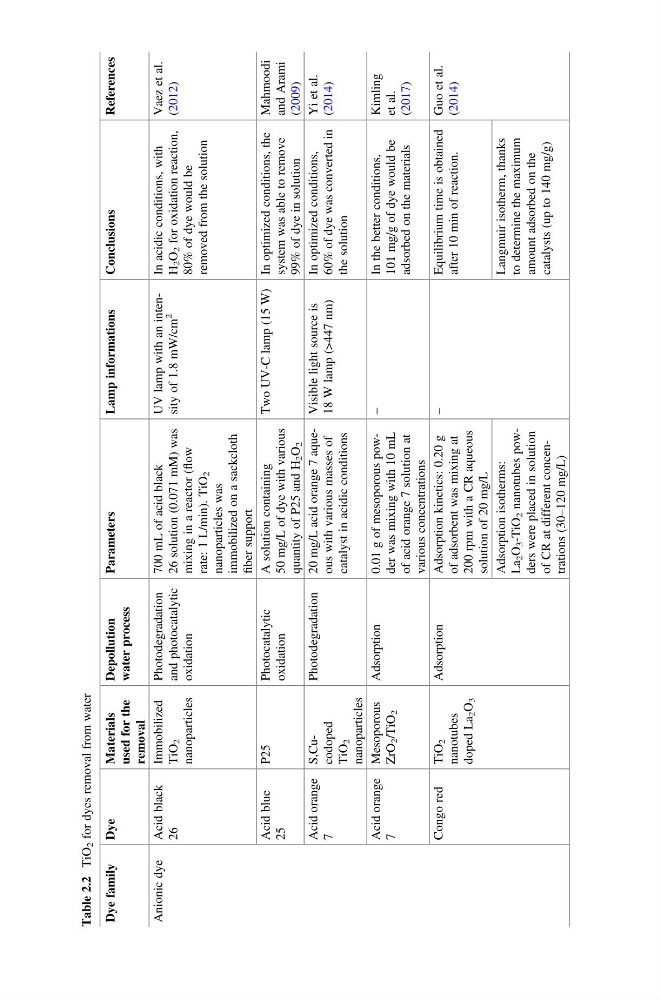
Table 2.2
TiO
2 for dyes removal from water
Dye family
Dye
Materials
used for the
removal
Depollution
water process
Parameters
Lamp informations
Conclusions
References
Anionic dye
Acid black
26
Immobilized
TiO
2
nanoparticles
Photodegradation
and photocatalytic
oxidation
700 mL of acid black
26 solution (0.071 mM) was
mixing in a reactor (flow
rate: 1 L/min). TiO
2
nanoparticles was
immobilized on a sackcloth
fiber support
UV lamp with an intensity of 1.8 mW/cm
2
In acidic conditions, with
H
2 O
2 for oxidation reaction,
80% of dye would be
removed from the solution
Vaez et al.
(2012)
Acid blue
25
P25
Photocatalytic
oxidation
A solution containing
50 mg/L of dye with various
quantity of P25 and H
2 O
2
Two UV-C lamp (15 W) In optimized conditions, the
system was able to remove
99% of dye in solution
Mahmoodi
and Arami
(2009)
Acid orange
7
S,Cucodoped
TiO
2
nanoparticles
Photodegradation 20 mg/L acid orange 7 aqueous with various masses of
catalyst in acidic conditions
Visible light source is
18 W lamp (>447 nm)
In optimized conditions,
60% of dye was converted in
the solution
Yi et al.
(2014)
Acid orange
7
Mesoporous
ZrO
2 /TiO
2
Adsorption
0.01 g of mesoporous powder was mixing with 10 mL
of acid orange 7 solution at
various concentrations
–
In the better conditions,
101 mg/g of dye would be
adsorbed on the materials
Kimling
et al.
(2017)
Congo red
TiO
2
nanotubes
doped La
2 O
3
Adsorption
Adsorption kinetics: 0.20 g
of adsorbent was mixing at
200 rpm with a CR aqueous
solution of 20 mg/L
–
Equilibrium time is obtained
after 10 min of reaction.
Guo et al.
(2014)
Adsorption isotherms:
La
2 O
3 -TiO
2 nanotubes powders were placed in solution
of CR at different concentrations (30–120 mg/L)
Langmuir isotherm, thanks
to determine the maximum
amount adsorbed on the
catalysts (up to 140 mg/g)
TiO
2 for dyes removal from water
Dye family
Dye
Materials
used for the
removal
Depollution
water process
Parameters
Lamp informations
Conclusions
References
Anionic dye
Acid black
26
Immobilized
TiO
2
nanoparticles
Photodegradation
and photocatalytic
oxidation
700 mL of acid black
26 solution (0.071 mM) was
mixing in a reactor (flow
rate: 1 L/min). TiO
2
nanoparticles was
immobilized on a sackcloth
fiber support
UV lamp with an intensity of 1.8 mW/cm
2
In acidic conditions, with
H
2 O
2 for oxidation reaction,
80% of dye would be
removed from the solution
Vaez et al.
(2012)
Acid blue
25
P25
Photocatalytic
oxidation
A solution containing
50 mg/L of dye with various
quantity of P25 and H
2 O
2
Two UV-C lamp (15 W) In optimized conditions, the
system was able to remove
99% of dye in solution
Mahmoodi
and Arami
(2009)
Acid orange
7
S,Cucodoped
TiO
2
nanoparticles
Photodegradation 20 mg/L acid orange 7 aqueous with various masses of
catalyst in acidic conditions
Visible light source is
18 W lamp (>447 nm)
In optimized conditions,
60% of dye was converted in
the solution
Yi et al.
(2014)
Acid orange
7
Mesoporous
ZrO
2 /TiO
2
Adsorption
0.01 g of mesoporous powder was mixing with 10 mL
of acid orange 7 solution at
various concentrations
–
In the better conditions,
101 mg/g of dye would be
adsorbed on the materials
Kimling
et al.
(2017)
Congo red
TiO
2
nanotubes
doped La
2 O
3
Adsorption
Adsorption kinetics: 0.20 g
of adsorbent was mixing at
200 rpm with a CR aqueous
solution of 20 mg/L
–
Equilibrium time is obtained
after 10 min of reaction.
Guo et al.
(2014)
Adsorption isotherms:
La
2 O
3 -TiO
2 nanotubes powders were placed in solution
of CR at different concentrations (30–120 mg/L)
Langmuir isotherm, thanks
to determine the maximum
amount adsorbed on the
catalysts (up to 140 mg/g)