

metal oxides such as tin dioxide, indium oxide, and tungsten trioxide have been
tested as ozone detectors for environmental with monitoring applications (Starke and
Coles 2002). Among the various zinc oxide nanomaterials, the single-crystal
nanorods showed better response for ozone sensing at room temperature in terms
of response and recovery time (Chien et al. 2010; Wu et al. 2008). The dependence
of ozone sensing performances for zinc oxide nanostructure samples on surface
morphology, substrate coverage, and average thickness under ultraviolet irradiation
at room temperature has been reported and optimized (Kenanakis et al. 2007). An
optical ozone sensor was reported based on the ultrathin layers of indium oxide
nanoparticles and an indium gallium nitride–gallium nitride blue light-emitting
diode on a single sensor chip for concentrations as low as $40 ppb (Wang et al.
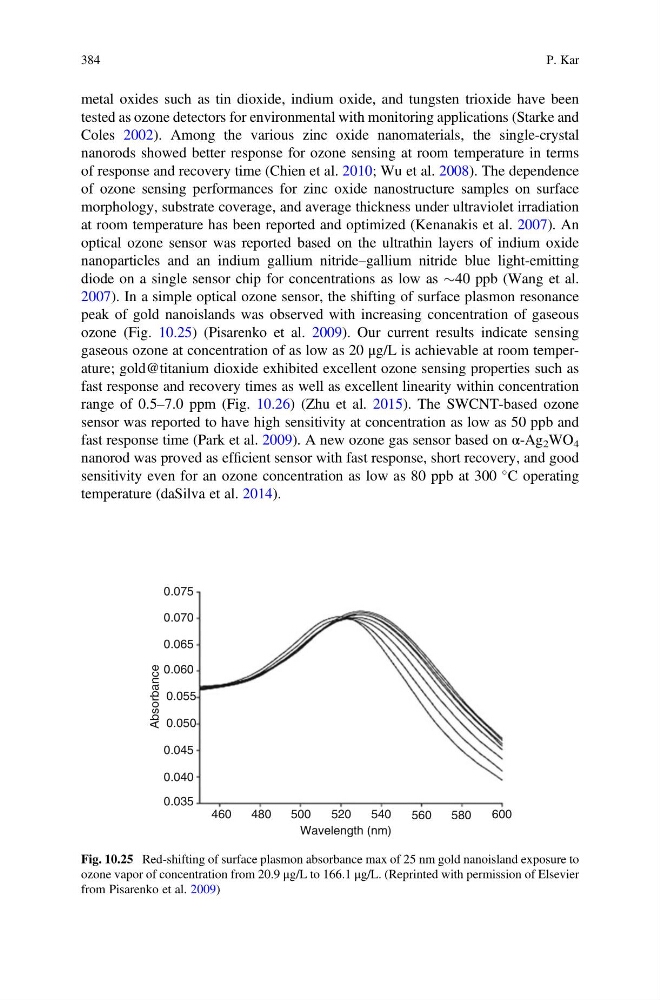
2007). In a simple optical ozone sensor, the shifting of surface plasmon resonance
peak of gold nanoislands was observed with increasing concentration of gaseous
ozone (Fig. 10.25) (Pisarenko et al. 2009). Our current results indicate sensing
gaseous ozone at concentration of as low as 20 μg/L is achievable at room temperature; gold@titanium dioxide exhibited excellent ozone sensing properties such as
fast response and recovery times as well as excellent linearity within concentration
range of 0.5–7.0 ppm (Fig. 10.26) (Zhu et al. 2015). The SWCNT-based ozone
sensor was reported to have high sensitivity at concentration as low as 50 ppb and
fast response time (Park et al. 2009). A new ozone gas sensor based on α-Ag 2 WO 4
nanorod was proved as efficient sensor with fast response, short recovery, and good
sensitivity even for an ozone concentration as low as 80 ppb at 300
C operating
temperature (daSilva et al. 2014).
0.075
0.070
0.065
0.060
0.055
0.050
0.045
0.040
0.035
460
480
500
520
540
560
580
600
Absorbance
Wavelength (nm)
Fig. 10.25 Red-shifting of surface plasmon absorbance max of 25 nm gold nanoisland exposure to
ozone vapor of concentration from 20.9 μg/L to 166.1 μg/L. (Reprinted with permission of Elsevier
from Pisarenko et al. 2009)
384
P. Kar
tested as ozone detectors for environmental with monitoring applications (Starke and
Coles 2002). Among the various zinc oxide nanomaterials, the single-crystal
nanorods showed better response for ozone sensing at room temperature in terms
of response and recovery time (Chien et al. 2010; Wu et al. 2008). The dependence
of ozone sensing performances for zinc oxide nanostructure samples on surface
morphology, substrate coverage, and average thickness under ultraviolet irradiation
at room temperature has been reported and optimized (Kenanakis et al. 2007). An
optical ozone sensor was reported based on the ultrathin layers of indium oxide
nanoparticles and an indium gallium nitride–gallium nitride blue light-emitting
diode on a single sensor chip for concentrations as low as $40 ppb (Wang et al.
2007). In a simple optical ozone sensor, the shifting of surface plasmon resonance
peak of gold nanoislands was observed with increasing concentration of gaseous
ozone (Fig. 10.25) (Pisarenko et al. 2009). Our current results indicate sensing
gaseous ozone at concentration of as low as 20 μg/L is achievable at room temperature; gold@titanium dioxide exhibited excellent ozone sensing properties such as
fast response and recovery times as well as excellent linearity within concentration
range of 0.5–7.0 ppm (Fig. 10.26) (Zhu et al. 2015). The SWCNT-based ozone
sensor was reported to have high sensitivity at concentration as low as 50 ppb and
fast response time (Park et al. 2009). A new ozone gas sensor based on α-Ag 2 WO 4
nanorod was proved as efficient sensor with fast response, short recovery, and good
sensitivity even for an ozone concentration as low as 80 ppb at 300
C operating
temperature (daSilva et al. 2014).
0.075
0.070
0.065
0.060
0.055
0.050
0.045
0.040
0.035
460
480
500
520
540
560
580
600
Absorbance
Wavelength (nm)
Fig. 10.25 Red-shifting of surface plasmon absorbance max of 25 nm gold nanoisland exposure to
ozone vapor of concentration from 20.9 μg/L to 166.1 μg/L. (Reprinted with permission of Elsevier
from Pisarenko et al. 2009)
384
P. Kar