

10.5.3 Oxides of Sulfur
Sulfur dioxide is the main type of oxides of sulfur, and it is further oxidized to sulfur
trioxide. Sulfur dioxide is originated from human activities like combustion of coal
or fuel and petroleum refining and is environmentally harmful as it can aid in the
formation of acid rain. The gaseous pollutant can induce respiratory problems in
humans above the threshold limit value of 2 ppm.
Semiconductor sensors based on vanadium pentoxide-doped tin dioxide
nanocomposite was used for the successful sensing of sulfur dioxide gas with
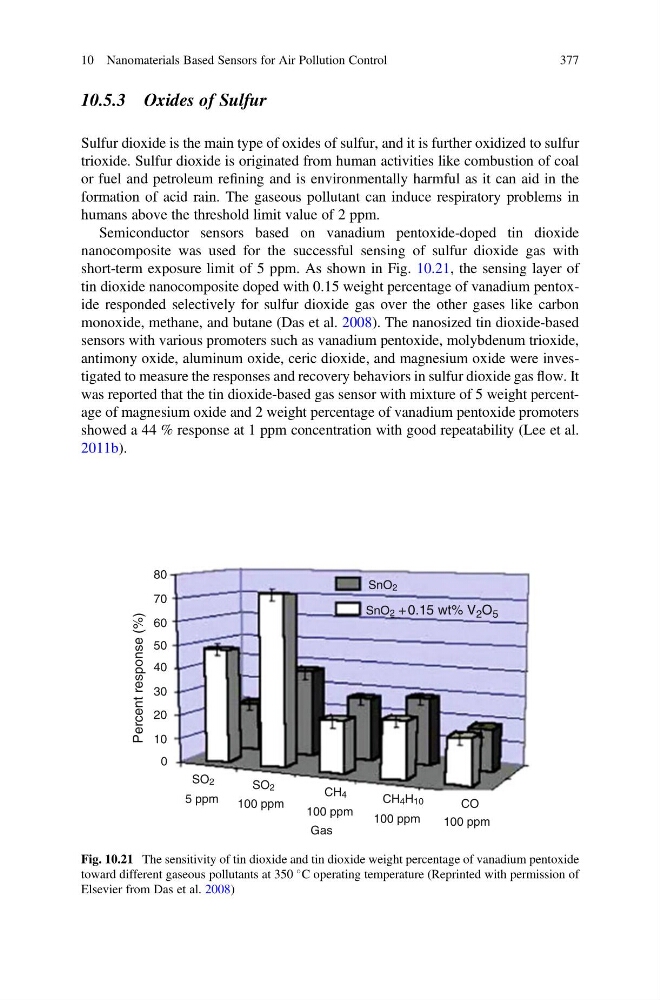
short-term exposure limit of 5 ppm. As shown in Fig. 10.21, the sensing layer of
tin dioxide nanocomposite doped with 0.15 weight percentage of vanadium pentoxide responded selectively for sulfur dioxide gas over the other gases like carbon
monoxide, methane, and butane (Das et al. 2008). The nanosized tin dioxide-based
sensors with various promoters such as vanadium pentoxide, molybdenum trioxide,
antimony oxide, aluminum oxide, ceric dioxide, and magnesium oxide were investigated to measure the responses and recovery behaviors in sulfur dioxide gas flow. It
was reported that the tin dioxide-based gas sensor with mixture of 5 weight percentage of magnesium oxide and 2 weight percentage of vanadium pentoxide promoters
showed a 44 % response at 1 ppm concentration with good repeatability (Lee et al.
2011b).
80
70
60
50
40
30
20
10
0
SO2
SnO2
SnO 2
SO2
CH4
CH4H10
CO
5 ppm
100 ppm
100 ppm
100 ppm
100 ppm
Gas
Percent response (%)
+ 0.15 wt% V 2 O 5
Fig. 10.21 The sensitivity of tin dioxide and tin dioxide weight percentage of vanadium pentoxide
toward different gaseous pollutants at 350
C operating temperature (Reprinted with permission of
Elsevier from Das et al. 2008)
10 Nanomaterials Based Sensors for Air Pollution Control
377
Sulfur dioxide is the main type of oxides of sulfur, and it is further oxidized to sulfur
trioxide. Sulfur dioxide is originated from human activities like combustion of coal
or fuel and petroleum refining and is environmentally harmful as it can aid in the
formation of acid rain. The gaseous pollutant can induce respiratory problems in
humans above the threshold limit value of 2 ppm.
Semiconductor sensors based on vanadium pentoxide-doped tin dioxide
nanocomposite was used for the successful sensing of sulfur dioxide gas with
short-term exposure limit of 5 ppm. As shown in Fig. 10.21, the sensing layer of
tin dioxide nanocomposite doped with 0.15 weight percentage of vanadium pentoxide responded selectively for sulfur dioxide gas over the other gases like carbon
monoxide, methane, and butane (Das et al. 2008). The nanosized tin dioxide-based
sensors with various promoters such as vanadium pentoxide, molybdenum trioxide,
antimony oxide, aluminum oxide, ceric dioxide, and magnesium oxide were investigated to measure the responses and recovery behaviors in sulfur dioxide gas flow. It
was reported that the tin dioxide-based gas sensor with mixture of 5 weight percentage of magnesium oxide and 2 weight percentage of vanadium pentoxide promoters
showed a 44 % response at 1 ppm concentration with good repeatability (Lee et al.
2011b).
80
70
60
50
40
30
20
10
0
SO2
SnO2
SnO 2
SO2
CH4
CH4H10
CO
5 ppm
100 ppm
100 ppm
100 ppm
100 ppm
Gas
Percent response (%)
+ 0.15 wt% V 2 O 5
Fig. 10.21 The sensitivity of tin dioxide and tin dioxide weight percentage of vanadium pentoxide
toward different gaseous pollutants at 350
C operating temperature (Reprinted with permission of
Elsevier from Das et al. 2008)
10 Nanomaterials Based Sensors for Air Pollution Control
377