

ratio as well as improved thermal stability were used as solid-state electrochemical sensor
for the high-temperature online detection of carbon monoxide (Wu et al. 2005). The gold
nanoparticles adsorbed zinc oxide nanowires hydride material was fabricated for 5, 20,
50 and 100 ppm carbon monoxide sensors at 350
C (Chang et al. 2008). A room
temperature sensing of carbon monoxide gas (1–5 ppm) by change in conductivity of
zinc–indium oxide nanowire hybrid was achieved selectively over nitric oxide and nitrous
oxide (Singh et al. 2010). The hybrid material of tin dioxide combined with 0.1 weight
percentage of MWNT having nearly two times higher specific surface area compared to
pure tin dioxide was fabricated by simple in situ method for better carbon monoxide gas
sensing at room temperature (Zhao et al. 2007). The low-temperature semiconductor
carbon monoxide gas sensor in nitrogen flow was constituted by vanadium–tin oxide
nanohybrid prepared by a coprecipitation method (Wang and Chen 2010). A novel
amperometric carbon monoxide sensor by cyclic voltammetry measurement was fabricated by MWNT-grafted polydiphenylamine hybrid material. The excellent linear concentration range between 10 and 200 ppm was reported under optimal conditions showing
a substantially low detection limit of 0.01 ppm (Santhosh et al. 2007). The carboxylic acid
group functionalized CNT composite with polyaniline matrix has shown good reversible
response to carbon monoxide at 100–500 ppm concentration range (Wanna et al. 2006).
The nanocomposite of CNT with platinum and rhodium metal (Star et al. 2006) or
tungsten trioxide (Bittencourt et al. 2006) was capable to detect low level of carbon
monoxide gas. Another study focused on the sensing of carbon monoxide gas by the
highly organized ultrathin polyaniline/metal oxide such as tin dioxide and/or titanium
dioxide nanocomposite films (Ram et al. 2005).
10.5.2 Oxides of Nitrogen
Oxides of nitrogen especially nitrogen dioxide are also a potentially toxic gas that
can lead to respiratory symptoms in humans and adversely influence plant growth
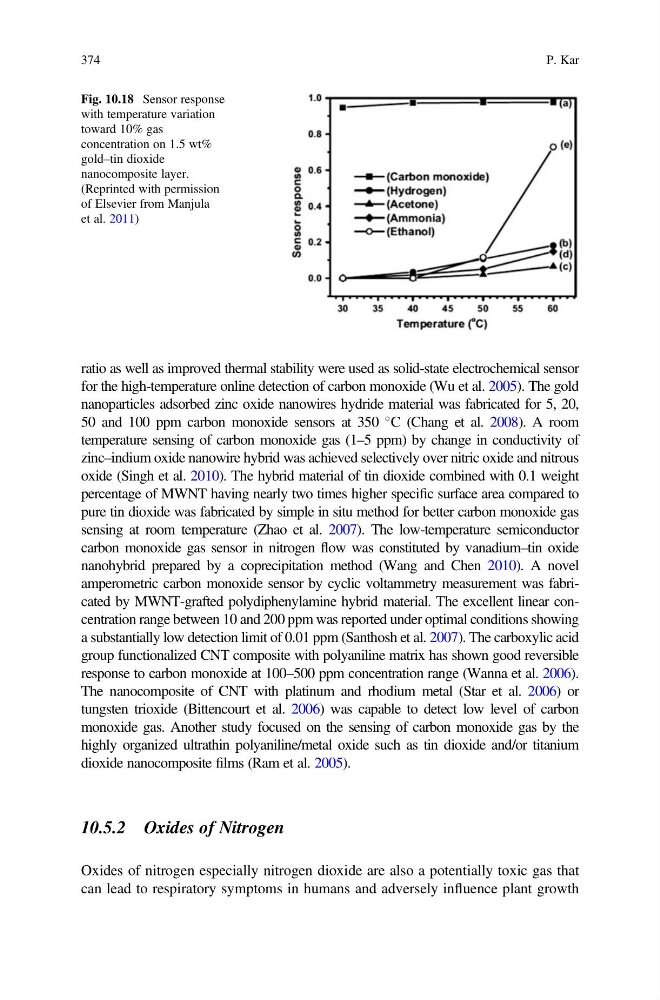
Fig. 10.18 Sensor response
with temperature variation
toward 10% gas
concentration on 1.5 wt%
gold–tin dioxide
nanocomposite layer.
(Reprinted with permission
of Elsevier from Manjula
et al. 2011)
374
P. Kar
for the high-temperature online detection of carbon monoxide (Wu et al. 2005). The gold
nanoparticles adsorbed zinc oxide nanowires hydride material was fabricated for 5, 20,
50 and 100 ppm carbon monoxide sensors at 350
C (Chang et al. 2008). A room
temperature sensing of carbon monoxide gas (1–5 ppm) by change in conductivity of
zinc–indium oxide nanowire hybrid was achieved selectively over nitric oxide and nitrous
oxide (Singh et al. 2010). The hybrid material of tin dioxide combined with 0.1 weight
percentage of MWNT having nearly two times higher specific surface area compared to
pure tin dioxide was fabricated by simple in situ method for better carbon monoxide gas
sensing at room temperature (Zhao et al. 2007). The low-temperature semiconductor
carbon monoxide gas sensor in nitrogen flow was constituted by vanadium–tin oxide
nanohybrid prepared by a coprecipitation method (Wang and Chen 2010). A novel
amperometric carbon monoxide sensor by cyclic voltammetry measurement was fabricated by MWNT-grafted polydiphenylamine hybrid material. The excellent linear concentration range between 10 and 200 ppm was reported under optimal conditions showing
a substantially low detection limit of 0.01 ppm (Santhosh et al. 2007). The carboxylic acid
group functionalized CNT composite with polyaniline matrix has shown good reversible
response to carbon monoxide at 100–500 ppm concentration range (Wanna et al. 2006).
The nanocomposite of CNT with platinum and rhodium metal (Star et al. 2006) or
tungsten trioxide (Bittencourt et al. 2006) was capable to detect low level of carbon
monoxide gas. Another study focused on the sensing of carbon monoxide gas by the
highly organized ultrathin polyaniline/metal oxide such as tin dioxide and/or titanium
dioxide nanocomposite films (Ram et al. 2005).
10.5.2 Oxides of Nitrogen
Oxides of nitrogen especially nitrogen dioxide are also a potentially toxic gas that
can lead to respiratory symptoms in humans and adversely influence plant growth
Fig. 10.18 Sensor response
with temperature variation
toward 10% gas
concentration on 1.5 wt%
gold–tin dioxide
nanocomposite layer.
(Reprinted with permission
of Elsevier from Manjula
et al. 2011)
374
P. Kar