

while the carbon monoxide is produced by incomplete burning, e.g., a major source
of those oxides is emission from vehicle exhaust. The exposure of carbon monoxide
in the air above threshold limit value of 25 ppm is especially dangerous as it becomes
explosive and deadly poisonous for animals. The carbon monoxide may also help to
form smog, a secondary pollutant. However, carbon dioxide, which causes global
warming by increasing greenhouse effect, is not such dangerous like carbon
monoxide.
In general, the sensing study of carbon monoxide has been attempted more than that of
carbon dioxide. The highly sensitive tin dioxide nanowire fabricated by self-organized
highly ordered porous alumina template was reported to sense the carbon monoxide and
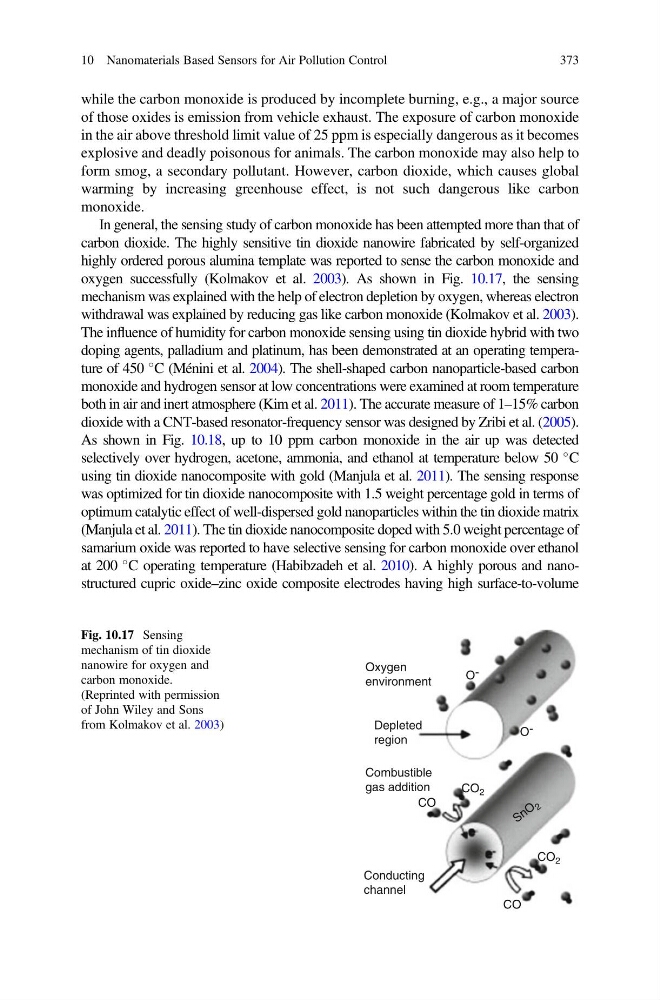
oxygen successfully (Kolmakov et al. 2003). As shown in Fig. 10.17, the sensing
mechanism was explained with the help of electron depletion by oxygen, whereas electron
withdrawal was explained by reducing gas like carbon monoxide (Kolmakov et al. 2003).
The influence of humidity for carbon monoxide sensing using tin dioxide hybrid with two
doping agents, palladium and platinum, has been demonstrated at an operating temperature of 450
C (Ménini et al. 2004). The shell-shaped carbon nanoparticle-based carbon
monoxide and hydrogen sensor at low concentrations were examined at room temperature
both in air and inert atmosphere (Kim et al. 2011). The accurate measure of 1–15% carbon
dioxide with a CNT-based resonator-frequency sensor was designed by Zribi et al. (2005).
As shown in Fig. 10.18, up to 10 ppm carbon monoxide in the air up was detected
selectively over hydrogen, acetone, ammonia, and ethanol at temperature below 50
C
using tin dioxide nanocomposite with gold (Manjula et al. 2011). The sensing response
was optimized for tin dioxide nanocomposite with 1.5 weight percentage gold in terms of
optimum catalytic effect of well-dispersed gold nanoparticles within the tin dioxide matrix
(Manjula et al. 2011). The tin dioxide nanocomposite doped with 5.0 weight percentage of
samarium oxide was reported to have selective sensing for carbon monoxide over ethanol
at 200
C operating temperature (Habibzadeh et al. 2010). A highly porous and nanostructured cupric oxide–zinc oxide composite electrodes having high surface-to-volume
Oxygen
environment
Depleted
region
Combustible
gas addition
Conducting
channel
CO
CO
CO 2
CO 2
S n O 2
O -
O -
Fig. 10.17 Sensing
mechanism of tin dioxide
nanowire for oxygen and
carbon monoxide.
(Reprinted with permission
of John Wiley and Sons
from Kolmakov et al. 2003)
10 Nanomaterials Based Sensors for Air Pollution Control
373
of those oxides is emission from vehicle exhaust. The exposure of carbon monoxide
in the air above threshold limit value of 25 ppm is especially dangerous as it becomes
explosive and deadly poisonous for animals. The carbon monoxide may also help to
form smog, a secondary pollutant. However, carbon dioxide, which causes global
warming by increasing greenhouse effect, is not such dangerous like carbon
monoxide.
In general, the sensing study of carbon monoxide has been attempted more than that of
carbon dioxide. The highly sensitive tin dioxide nanowire fabricated by self-organized
highly ordered porous alumina template was reported to sense the carbon monoxide and
oxygen successfully (Kolmakov et al. 2003). As shown in Fig. 10.17, the sensing
mechanism was explained with the help of electron depletion by oxygen, whereas electron
withdrawal was explained by reducing gas like carbon monoxide (Kolmakov et al. 2003).
The influence of humidity for carbon monoxide sensing using tin dioxide hybrid with two
doping agents, palladium and platinum, has been demonstrated at an operating temperature of 450
C (Ménini et al. 2004). The shell-shaped carbon nanoparticle-based carbon
monoxide and hydrogen sensor at low concentrations were examined at room temperature
both in air and inert atmosphere (Kim et al. 2011). The accurate measure of 1–15% carbon
dioxide with a CNT-based resonator-frequency sensor was designed by Zribi et al. (2005).
As shown in Fig. 10.18, up to 10 ppm carbon monoxide in the air up was detected
selectively over hydrogen, acetone, ammonia, and ethanol at temperature below 50
C
using tin dioxide nanocomposite with gold (Manjula et al. 2011). The sensing response
was optimized for tin dioxide nanocomposite with 1.5 weight percentage gold in terms of
optimum catalytic effect of well-dispersed gold nanoparticles within the tin dioxide matrix
(Manjula et al. 2011). The tin dioxide nanocomposite doped with 5.0 weight percentage of
samarium oxide was reported to have selective sensing for carbon monoxide over ethanol
at 200
C operating temperature (Habibzadeh et al. 2010). A highly porous and nanostructured cupric oxide–zinc oxide composite electrodes having high surface-to-volume
Oxygen
environment
Depleted
region
Combustible
gas addition
Conducting
channel
CO
CO
CO 2
CO 2
S n O 2
O -
O -
Fig. 10.17 Sensing
mechanism of tin dioxide
nanowire for oxygen and
carbon monoxide.
(Reprinted with permission
of John Wiley and Sons
from Kolmakov et al. 2003)
10 Nanomaterials Based Sensors for Air Pollution Control
373